Showing posts with label California Unearthed. Show all posts

Monday, November 16, 2026

Shasta County’s first sheriff suffered an interrupted story.

Shasta County’s first sheriff suffered an interrupted story


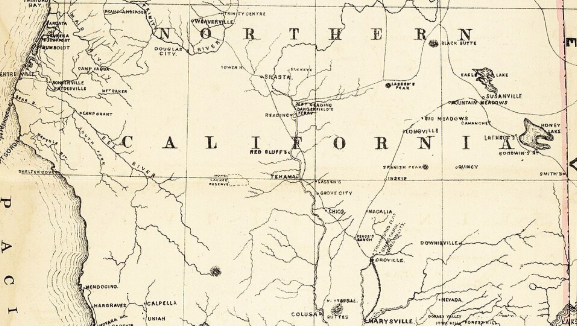
1866 Northern California map source: wikimedia.org.

When Shasta County was created on February 18, 1850, it entered a new and uncertain era. The Gold Rush had brought miners, merchants, traders, politicians, adventurers and drifters into the region, and mining camps were growing faster than a permanent government could keep pace.

Among the men who helped build that government was Michael Oppenheimer, a little-known pioneer whose brief career as sheriff has long been clouded by gaps and contradictions in the historical record. The Shasta County Sheriff’s Office today recognizes him as the county’s first elected sheriff, beginning September 7, 1850. Yet his name appears only briefly in many later accounts, leaving the impression that he simply disappeared from office.

The surviving evidence tells a different story. Oppenheimer was elected sheriff -- contemporary newspapers identified him as serving in the office -- and he won another election in 1851. His death in February 1852 created a vacancy that led to a special election that April. The mystery is not that Oppenheimer disappeared, but that his story was interrupted before much of his life could be preserved.

A New County and Its First Sheriff

Shasta County was one of California’s original 27 counties, created during the months surrounding the Gold Rush and statehood. California entered the Union in September 1850, as communities across the new state moved toward organized county government and elected offices. Before official law enforcement was firmly established, mining camps often relied on miners’ committees, citizens’ groups and other informal forms of justice. As the population grew, the need for a sheriff became harder to ignore.

Oppenheimer emerged during this period, as newcomers from Jackson, Michigan, were gaining political influence in the county. Among those who traveled west from Jackson were attorney Homer A. Curtiss, Reuel C. Baker and Oppenheimer, part of a larger wave of eastern migrants who became involved in the county’s new political and legal institutions. Curtiss became Shasta County’s first district attorney, while Oppenheimer became sheriff. They did not merely come west to mine gold. Some came to practice law, establish businesses and seek public office, helping create the institutions that would serve a rapidly growing population.

Oppenheimer in Office

For years, historians questioned whether Oppenheimer actually served as sheriff or was simply a name on an early election return. Contemporary newspapers help answer that question. An October 1850 report in the Daily Alta California identified him as sheriff and stated that he and the other county officers were performing their duties and maintaining good order.

A letter Curtiss wrote to the Jackson Citizen in Michigan on October 26, 1850, reporting the results of a Shasta County election, provides further evidence. He wrote: “M. Oppenheimer is elected Sheriff of this County for the next two years.”


Curtiss also reported his own election as district attorney. Together, these accounts establish Oppenheimer’s election and recognition as sheriff, evidence that later historical lists alone could not supply. Curtiss’s reference to a two-year term, however, raises a question because Oppenheimer appeared on the ballot again in 1851. Whether this discrepancy reflected changes in election arrangements or other circumstances has not yet been established, and the surviving evidence does not provide a definitive explanation.

Several additional details come from the Shasta County Sheriff’s Office historical presentation, available online in its document titled Michael Oppenheimer, rather than contemporary newspapers. According to the presentation, Oppenheimer’s September 1850 victory was challenged by another candidate who alleged voter fraud. A lawsuit followed, but both parties reportedly agreed to dismiss it in October, allowing Oppenheimer to continue as sheriff. Although the original court proceedings have not yet been examined, the account suggests that disputes over the office began almost as soon as county government was established.

The Election of 1851

The following year, Oppenheimer stood for election again, defeating William G. Ross, the regular Democratic candidate. Oppenheimer ran as an Independent Democrat with support from Whigs. Transcriptions of the election figures disagree on Ross’s total, but the result is not in question: Oppenheimer won.
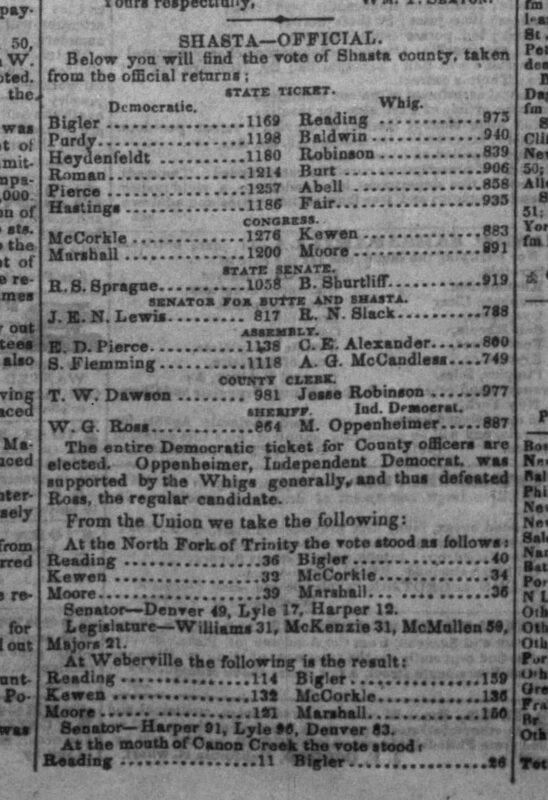


A September 1851 report in the Daily Alta California documented the Shasta County sheriff’s election involving Michael Oppenheimer and William G. Ross. Oppenheimer, running as an Independent Democrat with Whig support, defeated Ross, the regular Democratic candidate, securing another term as sheriff. Source: Daily Alta California, September 20, 1851.

His second election, however, reportedly produced another legal challenge. According to the Sheriff’s Office presentation, a fellow candidate filed a lawsuit following the September 1851 election. During the dispute, David Corsaut is believed to have served as acting sheriff, although the circumstances of his appointment and the length of his service remain uncertain. This may explain why some later histories associate Corsaut with the office before Oppenheimer’s death and illustrates the difficulty of establishing an uninterrupted chronology of the county’s earliest sheriffs.

Illness and Death

Sometime after the 1851 election, Oppenheimer became seriously ill while staying at the Shasta Hotel in the town of Shasta. Contemporary reporting described his condition as an “inflammation of the lungs,” a nineteenth-century description of a serious respiratory illness. He died in February 1852, bringing an unexpected end to his brief political career.

A contemporary newspaper report clarified what happened next:

“In consequence of the death of Mr. Oppenheimer, Sheriff elect of Shasta, a vacancy has been created in that office.”

That sentence is among the most important pieces of evidence in reconstructing his story. The newspaper described Oppenheimer as “Sheriff elect” and explicitly connected his death to the vacancy. Although that designation raises questions about the precise timing of his second term, it does not erase the earlier newspaper evidence identifying him as sheriff in 1850.

The same report named Isaac Roop, John Gillson and F. Bates as candidates for the vacant office. David Corsaut was announced as a candidate later. Roop was already a prominent pioneer and trader who would become an important figure in Nevada history, while Gillson and Bates were also involved in early Shasta County politics. Only months after Oppenheimer won another election, the county was preparing to choose his replacement.

The Legislature Steps In

The vacancy was not filled informally. The California Legislature authorized a special election. On March 8, 1852, the Sacramento Daily Union reported legislative activity concerning the matter, and on March 25 it reported that the House had passed the authorizing bill.

The county still needed a sheriff until voters could choose a successor. According to the Sheriff’s Office presentation, the Court of Sessions appointed James M. Coats to serve during March and April 1852. The original Court of Sessions proceedings have not yet been examined to confirm the date or circumstances of that appointment.

On April 13, the Sacramento Daily Union announced:

“A proclamation ordering the election of a sheriff for the County of Shasta, has been published. The election will take place on the 14th inst.”

The election was held on April 14, 1852, and Corsaut won by 130 votes. His tenure, however, would soon encounter difficulties involving the requirements of the office.
David Corsaut and the Conflicting Timeline

Later histories identify Corsaut as one of Shasta County’s earliest sheriffs and generally place him immediately after Oppenheimer. The Sheriff’s Office identifies him as the county’s second sheriff. Yet some lists assign Corsaut dates that appear to overlap with Oppenheimer’s service and election, creating a chronology that is difficult to reconcile with the contemporary newspapers.

The election evidence establishes that Corsaut won the April 1852 special election. His possible earlier service as acting sheriff during the 1851 dispute offers one explanation for the overlap, although the exact nature of that service has not been established.

The Sheriff’s Office presentation also reports that Corsaut was suspended in May 1852 because the required bonds had not been submitted. The Court of Sessions then appointed Coats again, on June 15, 1852, and Corsaut resumed the office in September after satisfying the bonding requirement. The available account does not clearly identify who carried out the sheriff’s duties between Corsaut’s suspension in May and Coats’s June appointment, leaving another question about the early succession of officers.

These developments help explain why Coats appears among the county’s earliest sheriffs despite Corsaut’s election victory. Rather than a straightforward succession of elected officials, the county experienced disputed elections, possible acting appointments, a vacancy and interruptions involving bonds. The Court of Sessions records remain important for verifying the appointments and clarifying the dates of service.

The 1977 Search

The confusion persisted long after the 19th century. In 1977, members of the Shasta County Historical Records Commission examined old county records and sheriff’s office materials in an effort to reconstruct the history of the county’s earliest sheriffs. The surviving records did not provide a simple timeline, and conflicting information about Oppenheimer and Corsaut left researchers uncertain whether Oppenheimer had actually taken office, how long he served and when Corsaut assumed the position. More than a century after his death, even the basic details of his service remained unclear.

The Mystery Is Smaller Now

The newspaper evidence does more than add dates to Oppenheimer’s biography. It changes the interpretation of his tenure. Earlier accounts could make it appear that he was elected and then vanished while another man took over. The contemporary record shows otherwise. Oppenheimer was recognized as sheriff in 1850, won another election in 1851, became ill and died in February 1852. His death created a vacancy that led to a special election, which Corsaut won by 130 votes.

There is still more to learn. Oppenheimer’s birth information remains difficult to establish, and his burial place has not been located. The circumstances of his illness and death deserve further study in contemporary newspapers and county records. The original 1851 election return should be consulted to resolve the conflicting vote totals, and the Court of Sessions records may help clarify the election disputes and the early succession of sheriffs.

But the central question has changed. The surviving evidence does not support the impression that Oppenheimer abandoned his office or disappeared from California. His career ended while Shasta County’s government and law enforcement institutions were still taking shape, and the confusion that followed arose from gaps and contradictions in the historical record.

Michael Oppenheimer did not disappear. He died at a moment when Shasta County was still learning how to govern itself, and his story was interrupted before much of his life could be preserved for future generations.


RESOURCES:

Sacramento Intelligence - The Daily Alta California newspaper of San Francisco, October 7, 1850

Shasta Official - The Daily Alta California newspaper of San Francisco, September 20, 1851

Sacramento Intelligence - The Daily Alta California newspaper of San Francisco, September 20, 1851 

From California written by Homer A. Curtiss - The Jackson Weekly Citizen newspaper of Jackson, Michigan, January 7, 1852

The Sacramento Daily Union newspaper of Sacramento, January 13, 1852

Correspondence of the Daily Union - The Sacramento Daily Union newspaper of Sacramento, January 29, 1852

The Sacramento Daily Union newspaper of Sacramento, March 1, 1852

The Sacramento Daily Union newspaper of Sacramento, March 8, 1852

From the Upper Sacramento - The Sacramento Daily Union newspaper of Sacramento, March 18, 1852

California Legislature - The Sacramento Daily Union newspaper of Sacramento, March 25, 1852

Shasta - The Sacramento Daily Union newspaper of Sacramento, April 13, 1852

From the Interior - The Sacramento Daily Union newspaper of Sacramento, April 21, 1852

The Case of the Missing Sheriff - The Record Searchlight newspaper of Redding, June 28, 1977

Errant found, but did he take job? - The Record Searchlight newspaper of Redding, July 12, 1977


Friday, October 9, 2026

Celebrating Redding’s 139th birthday, and Chauncey C. Bush Sr., ‘Father of Redding’

Celebrating Redding’s 139th birthday, and Chauncey C. Bush Sr., ‘Father of Redding’


Portrait of Judge Chauncey C. Bush Sr. (1831–1907), pioneer merchant, judge, banker, and civic leader whose career linked Gold Rush-era Shasta with railroad-era Redding. Courtesy of California State Archives.


When the California and Oregon Railroad bypassed the old mining town of Shasta, its merchants faced a hard choice: remain with the community where they had built their names or gamble on an uncertain settlement rising on the Sacramento River flats. Chauncey Carroll Bush Sr. chose the gamble. His decision alone did not make Redding, but few early residents touched so many of its foundations at once—commerce, government, freight, banking, fraternal life, and civic promotion. By the time he died in 1907, the title so often attached to his name, the “Father of Redding,” reflected a lifetime spent helping a new town take shape.

Redding was established on June 15, 1872, when the California and Oregon Railroad, a division of the Central Pacific, made it the temporary end of the line at Poverty Flat, a stretch of swampy, unfarmable ground that earlier settlers had largely passed over. A persistent local myth holds that the town was named for Major Pierson B. Reading, the pioneer who settled Shasta County in 1843 under a Mexican land grant. In fact, it was named for railroad agent Benjamin Bernard Redding of Sacramento. Residents used the spelling “Reading” in the major’s honor for years, until a Superior Court ruling in 1880 upheld the railroad’s spelling and settled the matter.

Bush Sr. was born in Pittsfield, Massachusetts, on July 31, 1831. After he lost his mother in infancy, his father moved the family west to Pittsfield in Pike County, Illinois. In 1850, at eighteen, Bush Sr. joined the westward rush to California, leaving Illinois in March and reaching Hangtown—now Placerville—on August 20. He mined first near Auburn, then reached Shasta County by early 1851 and took up a claim near French Gulch.

That claim was only the beginning. Bush Sr. packed supplies by mule through rugged country, worked as a store clerk, and eventually entered business for himself. By the 1860s, C. C. Bush and Company operated a substantial wholesale and retail store on Main Street in Shasta, carrying the provisions and goods a mining district required. Bush Sr. also represented insurance companies. In September 1860, he won election as justice of the peace in Shasta Township, beginning the judicial career that made “Judge” a permanent part of his public identity.

Bush Sr.’s politics changed with a turbulent era. He was active in the Douglas Democratic organization in 1860 and ran as a Union Democratic candidate for county judge the following year. He also served as vice president of Shasta County’s Soldiers’ Relief Society, which raised aid for Union servicemen. Later records place him in county judicial service through the 1860s and into 1872, after which he studied law and entered practice.

On June 27, 1865, he married Ida Matilda Schroeder, who had arrived in Shasta as a young teenager. Their first home stood on High Street, across from Shasta’s Union Church. The house had been built in 1854 by a carpenter named Barton. A newspaper account published after it was destroyed by fire in 1904 stated that Bush Sr. had purchased the property in 1855. Chauncey and Ida had seven children: Maria Merrick Bush; William Bush; Eda Ellen Bush; Chauncey Carroll Bush Jr.; George William Bush; Jennie Brown Bush; and Harry Edward Bush. Only four survived childhood.


Ida Matilda (Schroeder) Bush (1847–1925), a pioneer and the wife of Judge Chauncey Carroll Bush Sr. She shared in the civic and social life of early Shasta and Redding. Courtesy of California State Archives.


The railroad changed the direction of Bush Sr.’s life. When it chose lower ground along the Sacramento River rather than extending its line to Shasta, he tried to keep the route at the old county seat. When that effort failed, he recognized where the region’s future lay. He broke ground for a cellar on July 22, 1872—reported as the town’s first permanent improvement—and his family moved to the new settlement that summer. Lots went on sale two weeks later, on August 3; seventeen sold at an average of $108 each. By August 11, Bush Sr. had opened Redding’s first general mercantile store, even as he continued to operate his Shasta business.

The new town grew with startling speed. On September 1, 1872, the first passenger train arrived in Redding by way of Red Bluff, Cottonwood, and Anderson, drawing a large crowd to the depot. Among the passengers were Charles Litsch and Mary Jane Culverhouse, the only woman aboard. Barely three weeks later, on September 23, the U.S. Post Office Department appointed Bush Sr. Redding’s first postmaster. The post office operated from his residence at the corner of Sacramento and Market streets, on the ground later occupied by the Redding Hotel. By November 22, only three months after the first lots sold, seventy new houses had already been built.

Bush Sr. built more than a store. He partnered with George Merrick Hatch in a ranching venture near Wells Ferry and later joined Henry F. Johnson in a forwarding and commission firm at the railroad terminus. Their business handled freight between the rail line and the towns and mining districts farther north, placing them within the supply chain that served northern California and southern Oregon long before modern highways.

The young town was not gentle with its builders. A major fire in 1873 destroyed the C. C. Bush and Company store, leaving losses beyond the insurance carried. Bush Sr. rebuilt and continued. In 1879, he helped organize Redding’s first fire department, the Hook and Ladder Company, serving as its inaugural foreman. That same year, he helped organize Reading Lodge No. 254, Redding’s Masonic lodge, and became its first worshipful master. His influence extended into statewide Masonry as well; in 1883, he helped lay the cornerstone for the Garfield monument in Golden Gate Park. In Redding, the Bush name became attached to commercial property, including Bush Hall and the Bush Block, where tenants operated businesses serving the growing railroad town.

Redding was incorporated on September 5, 1887, with the official filing following on October 4. On October 10, Bush Sr. became the first president of Redding’s Board of Trustees—an office then equivalent to mayor—and served until Jerry Culverhouse succeeded him the following April. Bush Sr. was associated with the Bank of Shasta County from its early years and later served as its president and manager. He also supported moving the county seat from Shasta to Redding, a change completed on May 19, 1888, the same day Redding held its first court session.

The Bush household maintained a civic life of its own. Ida Bush and daughter Eda hosted Presbyterian gatherings and charitable events, and the family home became a familiar setting for meetings, music, and fundraising. That quieter work complemented Bush Sr.’s public and commercial achievements.

Bush Sr.’s commitment to promoting the community had begun much earlier. In 1888, he helped organize the Shasta County Board of Trade, chaired its founding meeting, and became its temporary president. The organization set out to publicize the county’s communities, resources, and opportunities to a wider audience. By the first years of the new century, Bush Sr. was still doing that work. As president of the Board of Trade in 1902, he corresponded with a prospective developer about a woolen mill. Later that year, he helped organize Redding’s reception for a touring group of San Francisco businessmen, chairing the meeting and delivering the public welcome. The effort was intended to promote the town and its prospects for investment.

His most visible late investment came in 1902, when Bush Sr. erected a brick building at 1449 Market Street beside the Bank of Shasta County to provide new post-office quarters for the federal government. Architect Matthew W. Herron designed the building, and Holt & Gregg Company of Anderson completed its brickwork. The post office opened there in 1904; the building later housed a cigar store and other businesses. Nearly a century after Bush Sr. built it, the Shasta Historical Society purchased the property in 1996, moved its archival collections there the following year, and formally opened its new home in 1998. It remains a direct, physical link between Bush Sr.’s investment in early Redding and the institution that preserves the county’s history today.

The following year, a notice signed by Bush Sr. called for bids to remodel the Bush Block on California Street. The proposed work included excavation, brickwork, carpentry, plastering, glazing, roofing, and painting—another practical sign that he was still reinvesting in Redding’s business center decades after arriving at Poverty Flat.


In 1903, C. C. Bush sought bids for extensive improvements to the Bush Block, a commercial property in the original town of Redding. From the Searchlight newspaper of Redding, March 8, 1903.

His later years did not remove him from public responsibility. In 1903, the Armory Hall Building Association named Bush Sr. secretary, with his son Chauncey Carroll Bush Jr. as treasurer and his son George as manager. In 1905, he served on several Shasta County grand-jury committees inspecting public buildings, records, finances, and roads. That June, he joined Judge Edward Sweeney and George O. Perry in representing the county at a San Francisco dinner honoring the National Irrigation Committee.

That same year, Chauncey and Ida celebrated their fortieth wedding anniversary during an Order of the Eastern Star observance. Beneath a large wedding bell, they renewed their vows before family and friends, with their son George—then a justice of the peace—performing the ceremony.

Bush Sr. attended the 1907 session of the Grand Lodge of Masons in San Francisco as grand Bible bearer, his final official duty. He died in Redding on December 21, 1907, at the age of seventy-six, and the Superior Court adjourned that morning in his honor. His influence remained visible in the institutions and properties he had helped build, and in the example he set. Judge Chauncey Carroll Bush Sr. was buried in the chapel at Evergreen Cemetery in Oakland, California, alongside members of his family.

Redding’s growth rested on the work of merchants, railroad laborers, farmers, families, civic officials, and countless others whose names history remembers less often. Calling Chauncey Carroll Bush Sr. the Father of Redding should not erase any of them. It recognizes his remarkable ability to adapt, rebuild, and keep investing in the community as Shasta County’s center of gravity shifted from the old mining town to the railroad city on the Sacramento River. More than a century after his death, his story remains one of the clearest bridges between those two worlds.


Judge Chauncey Carroll Bush Sr. (1831–1907) in later life. A pioneer merchant, banker, civic leader, and one of the principal builders of early Redding. Courtesy of California State Archives.


RESOURCES:


1850 U.S. Census

1860 U.S. Census

Great Register of Shasta County, 1866

1870 U.S. Census

New Town — The Shasta Courier newspaper of Shasta, June 15, 1872

Redding — The Shasta Courier newspaper of Shasta, August 3, 1872

First Train — The Shasta Courier newspaper of Shasta, September 7, 1872

Trip to Redding — The Shasta Courier newspaper of Shasta, September 28, 1872

1880 U.S. Census

History and Business Directory — Shasta County, by B. F. Frank and H. W. Chappell. Redding Independent Book and Job Printing House, Redding, California, 1881

Incorporation Prevails — The Republican Free Press newspaper of Redding, September 3, 1887

Supervisors Proceedings, May Term 1888 — The Shasta Courier newspaper of Shasta, May 19, 1888

Listing of Redding Mayors, 1887–2007

U.S., Appointments of U.S. Postmasters, 1832–1971, available on microfilm in the archives of the Shasta Historical Society

Outpost on Poverty Flats, by Charles J. Gleeson. Redding Printing Company, 1978

Redding the First Hundred Years, by Edward Petersen. North-Cal Printing & Litho., 1972

A History of Redding: The Early Years, 1872–1875, by Al M. Rocca. Renown Publishing, 2014

Association of Territorial Pioneers of California certificate presented to Chauncey Carroll Bush Sr., 1883

The Bank of Shasta County — The Free Press and Record Searchlight newspapers of Redding, 1880s–1903

Post Office to Have Handsome New Quarters Adjoining Bank of Shasta County — Weekly Searchlight newspaper of Redding, September 19, 1902

Notice to Contractors — The Searchlight newspaper of Redding, March 8, 1903

Dressed in a New Suit of Clothes — The Searchlight newspaper of Redding, March 18, 1903

Colonial Dames Exhibit Antiques — The Searchlight newspaper of Redding, February 24, 1903

Fire Wipes Out a Pioneer Home — The Searchlight newspaper of Redding, July 26, 1904

Redding Had a $75,000 Blaze — Record Searchlight newspaper of Redding, July 5, 1904

Will Meet with the Committee on Irrigation — Record Searchlight newspaper of Redding, June 9, 1905

The Bank of Shasta County, written by Mary Graham Bush, The Covered Wagon, Shasta Historical Society, 1973

Shasta Historical Society archival collections, Redding, California

Reading Lodge No. 254 and Western Star Lodge No. 2 historical records and portrait collections

Wednesday, September 23, 2026

Visiting the Grave of Governor Isaac N. Roop: A Shasta County Pioneer.


Filmed on location, September 4, 2026. 

In this historical travel segment, Jeremy M. Tuggle visits the graves of Governor Isaac N. Roop and his daughter, Susan Roop Arnold. Roop was a Shasta County pioneer who later founded Susanville and served as provisional governor during the movement to organize Nevada Territory. The video concludes with Susan, for whom both the town of Susanville and the Susan River were named.

Resources:

1850 U.S. Census

1852 California State Census

1860 U.S. Census

I.N. Roop - The Shasta Courier newspaper of Shasta, March 6, 1869

Death of a Pioneer - The Appeal-Democrat newspaper of Marysville, February 25, 1869

Death of a Pioneer - The San Francisco Examiner newspaper of San Francisco, February 25, 1869

Dr. John V. Roop - The Lassen Mail newspaper of Susanville, September 12, 1919

Dr. John Roop Dies at His Home in Oaklahoma - The Lassen Mail newspaper of Susanville, November 7, 1919

Was Son of Pioneer - The Lassen Advocate newspaper of Susanville, November 7, 1919

Noble Pioneer Woman Answers Call - The Lassen Advocate newspaper of Susanville, July 29, 1921

Mrs. Susan Roop Arnold - The Sacramento Bee newspaper of Sacramento, July 25, 1921

U.S., Appointments of U.S. Postmasters, 1832-1971.

Monday, August 31, 2026

PRESENTING TUGGLE TALES ON A NEWS CAFE!

I’m excited to share some news about my local-history work!

For years, I’ve enjoyed researching and sharing the people, places, and stories of our area through Exploring Shasta County History, and that work will continue.

I’m now also excited to begin a new partnership with A News Cafe as the author of a new local-history column, Tuggle Tales. Unearthing the People, Places, and Stories of Shasta County—Past and Present.

I’m grateful to Doni Chamberlain and A News Cafe for this opportunity to bring my research to another audience. My first Tuggle Tales column, “How Roller Skating Captivated Redding,” is now live!

I look forward to sharing many more stories with you.

Read the first Tuggle Tales column at A News Cafe:

Sunday, July 12, 2026

THE GHOST SIGN OF REDDING'S FORMER SWIMMING HOLE.


Video filmed on location July 10, 2026.


An often-overlooked and rapidly fading painted vintage sign remains on one of the bridge piers of Redding's historic Diestelhorst Bridge. It is frequently overshadowed by the better-known Redding Regatta painted sign nearby, which is accompanied by a historical marker explaining its significance. Yet this lesser-known sign is an equally compelling reminder of the former municipal swimming resort and popular swimming hole that operated here from 1920 to 1929. Today, it can only be viewed up close by watercraft on the Sacramento River or by swimming to the bridge pier through the river's frigid, swift-moving current, making it one of Redding's most elusive and overlooked historic relics. The nearby Regatta sign commemorates the annual water carnival era that later became a celebrated part of Redding's riverfront history, while this fading advertisement quietly preserves another chapter of the site's recreational past.


Etched in Stone: Conflicts on the Frontier.


Filmed on location. 

Etched in Stone: Conflicts on the Frontier explores the stories behind two marble headstones standing in the Pioneer Union Cemetery, also known as Shasta Union Cemetery, in the historic town of Shasta, California. The lives and deaths of Hugh H. Burns and James Macklay reveal the dangers, tensions, and conflicts that shaped California’s Gold Rush frontier. Their stories unfolded during a period of rapid change that brought opportunity and hardship, while also profoundly affecting the Indigenous peoples whose homelands were transformed by the arrival of thousands of newcomers. Together, their graves serve as enduring reminders that the Gold Rush was not defined solely by the pursuit of fortune, but also by hardship, violence, and profound human loss.


Resources:

1850 U.S. Census

Sacramento Intelligence - The Miners Express newspaper of Dubuque, Iowa, September 17, 1851

1852 U.S. Census

Died - The Shasta Courier newspaper of Shasta, October 1, 1853

From the Plains - The Shasta Courier newspaper of Shasta, October 1, 1853


Monday, March 16, 2026

MONTGOMERY CREEK FALLS


Filmed on location March 14, 2026.

A personal look into the history of this natural 60-foot picturesque waterfall, and the person which the falls, the creek and the nearby townsite is named in honor of. This is Montgomery Creek Falls.


RESOURCES:

Montgomery Notes - The Daily Free Press newspaper of Redding, April 6, 1900

Montgomery Notes - The Daily Free Press newspaper of Redding, April 21, 1900

Zach Montgomery Passes Away - The Sacramento Bee newspaper of Sacramento, September 4, 1900

Echoes from the Past: Pioneers Left Their Names to County written by Rosena A. Giles - The Record Searchlight newspaper of Redding, March 20, 1953

Montgomery Creek Falls Eyed as Site for Hydro Project - The Record Searchlight newspaper of Redding, January 22, 1986

Apples and People Like Cooler Weather written by Sharon Hamblin - The Record Searchlight newspaper of Redding, August 12, 1992

Numerous Waterfalls Formed by Rushing Streams - The Record Searchlight newspaper of Redding, May 5, 1993

Residents Persist After Devastating Fire - The Record Searchlight newspaper of Redding, August 14, 1996

Monday, July 28, 2025

THE DEMISE OF REDDING'S HISTORIC TURNTABLE WAS BEING RELOCATED TO MONTAGUE.

One of the most iconic features of this terminus was the turntable system which rotated iron horses around on the rail line which came north towards Redding from Anderson and south from Redding to southern localities already in existence by rotating them on this circular contraption. Redding became the end-of-the-line at that time for trains traveling north in California for about a decade from 1872 until construction resumed north in 1883. At this location Redding’s iconic turntable once stood off of Tehama Street, in the railroad yard at Redding. Find out more in my newest video from Exploring Shasta County history.


Filmed on location.


SOURCES:


New Town - The Shasta Courier newspaper of Shasta, June 15, 1872

The Shasta Courier newspaper of Shasta, June 22, 1872

Redding City - The Shasta Courier newspaper of Shasta, June 29, 1872

Redding - The Shasta Courier newspaper of Shasta, July 13, 1872

Redding - The Shasta Courier newspaper of Shasta, August 3, 1872

First Train - The Shasta Courier newspaper of Shasta, September 7, 1872

Trip To Redding - The Shasta Courier newspaper of Shasta, September 28, 1872

History and Business Directory - Shasta County - 1881 by B.F. Frank and H.W. Chappell. Redding Independent Book and Job Printing House, Redding, California, ©1881.

Redding Loses Old Turntable - The Tehama County Daily Republican, October 27, 1910

My Playhouse Was a Concord Coach, an anthology of newspaper clippings and documents relating to those who made California history during the years 1822-1888, by Mae Helene Bacon Boggs. Published by Howell-North Press ©1942

Shasta County, California A History, by Rosena Giles, published by Biobooks, ©1949.

Outpost On Poverty Flats by Charles J. Gleeson, ©1978 published by Redding Printing Company

Redding & Shasta County – Gateway to the Cascades – by John D. Lawson ©1986 published by Windsor Publications Inc.

Redding the First Hundred Years by Edward Petersen, ©1972 published by North-Cal Printing & Litho.

A History of Redding the Early Years, 1872-1875 by Al M. Rocca, ©2014 published by Renown Publishing.


Friday, January 17, 2025

The Disappearance of Thomas F. Halcomb


Filmed on location.


Resources:

1920 U.S. Census

1930 U.S. Census

File: Redding, California, 1930 Census Enumeration District Maps. Source: Wikimapia.

Community Is Searched for Missing Boy - The Searchlight newspaper of Redding, July 6, 1932
 
Halcomb Youth Still Missing After 2 Days - The Courier-Free Press newspaper of Redding, July 6, 1932

Redding Plane Crash Kills Three - The Shasta Courier newspaper of Shasta, July 7, 1932

The Searchlight newspaper of Redding, July 7, 1932

Young Halcomb Believed Seen Wednesday P.M. -  The Courier-Free Press newspaper of Redding, July 7, 1932

Structural Defect Was Not Cause of Accident to Plane - Inspector - The Courier Free Press newspaper of Redding, July 8, 1932

George Halcomb, Wife, O.A. Rose Die in Air Crash - The Searchlight newspaper of Redding, July 8, 1932

Reports Halcomb Youth Found Without Ground - The Searchlight newspaper of Redding, July 8, 1932

Searchers For Missing Youth Die in Plunge - The Santa Cruz Sentinel newspaper of Sant Cruz, July 8, 1932

Three Victims of Plane Crash - The Madera Tribune newspaper of Madera, July 8, 1932

Three Die in Plane Crash at Redding - The Tulare Daily Times newspaper of Tulare, July 8, 1932

The Searchlight newspaper of Redding, July 9, 1932

Halcomb Is Continued Monday - The Courier Free Press newspaper of Redding, July 11, 1932

Search Still Being Pushed for Missing Boy; Reported Seen - The Searchlight newspaper of Redding, July 12, 1932

Halcomb Estate Comprises $4,000 Insurance Policy - The Courier-Free Press newspaper of Redding, July 13, 1932

The Courier-Free Press newspaper of Redding, July 14, 1932

$100 Reward for Finding Halcomb - The Courier-Free Press newspaper of Redding, July 16, 1932

Reward Spurs Search for Boy - The Bee News Bureau newspaper of Sacramento, July 18, 1932

Statewide Appeal Made in Boy Hunt - The Courier-Free Press newspaper of Redding, July 19, 1932

Plane Victims’ Estates Are Probated - The Courier-Free Press newspaper of Redding, July 22, 1932

Grandparents May Contest Custody of Halcomb Baby - The Searchlight newspaper of Redding, July 23, 1932

Halcomb Youth - The Courier-Free Press newspaper of Redding, August 12, 1932

Contest Over Halcomb Youth - The Courier-Free Press newspaper of Redding, August 29, 1932

Hearing on Contest Over Halcomb Boy Is Continued in Two Weeks - The Searchlight newspaper of Redding, August 30, 1932

Halcomb Boy’s Body Believed Found in River - The Colusa Herald newspaper of Colusa, September 22, 1932

Amos Halcomb Named Guardian of Grandson - The Courier-Free Press newspaper of Redding, September 26, 1932

Thomas Halcomb's Body Is Found - The Searchlight newspaper of Redding, February 26, 1933

Halcomb Boy’s Body Is Found in Oregon Gulch - The Courier Free Press newspaper of Redding, February 27, 1933 

Funeral Services to Be Held Today for Halcomb Boy - The Searchlight newspaper of Redding, February 28, 1933

Card of Thanks - The Searchlight newspaper of Redding, March 2, 1933

Halcomb Action Over Insurance to Start Today - The Searchlight newspaper of Redding, October 3, 1933

The Courier Free Press newspaper of Redding, October 4, 1933

Jury Holds Rose Made Contract to Carry Halcomb's on Fatal Journey - The Searchlight newspaper of Redding, October 5, 1933

Correction Made - The Searchlight newspaper of Redding, October 5, 1933

Thomas F Halcomb in the California, U.S., Death Index, 1905-1939

The Searchlight newspaper of Redding, April 7, 1940


Saturday, December 28, 2024

ROYAL TYLER SPRAGUE; A SHASTA COUNTY 49NER & A CALIFORNIA SUPREME JUSTICE.

Royal Tyler Sprague, a native of Vermont, (according to the 1870 U.S. Census) was born about 1814. He led a busy productive life who started out as an elementary school teacher, and eventually Sprague opened his own school. Later on, he became a lawyer, and eventually the seduction of the California Gold Rush seduced him to venture west from Ohio to California where he settled in Shasta County in September of 1849, settling at Reading Springs (now Shasta), that month. This is where the forty-niner mined for gold on Clear Creek. He became a public figure holding various titles in the State of California, and ultimately, becoming a California Supreme Justice. He died on February 24, 1872, and is buried in the historic Old Sacramento City Cemetery, in Sacramento, California. You can learn more about this Shasta County pioneer in the following YouTube video from Exploring Shasta County History:


Filmed on location October 19, 2024.


Resources:

1850 U.S. Census

1852 California State Census

The Supreme Judgeship - The Shasta Courier newspaper of Shasta, May 22, 1858

Death of Chief Justice Sprague - The Sacramento Daily Union newspaper of Sacramento, February 26, 1872

Death of Judge Sprague - The Shasta Courier newspaper of Shasta, March 2, 1872

1860 U.S. Census

1866 California, U.S., Voter Registers

Sacramento Daily Union newspaper of Sacramento, October 10, 1867

Took the Oath - The Shasta Courier newspaper of Shasta, January 11, 1868

Appleton's annual Cyclopedia (1867), Volume 7, 1869.

1870 U.S. Census

Appointment of Supreme Judge. Russian River Flag. No. 17. California Digital Newspaper Collection. 7 March 1872. p. 2. 

Sacramento Daily Union, January 1, 1873, State & County Statistics (For the year 1872)

The Legislature Sacramento Daily Union. Vol. 2, no. 247. California Digital Newspaper Collection. 6 January 1852. p. 2. 

My Playhouse Was A Concord Coach, an anthology of newspaper clippings and documents relating to those who made California history during the years 1822-1888, by Mae Hélène Bacon Boggs. Published by Howell-North Press ©1942

Shasta County, California A History by Rosena Giles, published by Biobooks, ©1949.

Johnson, J. Edward (1963). History of the California Supreme Court: The Justices 1850-1900, vol 1 (PDF). San Francisco, CA: Bender Moss Co. pp. 104–106. Archived from the original (PDF) on December 27, 2016. 

Old Shasta, Town of Shasta Interpretive Association with Al M. Rocca, 2005, Arcadia Publishing, p.

Sacramento Historic City Cemetery Burial Index (PDF). Old City Cemetery Committee. 2005. 

Online Archive of California, Royal T. Sprague journals, collection guide.

Tuesday, December 3, 2024

BENJAMIN BARNARD REDDING (1824-1882); THE NAMESAKE OF THE CITY OF REDDING, IN SHASTA COUNTY, CALIFORNIA.


Filmed on location on October 19, 2024.

In my newest video you can visit the headstone and grave of Benjamin Barnard Redding who was born on January 17, 1824, to Fitz W. Redding and his wife Mary at Yartmouth, Yartmouth County, Nova Scotia, Canada, and died in San Francisco on August 21, 1882. Benjamin Barnard Redding is the man who the town of Redding, California was named for which was established on June 15, 1872, by the California & Oregon Railroad, a division of the Central Pacific Railroad. He was also a mayor of Sacramento in 1856 among other high profiled positions in California. He also became a land agent of the Central Pacific Railroad. This is the Redding family plot in the Sacramento Historic City Cemetery, in Sacramento, California, while I chase Shasta County's history to this historic location. Don't miss out, this is the newest video from Exploring Shasta County History... 

RESOURCES:


B.B. REDDING - The Sacramento Daily Union newspaper, of Sacramento, August 22, 1882

DEATH OF B.B. REDDING - The Shasta Courier newspaper, of Shasta, August 26, 1882

Tuesday, November 19, 2024

(OLD) HIGHWAY 299 EAST & WEST ALLIGNMENT BETWEEN WHISKEYTOWN AND THE TOWERHOUSE HISTORIC DISTRICT.


Filmed on location November 2, 2024.


Come explore the following sections of (Old) Highway 299 east and west alignment between Whiskeytown and the Towerhouse Historic District, of Shasta County, California. This highway route was formally a stage road established in 1854, and later a toll road called the Shasta to Weaverville Road or Weaverville to Shasta Road pre-1872 or after the establishment of Redding it was called the Redding to Weaverville Road or Weaverville to Redding Road. In 1934 this historic route became Highway 299 east and west and parts of this route were later decommissioned about 1963.


Resources:

Shasta - The Sacramento Daily Union newspaper of Sacramento, April 13, 1852

Shasta - The Sacramento Daily Union newspaper of Sacramento, June 14, 1852

California Legislature - Fifth Session - The Sacramento Daily Union newspaper of Sacramento, April 15, 1854

Trinity River Correspondence - The Shasta Courier newspaper of Shasta, May 20, 1854

From Weaverville - The Shasta Courier newspaper of Shasta, January 6, 1855

Trinity River Correspondence - The Trinity Journal newspaper of Weaverville, February 17, 1855

Trip To Weaverville - The Shasta Courier newspaper of Shasta, October 13, 1855

Report of the Wagon Road Committee - The Trinity Journal newspaper of Weaverville, June 20, 1857

Organization Of The Wagon Road Co. - The Trinity Journal newspaper of Weaverville, June 27, 1857

Wagon Road Meeting And Report Of Survey - The Trinity Journal newspaper of Weaverville, July 25, 1857

Proceedings of the Board of Supervisors - Aug. Term - The Trinity Journal newspaper of Weaverville, August 8, 1857

Wagon Road Meeting - The Trinity Journal newspaper of Weaverville, August 15, 1857

The Wagon Road - The Trinity Journal newspaper of Weaverville, August 15, 1857

The Trinity Wagon Road - The Shasta Republican newspaper of Shasta, August 22, 1857

Weaverville Wagon Road - The Sacramento Union newspaper of Sacramento, September 1, 1857

Hurrah For The Wagon Road - The Trinity Journal newspaper of Weaverville, October 3, 1857

Wagon Roads - The Sacramento Daily Union newspaper of Sacramento, October 16, 1857

The Sacramento Valley And Weaverville Wagon Company - The Shasta Republican newspaper of Shasta, October 16, 1857

Shasta And Our Neighbors - The Trinity Journal  newspaper of Weaverville, November 7, 1857

The Wagon Road - The Trinity Journal newspaper of Weaverville, November 28, 1857

Progress Of the Wagon Road - The Trinity Journal newspaper of Weaverville, December 26, 1857

Trinity Wagon  Road - The Trinity Journal newspaper of Weaverville, February 6, 1858

Wagon Road To Weaverville - The Shasta Courier newspaper of Shasta, March 27, 1858

Improvements As We Go - The Trinity Journal newspaper of Weaverville, March 27, 1858

The Trinity Wagon Road - The Shasta Courier newspaper of Shasta, January 2, 1858

The Road - The Shasta Republican newspaper of Shasta, January 16, 1858

The Louden Road - The Shasta Republican newspaper of Shasta, March 13, 1858 

Increased Travel To The North - The Trinity Journal newspaper of Weaverville, September 11, 1858

Staging To Weaverville - The Shasta Republican newspaper of Shasta, April 24, 1858

Trail To Weaverville - The Shasta Courier newspaper of Shasta, April 24, 1858

To Weaverville - The Shasta Courier newspaper of Shasta, May 1, 1858

Teams To Weaverville - The Shasta Republican newspaper of Shasta, May 15, 1858

A Bad Road - The Shasta Republican newspaper of Shasta, November 20, 1858

Bill Lowden declares... - The Trinity Journal newspaper of Weaverville, December 18, 1858

The Redding And Weaverville Stage - by May H. Southern, January 22, 1933, sketch by Mabel Lowden Moores, 388 - P. 1086; VF 388.0 Roads/Trails Misc., Roads/Trails 1086, available at Shasta Historical Society in Redding.

My Playhouse Was A Concord Coach, an anthology of newspaper clippings and documents relating to those who made California history during the years 1822-1888, by Mae Hélène Bacon Boggs. Published by Howell-North Press ©1942

Shasta County, California A History by Rosena Giles, published by Biobooks, ©1949

Historic Resource Study Whiskeytown National Recreation Area by Anna Coxe Toogood, May 1978, Denver Service Center, Historic Preservation Team, National Park Service, United States Department of the Interior

Whiskeytown National Recreation Area, by Al M. Rocca, Publisher: CreateSpace Independent Publishing Platform (May 3, 2010) ISBN10: 1451568533,ISBN-13: 978-1451568530

Monday, November 4, 2024

DR. KENNETH A. DAVIDSON, M.D., AND THE HISTORIC PINCKNEY CEMETERY.


Imagine yourself as a physician trying to conduct a critical operation upon yourself, while a neighbor holds a mirror during this critical chest surgery. One inch the wrong way during this major operation could end your own life. Well, that's just what happened to this local medical doctor who performed his own chest surgery after a major incident at a former settlement called Pinckney, now a ghost town in southwestern Shasta County, just about 24 miles from the city of Redding, in Shasta County, California. His death is what established this local cemetery there at the corner of Foster Road and Gas Point Road which is the only remainder of this former settlement. Come learn about the life of a Shasta County pioneer medical doctor named Kenneth Anderson Davidson and the establishment of the historic Pinckney Cemetery.


RESOURCES:

My Playhouse Was A Concord Coach, an anthology of newspaper clippings and documents relating to those who made California history during the years 1822-1888, by Mae Hélène Bacon Boggs. Published by Howell-North Press ©1942

Shasta County, California A History by Rosena Giles, published by Biobooks, ©1949.

Place Names of Shasta County by Gertrude A. Steger revision by Helen Hinckley Jones, ©1966 by La Siesta Press, Glendale, California

U.S., Appointments of U.S. Postmasters, 1832-1971

Tuesday, October 22, 2024

Return to the Ganim Mine

My buddy and I are uncovering a large body of talc in my newest episode on Exploring Shasta County History as we return to the Ganim mine in the Whiskeytown National Recreation Area. Come check this out as we visit the Jerusalem #1 Mine and the Hard Luck Quartz Mine which are all a part of the Ganim mine. Come learn of its history. Filmed on location on October 12, 2024.


Filmed on location.


Friday, September 13, 2024

OFT FORGOTTEN PLACES IN SHASTA COUNTY (PART II)

This is the second installment of oft forgotten places in Shasta County, in this edition we will continue to examine the lesser-known localities that formerly existed in our region.

An agricultural community called Alfa which was named after the settlement's primary crop was situated eight miles north and west of the town of Swazey, (now Glenburn), in Fall River Valley. According to records it was the United States Postal Service headquarters in Washington D.C., that appointed Alexander C. Hill, a local farmer, and native of North Carolina, to be its first postmaster on March 14, 1888. Hill served as its only postmaster until July 11, 1896, when its post office was discontinued, and the mail was rerouted to the Dana United States Post Office that same day, in the town of Dana.

Alfa had a large population in town and in nearby settlements to have a newspaper established there called the Alpha Advance, which was established in April of 1888. This local media outlet first started heralding local news blurbs from Alpha in the Republican Free Press newspaper of Redding that month. It was a regular feature, until the January 5, 1889, edition of the Republican Free Press newspaper of Redding printed the following column:

"The Alfa Advance will be an "all at home" printed paper with Claude McDermit, as editor, vice H.J. Richmond, resigned."

Alexander C. Hill, and his wife Isabelle, had four children and they remained in the area after the closure of the Alfa United States Post Office. Alexander C. Hill died two years after the post office closed on June 2, 1898. His wife Isabelle succeeded him in death, and she died on December 9, 1904, she is buried in the Dana Cemetery.

Brewster was another small community which came to fruition eight miles south of Dunsmuir, and located in Shasta County, California. A United States Post Office was established there in 1893 with Alexander Levy, as the first postmaster. It was said that Levy named the community Brewster after a geological surveyor named William H. Brewster who previously visited the locality. This town site lasted until 1895 when it was discontinued. 

Chromite was another small settlement which was located in the Sacramento River Canyon by local miners who located this black mineral ore nearby. In 1907 this mineral was being mined at the base of Castle Crags. Chromite's lustre is comprised of greasy, metallic, sub-met, and is part of the isometric crystal system. Chromite is utilized as a refractory in the production of steel, copper, glass and cement.

The settlement was located south of Sims and gave its name to the Chromite Spur near Hazel Creek when the miners started loading the cars on the track with this mineral. The settlement was active about 1889 through 1907.

Located five miles southwest of Redding was the community of Dolde which was settled in 1890. It was named after their first postmaster Arnold C. Dolde, a local merchant in the area. In April of 1893, this United States Post Office was discontinued due to its last postmaster C.H. Manning resigning and being appointed as postmaster at Fall River Mills, in eastern Shasta County, California. Today, nothing remains of this former townsite. 


Above: the townsite of Jillsonville, in Shasta County, California. Circa 1912.
Courtesy of Steven Walker.


It was Franklin W. Wheeler who located the vein of the Gladstone mine in Cline Gulch, near the town of French Gulch in 1886. The main producer of ore from this mine was the Ohio mine. It became the second largest producer of gold in French Gulch which rivaled the towns lucrative Washington mine. In 1912, the town of Jillsonville came to fruition on this mineral land even though it lacked a United States Post Office it began utilizing the French Gulch United States Post Office to send and receive mail. At the time it was owned by the Hazel Gold Mining Company, which was owned and operated by Issac O. Jillson, an energetic miner and prospector, who the townsite was named for.

By order of the above mining company the townsite was meant for married couples and families as ordered by the Hazel Gold Mining Company. Single men had to live in the bunkhouse on the mining property. The company erected a 23-room bunkhouse on the property for single men, a schoolhouse, a hospital, a dance hall and an electric railroad on the property. Jillsonville was active into the 1920's. What remains of this ghost town today are a few remaining foundations, tracks, rock walls with lots of artifacts from broken bottles to pottery and broken pipes with additional items lodged in the ground that we were able to preserve. When I was employed with the Shasta Historical Society in 2015, we took part in an archaeological dig and study on the property, with the present property owner, and the above items were found by us.


Above, the townsite of Little Italy, in Shasta County, California in 1916. Little Italy can be described as a hillside locality. Courtesy of Shasta Historical Society.

Established in 1900, and situated near the booming town of Kennett and upon the main road to the Mammoth mine and smelter was the town site of Little Italy. It was named for its large Italian population; it was also known Dago Town. "Dago Town" was a derogatory term to describe the Italian population within the community which wasn’t favored by local residents. Little Italy never had its own post office it used the Kennett United States Post Office to send and receive mail. This was quite common for smaller towns in California to use the nearest post office close to them. Kennett was established as a town in 1884 by the Central Pacific Railroad.

Little Italy was located near the Mammoth mine and smelter site which was owned by the Mammoth Copper Mining Company at Kennett. Little Italy boasted a number of saloons, a bank, and a hotel. One of its most enterprising people in town was Antonio Carattini who spearheaded the bank and owned a large interest of property there. He was also the energetic owner of the Mt. Shasta Hotel and a local restaurant. Due to this community an Italian newspaper was established at Kennett by Marco E. Arrighini that was called the Italian-American newspaper which local residents of Little Italy subscribed to. The children of the Little Italy townsite attended school at the Kennett School in Kennett as they walked there each day

In December of 1904 another townsite which spung up, in Shasta County, was located three-quarters of a mile south of Kennett and was called Bernhard. The town of Bernhard was established by Bernhard Golinsky, a native of Germany (he named the town for himself) and was located near Squaw Creek on the road past the Mammoth Hospital in Kennett. His family owned the Golinsky Hotel and Bernhard Golinsky served as postmaster of Kennett for a short time. Bernhard was laid out into the following streets: Bernhard Street, Flosa Street, Frieda Street, Lloyd Street, Reta Street, and Rubie Street. The first recorded birth in the town of Bernhard was a boy who was born to Mr. and Mrs. W.L. Woodward on August 31, 1905. 

Like Little Italy, Bernhard also used the Kennett United States Post Office to send and receive mail. At a later date both townsites Little Italy and Bernhard were “unofficially” annexed into Kennett. On June 3, 1915, Little Italy suffered a $30,000, fire in the heart of the townsite. The major losers were Marco E. Arrighini and Antonio Carrattini. The fires origin was never determined but it ignited in the Bella Vista hotel, a three-story hotel which was erected in 1905 at a cost of $10,000, by Benghi, Franchetti, and Perez.  It was later abandoned and sold at a Sheriffs sale for $500 to Giacoso and Belloni, who turned the empty building into a local warehouse and utilized its basement as a stable where two horses were burned to death in this fire.

Additional buildings were also burned to the ground. Total losses were: Carrattini, $15,000, amount of insurance, $9,000 Arrighini, $5,000, insurance $2,500, Giacoso and Belloni, $3,000, and additional owners, $2,000, for the additional owners their insurance wasn't noted for them, the townsite never rebuilt the buildings they lost after this fire. Little Italy and Bernhard's demise was the fall of the town of Kennett which was later incorporated as a city in 1911 and then the city became unincorporated in 1930 and lost its post office in 1942. The Kennett United States Post Office closed due to the construction of Shasta Dam, between 1938-1945. The impact that the dam had on the city was catastrophic. Bernhard, Little Italy and Kennett now lie under water in the deepest part of Shasta Lake.


Above: the official map of the townsite of Bernhard is shown which was surveyed by Alf Baltzell, on December 16, 1904.


Above: Homer Whiting Loomis (1817-1882).  

Loomis was a settlement which was first settled in 1859 by a Canadian settler named Homer Whiting Loomis, a pioneer who arrived in Shasta County, California, during the 1850s. He originally bought land on the east side of Stillwater Creek near present-day Loomis Corners, and erected a house there for him to reside in. This is where Loomis farmed planting wheat, barley and hay. He also raised cows and hogs on his property. 
 
During 1861, he purchased land on the opposite side of Stillwater Creek to enlarge his property. This is where Homer established an inn which included a stagecoach stopping place which did a remarkable business in the area with the California-Oregon Trail crossing there. On April 11, 1878, the United States Postal Service headquarters in Washington D.C., established a post office called Loomis in honor of Homer W. Loomis and they appointed Loomis as its first postmaster.  However, Loomis suggested the name Pine Grove, but the name was denied by the United States Postal Service.

The suggestion of the name Pine Grove to be used for the post office came from the local school in the area which was established in 1875 as the Pine Grove Schoolhouse. The United States Postal Service discontinued the post office at Loomis on May 14, 1879.  The post office was located inside his stopping place on what is now present-day, Old Alturas Road. 

In 1882, Leon Leighton was teaching school at Loomis and purchased Homer Whiting Loomis’s property from him before Loomis died on May 26, 1882. Years later, another United States Post Office was established in the former townsite by the United States Postal Service headquarters in Washington D.C., called Leighton after Leon Leighton. The United States Postal Service appointed Samuel W. Stallings to serve as the first postmaster here on June 3, 1889, according to official records, he was later succeeded by Laura Bermerly, on September 22, 1890, and she was succeeded as postmaster by Ida M. Leighton, on January 22, 1891, Leighton was succeeded as postmaster by John L. Hensel, on June 16, 1893. 

According to official records Hensel was the last and final postmaster of this United States Post Office, which was discontinued February 5, 1894, with the mail being rerouted to Redding. The former town of Loomis also known as Leighton is still referred to by many people as Loomis Corner’s.


Above: Homer Whiting Loomis erected this residence on the situated on the east side of Stillwater Creek. This building no longer exists. Courtesy of Shasta Historical Society.

Lisbon was a small settlement which was located south of Castella, in the Sacramento River Canyon, which had a United States Post Office established there on January 26, 1886. This townsite boasted a population of 15 people. Their first and only postmaster was Henry W. Walbridge who held the position until November 3, 1886, when the mail was rerouted to Bayles (now Delta). 

Records indicate that Scobieville was practically a townsite on wheels. It was located on the line of the railroad from Redding to Dunsmuir which relocated along the rail line between the years 1882 and 1887. It was named for Colonel James Ross Scobie, a native of Scotland, who was Superintendent of the masonry construction for the Southern Pacific Railroad.


Above: James Ross Scobie (1835-1902), the namesake of Scobieville. Later he followed the trade of a Stonemason, and afterwards became a Contractor for Stone Masonry work, principally for the Southern Pacific Company. Courtesy of California State Archives. 

John L. Zinn, a native of Virginia was a shoemaker, prospector and miner by trade who settled in Township Number 5 in 1880 with his wife Cathan and their family. By 1886 the Zinn family was living at Buckeye, and he eventually relocated his family to the Viola area in eastern Shasta County, California. About 1888, the settlement of Zinn came to fruition in that that region with Zinn selling town lots and newcomers buying them to settle there. During the following year, the United States Postal Service headquarters in Washington D.C., established a post office there on August 24, 1889, and appointed John L. Zinn as its first postmaster.

Eventually, Homer M. Maxwell succeeded Zinn as the town's postmaster on February 3, 1890, and Maxwell witnessed the decline of the townsite with the mail route eventually being rerouted to the Shingletown United States Post Office on April 25, 1890, and on that same day, the Zinn United States Post Office was discontinued. Can you imagine yourself living in some of these localities today if they had successfully worked out?


RESOURCES:

Board of Equalization - The Shasta Courier newspaper of Shasta, September 6, 1862

The Shasta Courier newspaper of Shasta, October 28, 1871

1880 U.S. Census

News From the Railroad Front - The Republican Free Press newspaper of Redding, September 29, 1883

J.W. Malone’s Letter - The Republican Free Press newspaper of Redding, October 27, 1883

The Republican Free Press newspaper of Redding, November 3, 1883

The Republican Free Press newspaper of Redding, November 10, 1883

The Republican Free Press newspaper of Redding, December 8, 1883

The Republican Free Press newspaper of Redding, January 5, 1884

The Republican Free Press newspaper of Redding, January 12, 1884

The Republican Free Press newspaper of Redding, February 2, 1884

The Republican Free Press newspaper of Redding, May 17, 1884

Sims Items - The Free Press newspaper of Redding, July 27, 1889

The Free Press newspaper of Redding, April 22, 1893

A Runaway - The Searchlight newspaper of Redding, November 1, 1898

California U.S. Voter Registration 1886

California U.S. Voter Registration 1892

California U.S. Voter Registration 1896

The Republican Free Press newspaper of Redding, January 5, 1889

Postmaster Appointed - The Sacramento Daily Union newspaper of Sacramento, February 4, 1890

Freight Wrecked at Chromite Spur -The Free Press newspaper of Redding, September 24, 1900

Chrome Mine Case Raises Novel Point - The Free Press newspaper of Redding, July 6, 1901

A Derailed Box Car Causes Long Delay - The Free Press newspaper of Redding, September 13, 1902

Platinum in Shasta County - The Free Press newspaper of Redding, February 14, 1903

Smelter Town of Kennett is Growing - The Searchlight newspaper of Redding, December 2, 1904

Bernhard Will Be Towns Name - The Free Press newspaper of Redding, December 6, 1904

Balaklala Smelter to Be Located on the Bernhard Townsite - The Free Press newspaper of Redding, July 7, 1905

Lots for Sale - The Searchlight newspaper of Redding, January 10, 1905

The Free Press newspaper of Redding, January 16, 1905

Cottages at Bernhard - The Searchlight newspaper of Redding, February 2, 1905

Bernhard Houses Being Rushed Along - The Free Press newspaper of Redding, March 11, 1905

The Searchlight newspaper of Redding, September 5, 1905

Chromite Mined at the Base of Castle Crags - The Searchlight newspaper of Redding, February 8, 1907

Three Cornered Fight in Kennett - The Sacramento Daily Union newspaper of Sacramento, June 20, 1910

Held On Serious Charge - The Sacramento Daily Union newspaper of Sacramento - July 17, 1910

Kennett Merchant Makes Assignment - The Sacramento Daily Union newspaper of Sacramento, June 19, 1912

Bought Keswick Property - The Courier-Free Press newspaper of Redding, May 26, 1915

Kennett Had A $30,000 Fire in Little Italy - The Searchlight newspaper of Redding, June 4, 1915

A. Carattini Is Called Beyond by Pneumonia - The Courier-Free Press newspaper of Redding, October 19, 1918 

Three More Pneumonia Victims in Kennett - The Searchlight newspaper of Redding, October 20, 1918

Carattini Goes to Final Resting Place Monday - The Shasta Courier newspaper of Shasta, October 22, 1918

Arrighini Sells to His Partner - The Searchlight newspaper of Redding, October 7, 1921

Marco E. Arrighini Pioneer Resident of Shasta County, Dies at Age 73 - The Searchlight newspaper of Redding, April 23, 1930

Place Names of Shasta County by Gertrude A. Steger revision by Helen Hinckley Jones, ©1966 by La Siesta Press, Glendale, California

U.S., Appointments of U.S. Postmasters, 1832-1971

French Gulch: miners went away - The Record Searchlight newspaper of Redding, August 10, 1983

Park Sought for Old Mine - Written by Kibkabe Araya. The Record Searchlight newspaper of Redding, March 9, 2011

Gold & Lore: Kennett was once a thriving city, competing with Redding for prominence - Written by Jeremy Tuggle. The Redding Record Searchlight newspaper of Redding, June 22, 2016