Showing posts with label Reading Springs. Show all posts

Monday, July 27, 2026

The Production of the First Lager Beer From Shasta.


Filmed on location.


During the California Gold Rush, lager beer was a scarce and costly luxury in northern mining camps, typically hauled in at great expense from distant coastal cities. Sensing opportunity in this thirsty frontier economy, German immigrant Jacob Ellsazer established Shasta’s first brewery in 1851, helping transform the rough mining town into a regional center for beer production. He was soon joined by fellow brewers Andrew Schuler, George W. Hoffman, and Louis Behrle, whose brewing operations supplied miners across northern California. In early Shasta County, their success underscored a broader reality: the most dependable fortunes were often made not in the mines themselves, but in the businesses that grew up around them, serving those who came to California prospecting for gold.


RESOURCES:

1850 U.S. Census

1852 California State Census

Fire - The Shasta Courier newspaper of Shasta, May 14, 1853

Blacksmithing (advertisement). - The Shasta Courier newspaper of Shasta, March 3, 1855

Tailoring (advertisement) - The Shasta Courier newspaper of Shasta, August 25, 1855

Improvements In Shasta - The Shasta Courier newspaper of Shasta, October 6, 1855

Gilbert & Arnold (advertisement) - The Shasta Courier newspaper of Shasta, November 24, 1855

Shasta Brewery - The Shasta Courier newspaper of Shasta, November 19, 1859

Washington Brewery Lager Beer - The Shasta Courier newspaper of Shasta, August 20, 1859

1860 U.S. Census

Dissolution - The Shasta Courier newspaper of Shasta, April 14, 1860

Express Saloon (advertisement, San Francisco) - The Shasta Courier newspaper of Shasta, February 9, 1861

Brewery For Sale (advertisement) - The Shasta Courier newspaper of Shasta, September 21, 1861

Notice - The Shasta Courier newspaper of Shasta, October 4, 1862

Died - The Shasta Courier newspaper of Shasta, October 10, 1863

Died - The Shasta Courier newspaper of Shasta, September 16, 1865

Dissolution of Partnership - The Shasta Courier newspaper of Shasta, December 21, 1867

The San Francisco Breweries - The Daily Alta California newspaper of San Francisco, April 1, 1867

Died - The Shasta Courier newspaper of Shasta, April 6, 1867 (Hoffman residence near the Washington Brewery.)

Delinquent Taxes 1868-1869 -The Shasta Courier newspaper of Shasta, January 30, 1869 (Hoffman)

1870 U.S. Census

Saloon - The Shasta Courier newspaper of Shasta, July 29, 1871

Returned - The Shasta Courier newspaper of Shasta, January 4, 1873

The Washington Brewery - The Shasta Courier newspaper of Shasta, April 27, 1878

1880 U.S. Census

Morning Union newspaper of Grass Valley, July 23, 1885

Morning Union newspaper of Grass Valley, October 20, 1885

The Shasta Brewery - The Morning Union newspaper of Grass Valley, December 15, 1886

Over the Coast - The San Jose Mercury newspaper of San Jose, December 25, 1886

The Red Bluff Daily News newspaper of Red Bluff, May 10, 1898

Shasta County, California Naturalization Records, 1850-1932, for Jacob Ellsazer

1900 U.S. Census

The Man Who Made Who Made the First Beer in Old Shasta - The Free Press newspaper of Redding, December 11, 1903

1910 U.S. Census


Saturday, December 28, 2024

ROYAL TYLER SPRAGUE; A SHASTA COUNTY 49NER & A CALIFORNIA SUPREME JUSTICE.

Royal Tyler Sprague, a native of Vermont, (according to the 1870 U.S. Census) was born about 1814. He led a busy productive life who started out as an elementary school teacher, and eventually Sprague opened his own school. Later on, he became a lawyer, and eventually the seduction of the California Gold Rush seduced him to venture west from Ohio to California where he settled in Shasta County in September of 1849, settling at Reading Springs (now Shasta), that month. This is where the forty-niner mined for gold on Clear Creek. He became a public figure holding various titles in the State of California, and ultimately, becoming a California Supreme Justice. He died on February 24, 1872, and is buried in the historic Old Sacramento City Cemetery, in Sacramento, California. You can learn more about this Shasta County pioneer in the following YouTube video from Exploring Shasta County History:


Filmed on location October 19, 2024.


Resources:

1850 U.S. Census

1852 California State Census

The Supreme Judgeship - The Shasta Courier newspaper of Shasta, May 22, 1858

Death of Chief Justice Sprague - The Sacramento Daily Union newspaper of Sacramento, February 26, 1872

Death of Judge Sprague - The Shasta Courier newspaper of Shasta, March 2, 1872

1860 U.S. Census

1866 California, U.S., Voter Registers

Sacramento Daily Union newspaper of Sacramento, October 10, 1867

Took the Oath - The Shasta Courier newspaper of Shasta, January 11, 1868

Appleton's annual Cyclopedia (1867), Volume 7, 1869.

1870 U.S. Census

Appointment of Supreme Judge. Russian River Flag. No. 17. California Digital Newspaper Collection. 7 March 1872. p. 2. 

Sacramento Daily Union, January 1, 1873, State & County Statistics (For the year 1872)

The Legislature Sacramento Daily Union. Vol. 2, no. 247. California Digital Newspaper Collection. 6 January 1852. p. 2. 

My Playhouse Was A Concord Coach, an anthology of newspaper clippings and documents relating to those who made California history during the years 1822-1888, by Mae Hélène Bacon Boggs. Published by Howell-North Press ©1942

Shasta County, California A History by Rosena Giles, published by Biobooks, ©1949.

Johnson, J. Edward (1963). History of the California Supreme Court: The Justices 1850-1900, vol 1 (PDF). San Francisco, CA: Bender Moss Co. pp. 104–106. Archived from the original (PDF) on December 27, 2016. 

Old Shasta, Town of Shasta Interpretive Association with Al M. Rocca, 2005, Arcadia Publishing, p.

Sacramento Historic City Cemetery Burial Index (PDF). Old City Cemetery Committee. 2005. 

Online Archive of California, Royal T. Sprague journals, collection guide.

Friday, July 5, 2024

JOHNSTON LECKY GRAVESITE AT SHASTA.

Note: this gravesite is located on private property in Shasta.


The headstone of Johnston Lecky (1809-1849) at Shurtleff Hill in Shasta. Courtesy of Shasta Historical Society.


The town of Shasta was established in 1848 as a sprawling tent community called Reading Springs which was surrounded by gold rush pandemonium as miners pitched up tents establishing the new settlement. A natural spring flowed near the community adding to its original name of Reading Springs. Reading Springs was named in honor of Major Pierson B. Reading (pronounced like the color red) the first European-American settler in Shasta County, California. The population at Reading Springs increased between 500 and 600 residents in September of 1849, near the end of Johnston Lecky's life on October 8, 1849. During the interim the name Reading Springs was changed to Shasta on June 8, 1850. It was named Shasta by Armstead C. Brown an early pioneer settler. Brown named the town Shasta because it was the nearest town to Mount Shasta. Siskiyou County wasn't formed yet in California until 1852. As Shasta grew, the early settlers made it a ramshackle community, but the town flourished.

On March 6, 1851, the town of Shasta became the county seat of Shasta County. Shasta was now a bustling city, and a future post office and a courthouse would be constructed soon. Locals would come to call it the Queen City of the Northern Mines or simply, the Queen City of the North, due to the many accommodations it boasted during its heyday. Johnston Lecky is well remembered by local historians in the area and what's known of him is that he caught the gold fever and came out during the California Gold Rush. Johnston Lecky became the first recorded death and burial in the history of Shasta County, California. He was a native of Pittsburg, Pennsylvania. His burial is located on Shurtleff Hill in the present-day town of Shasta. I was fortunate to create and Johnston Lecky to my Find A Grave.com, account today, and honor him with a proper memorial. This posting is an extension of that memorial found at: Johnston Lecky (1809-1849) - Find a Grave Memorial.

Resources:

The 1944 Covered Wagon, published by Shasta Historical Society, page 40.

The 1945 Yearbook, published by Shasta Historical Society, page 2.

Solitary Graves - The Oakland Tribune newspaper  of Oakland, December 8, 1946

Report On Cemeteries and Lone Graves written by Beth Shuford. The 1965 Covered Wagon. Published by Shasta Historical Society, pages 40-42.

The "Cemetery Book" and Some of its Stories written by Beth Shuford. The 1973 Covered Wagon Published by Shasta Historical Society, pages 60-70.

Shasta County, California A History by Rosena Giles, published by Biobooks, ©1949, page 188.

Shasta's Growth, Prosperity and Decline, Part One written by Jeremy Tuggle. Published July 5, 2018.

Shasta's Growth, Prosperity and Decline, Part Two written by Jeremy Tuggle. Published July 5, 2018

Johnston Lecky Gravesite Photo. Courtesy of Shasta Historical Society.

Wednesday, December 26, 2018

LOWER SPRINGS


Above: a cabin at Lower Springs. This photograph was taken in 1900. Courtesy of Shasta Historical Society.

After the first two gold discoveries in California were confirmed to be true, scores of people descended into California from around the world, and onto the Rancho Buena Ventura in 1849. As Gold Rush pandemonium struck this region and populated places near it, the forty-niners began pitching up their tents at a rapid pace. These people made their camp sites about two miles southeast of Reading Springs. After that, they began to prospect the nearby creek channels to stake out their placer mining claims. Not everyone was successful at mining. 

At this location, a tent community called Lower Springs was established by these forty-niners, that year. Lower Springs became one of the original gold rush communities of Shasta County. This new tent community was named Lower Springs because its name derived from the nearby community of Reading Springs. Later on, the name of Reading Springs was changed to Shasta on June 8, 1850, and the community of Lower Springs kept its name.

A man by the name of Benjamin Swasey was among the first settlers of this flourishing mining community. He was a native of New Hampshire and he arrived in Shasta County in 1849. After his arrival, the Lower Springs mining district formed its boundaries in the area. Some people made their fortune while others weren't as lucky, yet these miners kept locating new placer mines in this mining district. During the summer months, the Lower Springs mining district became dry diggings with the lack of rain, and water resources were unavailable for miners to use in their placer mines at that time.

Eventually, the rain fell and restored the water in the creek channels every year, as early as fall or as late as winter, however; summer rain storms were known to happen.  It was Swasey who purportedly owned some land near Lower Springs at Gold Gulch. Gold Gulch was a tributary of Salt Creek which reportedly yielded him, $1,500 to the cubic yard in gold. Salt Creek was another stream which channeled near Lower Springs.

In 1850, the first wooden home structure was erected at Lower Springs, and soon after, other homes were completed with additional bungalows and cabins. Lower Springs had a thriving population during its hey-day, the exact number of settlers weren't recorded. However, Lower Springs' population fueled this flourishing community to be a contender for the county seat of Shasta County, along with Horsetown and Shasta, in the running on the ballot at the local primary election in 1851. This is when the county seat was removed from the Reading Adobe at Cottonwood to Shasta.

Then on, March 6, 1851 the town of Shasta became the second county seat of Shasta County. The original location of Lower Springs was on the stage road which routed rigs from Canon House (Canyon House) to Shasta. The current site is located a quarter-mile west of the junction of Highway 299 and Ridge Drive.

The burgeoning community of Lower Springs was prone to Indian attack's, and the Indians raided many cabins in the area at that time, taking with them all of the supplies and provisions the early settlers owned. Then on, April 17, 1851, a man by the name of Merady Swan, a native of Missouri, was murdered by Indians in this community. The following article is from the Sacramento Transcript newspaper of Sacramento:

"Killed By Indians - A man named Merady Swan formerly of Missouri, was shot in his cabin at Lower Springs, two miles this side of Shasta City, one night last week. The Indians slipped up to his cabin at night and shot him through a crack in the door, while he was sitting at the table. Several other persons were in the house, which prevented them from robbing it." (SIC)

In May of 1852, the miners of this mining district were averaging five dollars to the pan per day on Salt Creek. A new settler to the area by the name of Jonathon F. Gage, a native of New Hampshire, erected a log style house there. Gage was married to Alice Jane Swasey a sister of Benjamin Swasey. Jonathon’s profession was farming but he also tried his hand at mining. Together they raised a large family, and then in 1866 they relocated from Lower Springs to Middletown, this is where Gage registered to vote that year.

In 1853, Benjamin Swasey filed a land claim at Shasta, for one hundred and sixty acres of land at Lower Springs, and then he erected a house on this property for him to live in. He also erected two additional buildings at Lower Springs for his businesses. Swasey became the proprietor of the Swasey hotel and the Swasey mercantile store. The hotel included a large barn and a corral with a natural spring of water. Hay and barley were also stocked in the hotel's barn. His business prospered as Swasey advertised in the Shasta Courier newspaper from Shasta. 


Above: an advertisement for Swasey's hotel at Lower Springs, the ad above is from the Saturday, January 21, 1854 edition of the Shasta Courier newspaper.


Above: this is an upper torso photograph of an elderly, Benjamin Swasey. Benjamin was born on January 31, 1822 in New Hampshire and he died in Oakland, Alameda County, California on September 19, 1912, at the age of ninety. He is buried at Redding in the Redding Memorial Park. He was married twice, first to Nellie Dalton, and second to, Emily Marshall. Then in 1861, Swasey became a photographer and relocated to San Francisco. This image was taken circa 1880s at Vance's Gallery in San Francisco. Courtesy of Shasta Historical Society.


Aside from the businesses owned by Benjamin Swasey, this community also included a boarding house called the Virginia House and a blacksmith shop which was owned and operated by Henry Jones. Jones was a native of Ohio, and he was married to his wife, Emily. There was at least one son produced during this union which they named James Jones. At a later date, Henry Jones changed his profession to become a gunsmith.

Then on, Saturday, April 2, 1853, the Shasta Courier newspaper reported the following information in the forthcoming article:

"DIGGINGS ABOUT LOWER SPRINGS - We have heard of remarkably good wages being made within the past few days in these diggings, and what is more, we know it to be true. Dr. Dunlap, in digging a cellar under his house, took the trouble to prospect the dirt, and found it paid upwards of two cents to the pan from the surface to the bed rock. This ground of course would pay fine wages for sluicing, if water was to be had." (SIC)

Later that month, additional excitement occurred at the placer mines on the hillside above the Virginia House, which yielded lucrative results to local miners. Miners also crossed the main stage road to the land opposite of the boarding house and they made the most gratifying success there. There were many delightful parties were held at the Swasey house where people danced the night away and during each ball a supper was prepared by Swasey’s wife, Nellie, to serve the guests. Anyone was welcome to join them and it was a great way for the lonely miners of the area to interact with the beautiful and single ladies.

The following year, the miners of the area were extremely harsh on the Chinese immigrants in the Lower Springs mining district, and at that time, they voted to ban all Chinese immigrants, and then, they forced them to turnover their mining properties to the miners of the area which were not of that race, and the "white miner" weren't the only race to enforce this policy. Hong Kong, near Shasta was closest Chinatown to Lower Springs, which was located two miles away. There were quite a number of anti-Chinese mining districts in Shasta County. Lower Springs wasn't the only mining district to evict the Chinese.


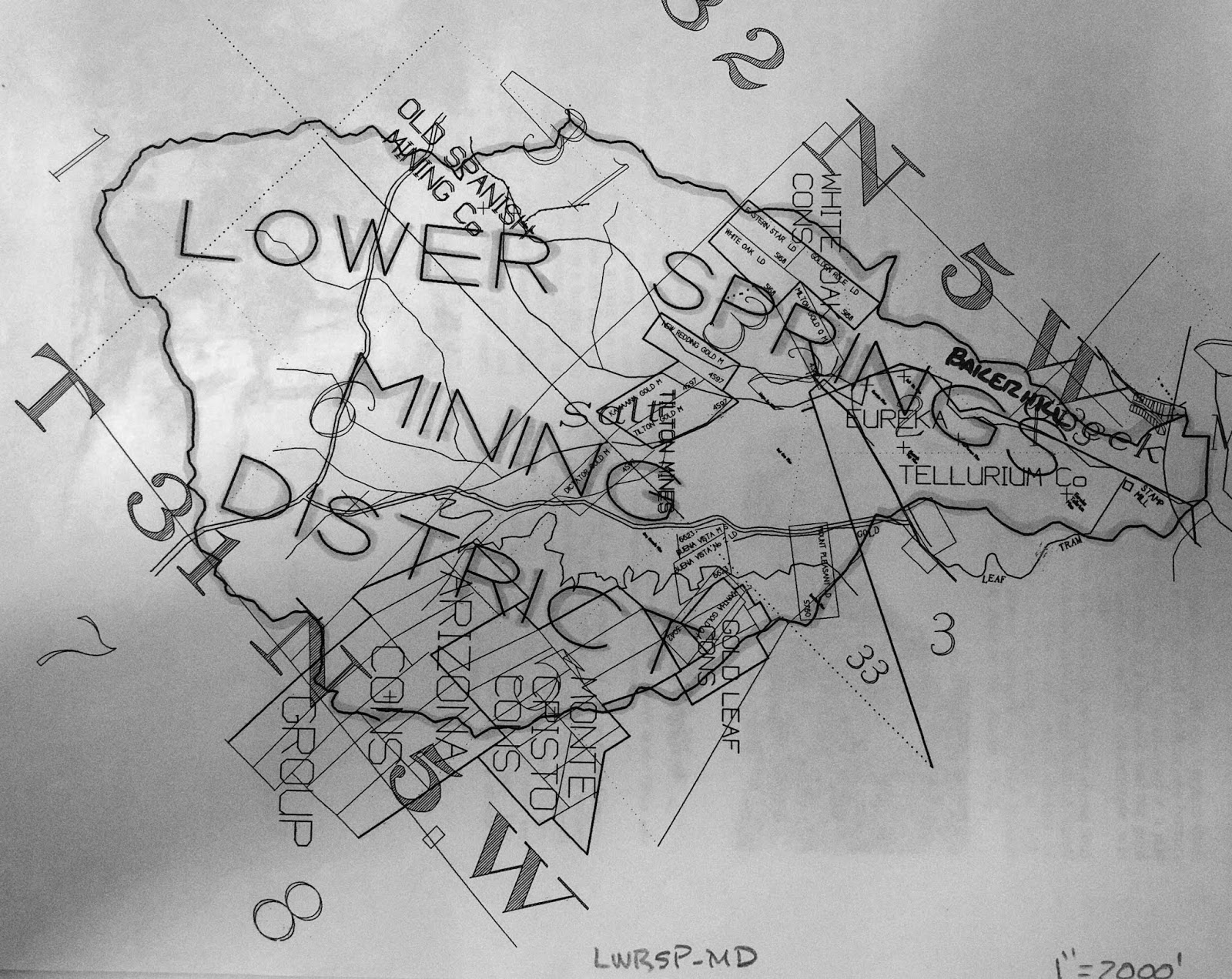
Above: This undated surveyed map shows the boundaries of the Lower Springs mining district and some of the mines included. Please note the name: the Old Spanish Mining Co., of course other mines and companies are noted on it as well. 

In the fall of 1854, a brand new trading post was established at Lower Springs by J.D. Dunlap & Company, and they began advertising their general merchandise store in the local media. Two months later, in December of that year, the first rain eventually fell, and miners had an abundance of water to use. The miners started washing their placer mines and they were making one hundred dollars per day by rocker at that time.


Above: an advertisement for J.D. Dunlap & Company at Lower Springs. This ad is from the Saturday, October 21, 1854 edition of the Shasta Courier newspaper.


The construction of the Clear Creek Ditch, sometimes referred to as the Clear Creek Canal, began in December of 1853. Local miners raised the money to back this large project to convey the water of Clear Creek into the nearby dry diggings of Briggsville, Horsetown, Lower Springs, Muletown, Shasta and Whiskeytown. The ditch connected with a large reservoir which was built as a major part of this project.

Local miners celebrated the ditches completion on November 24, 1855. The length of this ditch measured at sixty miles. The reservoir at Middletown covered fifteen acres to a depth of eight feet. Immediately, the water from this ditch began conveying water into the Lower Springs mining district at Salt Creek. The miners at Lower Springs now had an abundance of water to use in their mining claims.

There wasn't much of a ruckus at Lower Springs between the years 1856 and 1857; however, this community managed to stay relevant. The miners in the area focused on their placer mines, and local businesses advertised their companies in the local media. However, in July of 1857, Swasey’s hotel was still owned by Benjamin Swasey, but it was now under new management. A man by the name of Willam H. Bond was hired by Swasey to manage the hotel for him. Swasey still ran his mercantile store but his extra time was focused on being the public administrator of Shasta County, which is part of the reason he couldn’t manage both the mercantile store and the hotel by himself.
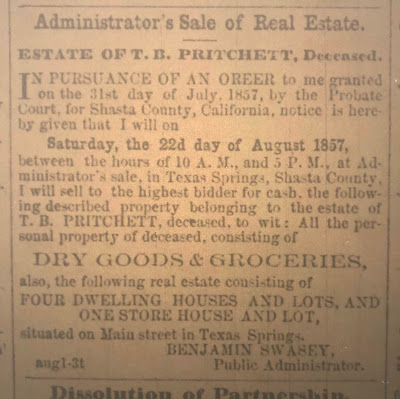

Above: an advertisement for the Administrator's Sale of Real Estate for the estate of T.B. Pritchett, deceased. This estate sale was held on Main Street at Texas Springs, in Shasta County, by Benjamin Swasey, Public Administrator on August 22, 1857. The above ad is from the Saturday, August 8, 1857 edition of the Shasta Courier newspaper.

Two years later, on February 19, 1859, the Shasta Courier newspaper heralded the following article:

“Pottery - The manufacture of pottery has been fairly commenced by Messrs., Bly & Co., at Lower Springs. It is the first manufactory of the kind that we have heard of being established in the Northern part of the State. The first kiln was burned a few days ago. It was entirely successful and the ware is of excellent quality. We have been presented with a large pitcher from this first kiln and we value it highly. It argued well for California to witness the commencement of manufacturing establishments throughout the State - however, humble they may be in their inception. We wish Messrs., Bly and Co., an abundant reward in the pursuit of their laudible enterprise.” (SIC) 

Apparently, the above article by the Shasta Courier newspaper conflicts with previous statements by local historians who claimed that, a man by the surname of Tozure, had owned and operated the first pottery shop at Lower Springs. There's no information to suggest that Tozure was employed by Bly and Company, or that Tozure had become Bly and Company’s successor at Lower Springs. There might have been two different pottery shops at different era's in this community, in operation, because the above article suggest otherwise.

This quiet burg was interrupted one day, in January of 1863, by an affray started by Lawrence O' Connell who assaulted William Thompson over a bottle of strychnine whiskey. This is one incident that the local media frenzied over. It was Thompson who was severely beaten by O’ Connell that day, and after the violent dispute, O'Connell immediately departed Lower Springs for Latona. Thompson traveled to Shasta where he pressed charges of assault against his assailant at the Sheriff’s office. O’Connell was later arrested at Latona by Sheriff John S. Follansbee, and then, Follansbee escorted him to Shasta where he was jailed.

In June of 1863, Jones & Company struck a fine ledge of gold particles on their mining property at Lower Springs. They believed that this ore would carry a high value at the assayers office and it won them quite a bit of praise in the local media. The ledge was measured at twenty-two feet wide, immediately, Henry Jones and his crew sunk a shaft down twenty feet below the surface of the earth. 

As they continued to lower the shaft, the ore they sought after revealed better quality. This discovery brought a boom to the community of Lower Springs, and it became one of the first quartz mines in the Lower Springs mining district. Everything until then had been placer mining, in that area, Jones & Company would soon develop the property further with tunnels, drifts and upraises. Its believed that this former placer mine became the quartz mine known as the Old Spanish Mine.

After this quartz mine was dug out, a number of placer mining properties in the Lower Springs mining district were transformed by miners into quartz mines. In November of 1864, Henry Jones who was one of Lower Springs leading citizens was elected as Supervisor of District 1 of Shasta County, the local media referred to Jones as being “eminently qualified for the position”. That month, a number of large quantity of rocks from the Old Spanish Mine at Lower Springs was hauled to the Spring Creek stamp mill on Spring Creek to be crushed so they can obtain the gold from the quartz rocks.

Then on, Saturday, March 4, 1865, the Shasta Courier heralded the following account of a recent discovery made by Henry Jones: 

“A SWEET DISCOVERY - Last week Mr. Jones, of Lower Springs observes s large number of honey bees working upon the willows in that vicinity, and being quite an expert apiarist, he noticed that in leaving the willows they generally flew in the same direction, and by taking observations from some willows in the vicinity of Mr. Wiser’s garden he saw that the course taken by the bees from the two points converged upon a hill about a half mile from Lower Springs, and upon going to the place, he found the bees occupying a log upon the hill. The log was opened and forty pounds of excellent honey taken therefrom and sufficient left for the bees, which Mr. Jones has taken to his house.” (SIC)

A man named Bert Wiser partnered with a another man by the surname of Terry and together they established an excellent vineyard at Lower Springs. Wiser & Terry were well-known purveyors of wine which became a locally renown favorite of the era. Their wine was bottled at their Lower Springs vineyard and then transported to Wiser’s home at Buckeye, in Shasta County. He lived on the Buckeye Ranch where Wiser & Terry kept a rather large cellar that they stored their wine in. Their wine was labeled as Wiser & Terry, Lower Springs, California.

Another serious affray occurred in this community on March 15, 1865, when a shooting of a Chinaman transpired over an apparent purchase of a mining claim and water ditch. The German settler who apparently sold the property to the Chinaman denied the fact that he had sold him the land. Then the German claimed that he didn't realize the area was an anti-Chinese district. After they quarreled- the German shot the Chinaman in the arm and the feud was settled according to reports, but both parties lived, and no one was arrested.

On September 9, 1865, the local media reported the following; 

"We are advised that there are fair prospects for the erection of a small mill at Lower Springs, this fall. - The good work goes on, and if the people will but prospect, the future of Shasta is assured." (SIC) 

The above quote by the Shasta Courier newspaper is referring to a brand new stamp mill to help crush the rock to obtain the ore from the samples they retrieved. The mining company to establish this new stamp mill at Lower Springs was the Union Company who hired a man by the name of L.A. Kelly to be their superintendent at the stamp mill and supervise their daily operations here. The Union Company's stamp mill wasn't in operation until mid-December. It's not known how many stamps this crusher had.

Between the years 1866 and 1870, there were newer quartz mines which were located in the Lower Springs mining district. The quartz rock from these mines were hauled to the Union Company's stamp mill or the Spring Creek stamp mill. The ore from these mines were assayed at high value, and due to this mining boom these lucrative quartz mines brought new settlers to the area. The Union Company actually began to dig and blast through surface rock to make their own quartz mine at their stamp mill property to prospect.

While the decade of the 1870s and 1880s evolved around the mining district at Lower Springs, the (old) gold mining burg flourished once again as work continued in number of mines in the area. One quartz mine in particular is the Old Spanish Mine, which is located in the Lower Springs mining district. Throughout history, this mining burg never established a post office, and it continued to be prominent into the 1890s, and past the turn of the 20th century. Today, Lower Springs Road retains the name of this once thriving gold rush community and present day Swasey Drive was named after forty-niner, Benjamin Swasey.


Above: In January of 1905, this plat map of the Telluride Consolidated Mine was surveyed by Alfred Baltzell, an U.S. Deputy Mineral Surveyor, for its owners Charles Piftschek, and Anton Herzlieb, of Redding. The Telluride Consolidated Mine embraced the Tellurium Quartz Mine, Diagonal Quartz Mining Claim, and the Hill Gravel and Quartz Mining Claim. All of these were located on the property of Piftschek and Herzlieb.


Legend has it that these iconic palm tree's were planted by pioneer, Benjamin Swasey at Lower Springs, and they grew in front of his Swasey hotel. The palm tree's lasted until the decade of the 1970s when the area was developed and they were uprooted. This photograph was taken in 1972. Courtesy of Shasta Historical Society.


RESOURCES:

1850 U.S. Census

Killed By Indians - The Sacramento Transcript newspaper of Sacramento, April 17, 1851

From The Interior - The Sacramento Daily Union newspaper of Sacramento, May 31, 1852

Lower Springs - The Shasta Courier newspaper of Shasta, March 12, 1853

Diggings About Lower Springs - The Shasta Courier newspaper of Shasta, April 2, 1853

The Lower Springs Road - The Shasta Courier newspaper of Shasta, May 7, 1853

The Ball At Lower Springs- The Shasta Courier newspaper of Shasta, January 21, 1854

J.D. Dunlap & Co. - The Shasta Courier newspaper of Shasta, October 21, 1854

Lower Springs - The Shasta Courier newspaper of Shasta, December 23, 1854

A Serious Difficulty - The Shasta Courier newspaper of Shasta, January 13, 1855

Convention of Shasta County Miners Relative to the Chinese Question - The Shasta Courier newspaper of Shasta, January 20, 1855

Clear Creek Ditch - The Sacramento Daily Union newspaper of Sacramento, October 29, 1855

Clear Creek Ditch Finished! - The Shasta Courier newspaper of Shasta, November 24, 1855

Swasey’s Hotel advertisement - The Shasta Courier newspaper of Shasta, July 11, 1857

Slanderous - The Shasta Courier newspaper of Shasta, February 19, 1859

1860 U.S. Census

Supervisor - The Shasta Courier newspaper of Shasta, November 19, 1864

Quartz - The Shasta Courier newspaper of Shasta, November 26, 1864

A Sweet Discovery - The Shasta Courier newspaper of Shasta, March 4, 1865

Shot - The Shasta Courier newspaper of Shasta, March 18, 1865

Still Another Mill - The Shasta Courier newspaper of Shasta, September 9, 1865

Lower Springs - Union Co. - The Shasta Courier newspaper of Shasta, December 9, 1865

New Discovery - The Shasta Courier newspaper of Shasta, January 6, 1866

Struck It - The Shasta Courier newspaper of Shasta, February 10, 1866

Prospecting Mill - The Shasta Courier newspaper of Shasta, March 10, 1866

Buckeye Ranch - The Shasta Courier newspaper of Shasta, April 1, 1865

1866 California Voters Registration

1870 U.S. Census

1880 U.S. Census

California Journal of Mines and Geology, Volume 10 1890, page 632.

Mining District Near Redding’s Limits - Mineral Wealth Magazine, March 15, 1905

Benjamin Swasey Dies At Home In Oakland - The San Francisco Call newspaper of San Francisco, September 20, 1912

My Playhouse Was A Concord Coach, an anthology of newspaper clippings and documents relating to those who made California history during the years 1822-1888, by Mae Hélène Bacon Boggs. Published by Howell-North Press ©1942

Shasta County, California A History by Rosena Giles, published by Biobooks, ©1949.

Lower Springs by Mabel Frisbie - The Covered Wagon, 1957, published by Shasta Historical Society.

In the Shadow of the Mountain A Short History of Shasta County, California, by Edward Petersen ©1965

Gage-Carter Family Stories, Compiled for Lloyd D. Carter, edited by M. Walsh © October 1990 929.2 Gage/Carter in Shasta Historical Society library

Middle Creek & Lower Springs Mining District 622 Mining, available at the Shasta Historical Society

Thursday, July 5, 2018

Shasta's Growth, Prosperity And Decline, Part One.


Shasta as it appeared in 1856. Courtesy of Shasta Historical Society.


The town of Shasta was established in 1848 as a sprawling tent community called Reading Springs which was surrounded by gold rush pandemonium as miners pitched up tents establishing the new settlement. A natural spring flowed near the community adding to its original name of Reading Springs. Reading Springs was named in honor of Major Pierson B. Reading (pronounced like the color red) the first European-American settler in Shasta County.

According to celebrated California historian, John S. Hittell, the first white woman was seen at Reading Springs in 1849. She was married and she had seven children of her own. Her name wasn’t remembered because it wasn’t recorded by the forty-niners. The population at Reading Springs increased between 500 and 600 residents in September of 1849.

The very first cabin was erected by Milton McGee the following month on High Street, after that other pioneers followed suit erecting additional bungalows on the hillsides near Main Street. The tents were taken down each time a new bungalow was completed. Then on, October 20, 1849, two cousins by the names of Harrison J. Shurtleff and Doctor Benjamin B. Shurtleff arrived together at Reading Springs from Boston, Massachusetts and they settled on a hillside near Main Street. Doctor Benjamin B. Shurtleff became the first surgeon and physician at Reading Springs. Eventually, he establishes the first pharmacy on Main Street and becomes one of the foremost leading citizens in the community.

On February 18, 1850 Shasta County was created as one of the original twenty-seven counties of the new State of California which was still transitioning from being controlled by the Mexican government to becoming a brand new state controlled by the American government. California wasn’t admitted into the Union as the thirty-first state until September 9, 1850. Shasta County is older than the State of California, and that is a true fact.

During the interim the name Reading Springs was changed to Shasta on June 8, 1850. It was named Shasta by Armstead C. Brown an early pioneer settler. Brown named the town Shasta because it was the nearest town to Mount Shasta. Siskiyou County wasn’t formed until 1852. As Shasta grew, the early settlers made it a ramshackle community but the town flourished.

One of the first merchants in town was a man by the name of R.J. Walsh who had a store on Main Street. There were many pioneer entrepreneurs establishing businesses in the new town site and they profited well, like Walsh did. One of the new businesses was the two-story St. Charles hotel which was built by John Mackley. The upstairs contained one large room with 250 cots, and no private rooms, while the downstairs portion of the building contained billiards with gambling tables.

A saloon was also included downstairs. In 1851 this hotel was owned and operated by Karl Augustas Grotefend. Even though the St. Charles hotel was the leading hotel in Shasta, Grotefend, was not concerned about the Globe hotel and the Trinity House (another hotel) being in operation at the same time.

On March 6, 1851 the town of Shasta became the county seat of Shasta County. Shasta was now a bustling city, and a future post office and a courthouse would be constructed soon. Locals would come to call it the Queen City of the Northern Mines or simply, the Queen City of the North, due to the many accommodations it boasted during its heyday.


CONTINUE TO PART TWO HERE.


RESOURCES:

A Jail And A Courthouse - The Shasta Courier newspaper, Saturday, November 19, 1853

Hong Kong - The Shasta Courier newspaper, Saturday, December 3, 1853

Our Storied Landmarks – Shasta County, California, written by May H. Southern, published by Balakshin Printing Company, ©1942.

Shasta County, California A History by Rosena Giles, published by Biobooks, ©1949.

In the Shadow of the Mountain A Short History of Shasta County, California, by Edward Petersen ©1965

Place Names of Shasta County by Gertrude Steger, published by La Siesta Press, ©1966.

Shasta: The Queen City by Mabel Moores Frisbie and Jean Moores Beauchamp, published by California Historical Society, ©1973.

Shasta State Historic Park Brief History and Tour Guide, published by Shasta State Historic Park, ©July 1985

Did Arsonists Raze and Re-Raze Shasta? by Jeremy M. Tuggle, the Record Searchlight newspaper, July 25, 2016