Showing posts with label Middletown. Show all posts

Tuesday, September 15, 2026

Middletown: Shasta County’s forgotten Gold Rush town

Middletown — Shasta County’s forgotten Gold Rush town


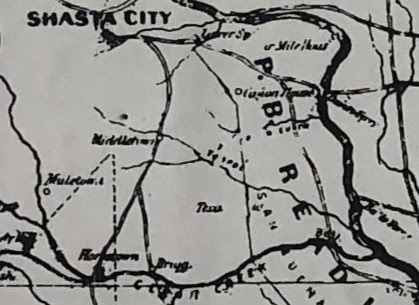
About six miles west of present-day Redding, in the rolling country between the historic town of Shasta and the old mining settlements along Clear Creek, once stood Middletown. Today almost nothing remains to suggest that hundreds of people once lived, worked, traded, celebrated, and searched for gold there. Yet during the 1850s, Middletown was one of the important mining communities of western Shasta County, surrounded by exceptionally rich placer ground and connected by roads and stage routes with Shasta, Horsetown, Muletown, Texas Springs, and other settlements scattered throughout the Clear Creek mining country. Middletown's story did not end when the first great placer-mining era faded. Although the community began declining during the late 1850s and eventually disappeared as a recognizable town, mining continued around the old settlement for generations. Farms, orchards, vineyards, homes, and a winery later occupied portions of the surrounding countryside, while miners continued searching the Middletown mining district for gold into the twentieth century. Middletown disappeared as a Gold Rush town, but it did not disappear as a place.

Middletown developed amid extraordinarily rich placer deposits during the opening years of the California Gold Rush. By March 1853, reports from the district were already attracting attention. A miner identified as Mr. Dilicolli discovered a piece of pure gold valued at $200 in his claim on Tadpole Creek near Middletown. The following month, A. E. Calloway recovered eleven ounces of gold and another six dollars from his claim near Middletown, while neighboring miners were reportedly earning between eighteen and twenty-five dollars per day. Later recollections reinforced just how rich the district had been. One newspaper remembered that there was no richer placer camp in the county than Middletown. Its surface gravel, heavily mixed with quartz, reportedly paid miners from ten to twenty dollars per day, with gold occurring from the grass roots down to bedrock. Large quartz boulders containing free gold were also encountered, suggesting that the rich placer deposits might have originated from undiscovered quartz ledges in the surrounding hills.

The remarkable discoveries continued. In March 1854, a lump of gold mixed with quartz weighing more than one hundred ounces was reported from the Middletown diggings and valued at no less than $1,000. Later that month, Hendricks & Stroud recovered another impressive piece weighing twenty-eight ounces and five and one-half dollars in additional weight, with an estimated value approaching $500. The gold drew a substantial population into the surrounding country. A later pioneer account remembered that when the Clear Creek Ditch was completed, more than three thousand miners were waiting for water throughout Muletown, Middletown, Jackass Flat, Texas Springs, Horsetown, and neighboring camps. Cabins were reportedly so numerous between Middletown and Briggsville that the four-mile road connecting them was remembered as almost a continuous street. Decades later, James Gleason, who had grown up in the neighboring Horsetown country, remembered Middletown and Centerville as good business centers and recalled that Middletown itself had spread across a comparatively large area.

As the population increased, Middletown quickly became part of western Shasta County's transportation and commercial network. In 1853, a new road was constructed between Middletown and Horsetown, and Middletown became a stop on Hall & Crandall's United States Mail stage route connecting Shasta with Marysville and Sacramento. Businesses followed the miners. In November 1853, property on the west side of Middletown's Main Street containing a tavern, store, and bakery was offered at auction. The tavern alone could accommodate approximately fifty boarders and included a cellar and large corral. In January 1854, John Heivner purchased the New York Bakery on the east side of Main Street, where customers could purchase bread, pies, cakes, provisions, mining implements, liquors, and cigars. Another pioneer, John Doebelin, was remembered in a 1935 obituary as having owned the first bakery in Middletown. Whether his establishment was connected with the New York Bakery is uncertain, but the accounts demonstrate the extent of Middletown's early commercial development.


The New York Bakery at Middletown, purchased by John Heivner in 1854, offered bread, pies, cakes, provisions, mining implements, liquors, and cigars from its location on the east side of Main Street. From the Shasta Courier newspaper of Shasta, edition of January 28, 1854.

Among the town's most important merchants were William Weil and L. Weil, who established their original store at Middletown in 1854. Their enterprise subsequently expanded to Texas Springs and Horsetown. The Union Hotel became another important Middletown institution. William S. Hughes assumed management in January 1855, offering food, lodging, a well-stocked bar, and stabling for travelers' animals. Middletown also supported an active social life. Balls and dances were held at its hotels, and a dancing school operated there in 1855. People were beginning to establish families as well. On June 4, 1855, M. L. Richmond and Mary McGuire were married at Middletown. The following month, John Doebelin was born there, beginning a life that would eventually span Middletown's transformation from thriving Gold Rush settlement to ghost town.

Middletown's growing importance was further reflected in the establishment of its own post office. A federal postal register for Shasta County lists Charles W. McKinney as Middletown's postmaster beginning June 18, 1856. The Middletown post office remained in operation until April 19, 1858, when the register records it as discontinued. Its existence provides another indication that Middletown had developed beyond a temporary collection of miners' cabins into an established community. The timing of its closure is also noteworthy. The post office was discontinued during the same year that Judge Chauncey C. Bush Sr. later remembered as the beginning of Middletown's decline, although the surviving postal record does not establish a direct connection between the two events.

For all its mineral wealth, Middletown suffered from one fundamental problem: water. During the winter of 1854, drought brought mining throughout the surrounding dry diggings nearly to a standstill. Without water, miners could not wash their gravel. Without gold, money disappeared from circulation, hotels lost boarders, and merchants lost customers. The solution appeared obvious—bring water from Clear Creek. A public meeting was called at the Excelsior House in Middletown in February 1854 to consider constructing a ditch and flume system. A proposal envisioned a roughly sixteen-mile canal built cooperatively by approximately one hundred miners. The movement continued in March when miners assembled again at Middletown, with James S. Ralston serving as chairman and Brice Grimes as secretary. The resulting plan called for one hundred shares valued at $500 each, with shareholders providing part of the necessary labor. Later accounts celebrated the eventual completion of a Clear Creek ditch system supplying the surrounding mining country, although a direct organizational connection between that completed ditch and the cooperative enterprise proposed at Middletown in 1854 has not been established.

Life in Middletown could also display the rougher character of the California mining frontier. In April 1855, the store of William Weil & Co. was burglarized, and approximately $1,500 in gold dust disappeared along with a black mare mule believed to have been used by the thieves. The merchants offered a $200 reward for recovery of the stolen property and apprehension of those responsible. At the same time, Middletown developed the civic institutions of a settled community. It sent delegates to county political conventions, produced candidates for public office, and maintained its own election precinct. These details reveal a place considerably more developed than the term “mining camp” might suggest. Middletown possessed businesses, hotels, homes, roads, stage service, political institutions, social gatherings, and a permanent population.

According to Judge Chauncey C. Bush Sr., who recalled Middletown's history during an 1893 land dispute, the community reached its height between 1853 and 1857, when approximately 500 people lived there. He remembered saloons, hotels, merchants, and substantial buildings, including a fireproof brick store occupied by Weil. Because Judge Bush was describing events several decades afterward, his testimony is best regarded as a pioneer recollection rather than a contemporary population count, but his description agrees closely with the substantial community documented in newspapers of the 1850s. Judge Bush placed the beginning of Middletown's decline in 1858, when the Frazier River excitement drew miners and residents away. The distinction is important: 1858 marked the beginning of Middletown's decline, not its end.

Middletown remained an established election precinct in 1858, with William Weil serving as inspector, and commercial life continued. In late 1859 and early 1860, William Weil & Bros. advertised the Middletown location as one of the firm's established “old stands,” alongside stores at Horsetown and Texas Springs. A butcher shop operated by Bennet & Waggoner also opened at Middletown, sending wagons throughout Buckeye, Churntown, Whisky Creek, Shasta, Texas Springs, and neighboring settlements. The Weil enterprise changed hands in 1861, when William Weil and L. Weil sold their interests to David Weil and Joseph Weil before returning to Germany. The two brothers later returned to California in 1867, after which the family established itself in Shasta.


William Weil & Bros. advertised Middletown as one of the firm's established “old stands” in 1859–1860, evidence that commercial activity continued after Middletown had begun to decline. From the Shasta Courier newspaper of Shasta, edition of January 7, 1860.

An 1862 sheriff's sale involving merchant Augustus Kessel provides one of the best surviving descriptions of Middletown's physical layout. In April of that year, Emanuel Lewin and Ferdinand Baehr obtained a judgment against Kessel for $2,867.90, plus interest and costs. Among the property subsequently offered for sale was a parcel on the west side of Middletown's principal street containing the fireproof brick store erected by William Weil & Co. Another parcel stood opposite Kessel's dwelling and included the site of his former storehouse. The measurements recorded in the legal notice reveal a developed commercial street containing defined lots, fences, residences, stores, and substantial buildings rather than merely the temporary cabins commonly associated with early mining camps. Even in 1863, Middletown remained socially and civically active. Michael B. Hickey hosted a grand St. Patrick's Day Ball at the Union Hotel, and the community continued functioning as an election precinct. Middletown was smaller, but it was still alive.

As the great placer-mining era faded, attention increasingly turned toward quartz. In January 1864, the Shasta Courier identified James Loag as the owner of a quartz mill near Middletown. A cleanup following the crushing of fifty tons of quartz from Jolly & Co.'s Muletown claim produced seventeen pounds of amalgam, with experienced observers estimating the ore at approximately forty dollars per ton. Two months later, an eight-stamp quartz mill at Middletown was offered for sale. The mill had recently been thoroughly repaired, contained two sets of Norton's Patent Amalgamators, and was described as being in good running order. Importantly, the advertisement stated that it was being sold to close a partnership rather than because the operation had failed.

Mining continued around Middletown long after the original town began declining. William Peterson developed a gold-bearing quartz ledge near Middletown, sank a shaft, constructed a roasting furnace, and built an arrastra. Other prospectors searched the surrounding hills for the quartz ledges believed to have produced the district's extraordinary placer deposits. In 1876, Michael Hickey applied for a federal patent covering the twenty-acre Hickey Placer Mine in the Middletown mining district. The property description is particularly valuable because it placed the claim near John Heivner's dwelling and garden and property associated with William Peterson. Heivner had purchased the New York Bakery more than twenty years earlier, while Peterson was associated with the district's later quartz development. Their appearance in the same property description shows that Middletown's later landscape contained not simply abandoned diggings, but residences, gardens, established property boundaries, and active mining claims.

The concentrated settlement nevertheless continued to disappear. By 1893, Judge Bush recalled that not a single vestige of the old town remained. Yet only two years later, a newspaper column headed “Middletown Notes” described a very different kind of community occupying the surrounding countryside. Peter McCann was pruning his orchard and sowing grain. Wolfgang Nachreiner was planting eighty acres of wheat and oats. Martin Nachreiner was clearing land, Anton Schwagel planned to sow forty acres of oats, and Jacob Peterson intended to cultivate twenty-five acres on Chris Stabler's ranch. Even the miners were reported to be making spring gardens and planting trees. The Gold Rush town had disappeared, but Middletown had become a dispersed rural community where mining existed alongside orchards, grain fields, gardens, homes, and ranches.

Agriculture eventually produced one of Middletown's most distinctive later industries. By 1899, Charles Brouillard was identified as the “Middletown wine maker,” and by the following year he was described as proprietor of the Middletown Winery. Brouillard's operation produced Claret, Zinfandel, White Wine, Riesling, Sauterne, Port, Sherry, Angelica, and brandy, with a distribution depot maintained at 305 Oregon Street in Redding. When the Middletown Ranch and Winery was advertised for sale in 1911, the property encompassed approximately 270 acres, including forty acres planted in grapes and fruit, 220 acres of pasture, and ten acres of mineral land. Even on a ranch devoted to agriculture and wine production, the mineral potential of the old Middletown country had not been forgotten.


Charles Brouillard's Middletown Winery produced a variety of locally made wines and brandy and maintained a distribution depot at 305 Oregon Street in Redding. From the November 22, 1911, edition of the Courier-Free Press newspaper of Redding. 

Nor had mining disappeared. New quartz claims continued to be recorded in the Middletown mining district during the twentieth century. In 1915, the Jim Loag Mine at Middletown was equipped with a two-stamp mill, ore discharge, rock breaker, and hoist, while other prospectors continued locating quartz claims throughout the surrounding country. By 1930, miners were still staking new ground in the Middletown district. The following years demonstrated that the old mining country could still produce the ambition and uncertainty that had characterized it since the Gold Rush.

In 1932, the White Mine was being developed near Olney Creek behind the old Middletown Cemetery, approximately five miles west of Redding. Dawson, Swinney, and Samson operated the property under lease and bond from Edwin White of Redding and installed a mill capable of processing approximately fifty tons of ore per day. Just as operations were preparing to begin, someone deliberately dynamited the cement diversion dam constructed across Olney Creek to provide water for the mill. The fifteen-foot-long and eight-foot-high structure was shattered. No known dispute over mining or water rights explained the destruction, and the motive remained a mystery. The operators nevertheless intended to rebuild the dam and continue mining. Nearly eighty years after Middletown's first great placer discoveries, people were still searching the surrounding hills for gold.

One physical remnant of the pioneer community proved especially enduring. The Middletown Cemetery, established near the settlement during the pioneer era, continued serving the surrounding countryside after the town's stores, hotels, saloons, and residences disappeared. Pioneers including John H. Owens, Bernard Scheurer, and George Miller were buried there. When Solomon McDaniel of the neighboring Centerville district was laid to rest in the cemetery, the Weekly Searchlight described his funeral as the largest ever held at Middletown, with mourners traveling from Redding and the surrounding countryside. The cemetery's continued use demonstrates that Middletown remained a meaningful community identity even after its commercial center vanished.


The entrance to the historic Middletown Cemetery, established during the 1850s near the once-thriving Gold Rush community of Middletown in Shasta County, California. The cemetery remains one of the few surviving physical reminders of the former settlement. Photograph taken by Jeremy M. Tuggle on September 1, 2026.

Few lives illustrate Middletown's transformation better than that of John Doebelin. He was born at Middletown in July 1855, when the settlement was near the height of its prosperity, and spent most of his eighty years in the surrounding mining country. When Doebelin died in 1935, his obituary described his birthplace as a ghost town situated between Briggsville and old Shasta. The infant born amid the Gold Rush boom had lived long enough to see his birthplace become a historical memory.

Middletown's history, however, was not simply the story of a mining town that flourished briefly and disappeared. Its first great era belonged to placer mining, when gold drew hundreds of people into the district and created stores, hotels, bakeries, homes, roads, stage connections, political institutions, and a thriving community. The Frazier River excitement began Middletown's decline in 1858, but decline was a process rather than an event. Merchants remained, elections continued, quartz mills operated, and residents maintained homes and gardens. As the concentrated settlement disappeared, farms, orchards, vineyards, and homes spread across the surrounding countryside, while prospectors continued recording mining claims into the twentieth century.

The town disappeared, but Middletown survived as a place. Its name remained attached to the countryside, its mines, farms and vineyards, roads, family memories, and most enduringly, its pioneer cemetery. Today, the Old Middletown Cemetery remains a tangible connection to a settlement whose Main Street and buildings have otherwise vanished—a surviving landmark of one of western Shasta County's richest Gold Rush communities and a reminder that Middletown's history continued long after the boomtown itself disappeared. 


Tall, dry grass surrounds a modern grave within the historic Middletown Cemetery in Shasta County, California. Established during the 1850s, the secluded cemetery remains one of the few surviving landmarks associated with the former Gold Rush community of Middletown. Photograph taken by Jeremy M. Tuggle on September 1, 2026.


RESOURCES:


1850 U.S. Census

1852 California State Census

The Shasta Courier newspaper of Shasta, March 12, 1853

Big Lump - The Shasta Courier newspaper of Shasta, March 19, 1853

Interesting Letter from One Horse Town - The Shasta Courier newspaper of Shasta, April 2, 1853

Good Wages - The Shasta Courier newspaper of Shasta, April 2, 1853

From Pitt River - The Shasta Courier newspaper of Shasta, April 23, 1853

French Gulch Correspondence - The Shasta Courier newspaper of Shasta, April 30, 1853

Middletown and One Horse Town Road - The Shasta Courier newspaper of Shasta, May 7, 1853

The Shasta Courier newspaper of Shasta, May 7, 1853

Attention Democrats - The Shasta Courier newspaper of Shasta, May 14, 1853

Shasta County Democratic Convention - The Shasta Courier newspaper of Shasta, June 11, 1853

The Shasta Courier newspaper of Shasta, July 2, 1853

Birth - The Shasta Courier newspaper of Shasta, July 16, 1853

Afternoon Session - The Shasta Courier newspaper of Shasta, July 30, 1853

The Shasta Courier newspaper of Shasta, September 3, 1853

Auction!! - The Shasta Courier newspaper of Shasta, October 22, 1853

Ball's - The Shasta Courier newspaper of Shasta, December 24, 1853

The Shasta Courier newspaper of Shasta, January 28, 1853

The Shasta County Dry Diggings - The Shasta Courier newspaper of Shasta, February 4, 1854

To The Public - The Shasta Courier newspaper of Shasta, February 11, 1854

The Shasta County Dry Diggings - The Shasta Courier newspaper of Shasta, February 11, 1854

Miner's Meeting - The Shasta Courier newspaper of Shasta, February 25, 1854

Miner's Convention - The Shasta Courier newspaper of Shasta, March 11, 1854

Miner's Meeting - The Shasta Courier newspaper of Shasta, May 4, 1854

Miner's Convention - The Shasta Courier newspaper of Shasta, March 11, 1854

Married - The Shasta Courier newspaper of Shasta, March 18, 1854

Middletown Dry Diggings - The Shasta Courier newspaper of Shasta, March 25, 1854

Mining In Shasta County - The Shasta Courier newspaper of Shasta, April 1, 1854

Rich Quartz - The Shasta Courier newspaper of Shasta, April 29, 1854

Miner's Meeting - The Shasta Courier newspaper of Shasta, May 20, 1854

Notice to the Democracy of Shasta County - The Shasta Courier newspaper of Shasta, June 24, 1854

Middletown Ball - The Shasta Courier newspaper of Shasta, September 30, 1854

The Travel This Way - The Shasta Courier newspaper of Shasta, October 28, 1854

The Shasta County Mining and Milling Water Company - The Shasta Courier newspaper of Shasta, December 23, 1854

The Storm - The Shasta Courier newspaper of Shasta, January 6, 1855

The Union Hotel - The Shasta Courier newspaper of Shasta, January 20, 1855

The Shasta Courier newspaper of Shasta, January 20, 1855

Another Ball - The Shasta Courier newspaper of Shasta, January 27, 1855

The Shasta Courier newspaper of Shasta, February 10, 1855

Shooting Affair - The Shasta Courier newspaper of Shasta, March 10, 1855

Candidates - The Shasta Courier newspaper of Shasta, April 7, 1855

$200 Reward - The Shasta Courier newspaper of Shasta, April 14, 1855

The Shasta Courier newspaper of Shasta, April 28, 1855

The Shasta Courier newspaper of Shasta, May 5, 1855

Dancing School - The Shasta Courier newspaper of Shasta, May 26, 1855

Temperance Lecture - The Shasta Courier newspaper of Shasta, June 2, 1855

Mule Thief Arrested - The Shasta Courier newspaper of Shasta, June 9, 1855

Married - The Shasta Courier newspaper of Shasta, June 9, 1855

Dissolution- The Shasta Courier newspaper of Shasta, July 7, 1855

Shasta County Democratic Convention - The Shasta Courier newspaper of Shasta, July 14, 1855

“Sam” In Shasta - His Nominees - The Shasta Courier newspaper of Shasta, August 4, 1855

A Card - The Shasta Courier newspaper of Shasta, August 11, 1855

Administrators Notice - The Shasta Courier newspaper of Shasta, August 11, 1855

Temperance Mass Meeting - The :$hasta Courier newspaper of Shasta, August 25, 1855

Mining Intelligence - The Shasta Courier newspaper of Shasta, February 2, 1856

Judges and Inpectors of Election - The Shasta Courier newspaper of Shasta, August 14, 1858

The Shasta Courier newspaper of Shasta, November 26, 1859

1860 U.S. Census

The Shasta Courier newspaper of Shasta, January 7, 1860

The Shasta Courier newspaper of Shasta, January 14, 1860

A Seven Hundred Dollar Chunk - The Shasta Courier newspaper of Shasta, January 21, 1860

Sheriff’s Sale - The Shasta Courier newspaper of Shasta, April 26, 1862

Notice - The Shasta Courier newspaper of Shasta, August 30, 1862

St. Patrick's Ball - The Shasta Courier newspaper of Shasta, January 1, 1863

A Contract - The Shasta Courier newspaper of Shasta, October 3, 1863

Sheriff's Sale - The Shasta Courier newspaper of Shasta, October 3, 1863

Quartz Mill in Operation - The Shasta Courier newspaper of Shasta, October 17, 1863

A Good Claim - The Shasta Courier newspaper of Shasta, January 9, 1864

Something About Our County - The Shasta Courier newspaper of Shasta, January 16, 1864

For Sale - The Shasta Courier newspaper of Shasta, March 5, 1864

Fire - The Shasta Courier newspaper of Shasta, October 15, 1864

Judges and Inspectors of Election - The Shasta Courier newspaper of Shasta, October 22, 1864

Robbery - The Shasta Courier newspaper of Shasta, November 5, 1864

Middletown Correspondence - The Shasta Courier newspaper of Shasta, December 3, 1864

Letter from Bed Rock - The Shasta Courier newspaper of Shasta, December 10, 1864

Letter from Bed Rock - The Shasta Courier newspaper of Shasta, January 21, 1865

Middletown - The Shasta Courier newspaper of Shasta, February 18, 1865

The Shasta Courier newspaper of Shasta, August 4, 1866

The Tornado Company - The Shasta Courier newspaper of Shasta, August 25, 1866

The Shasta Courier newspaper of Shasta, September 22, 1866

Middletown - The Shasta Courier newspaper of Shasta, September 29, 1866

Middletown - The Shasta Courier newspaper of Shasta, November 3, 1866

Administrators Sale of Real Estate - The Shasta Courier newspaper of Shasta, November 17, 1866

A Success - The Shasta Courier newspaper of Shasta, March 23, 1867

Not Played Out. - The Shasta Courier newspaper of Shasta, August 31, 1867

School House - The Shasta Courier newspaper of Shasta, October 5, 1867

Robbed - The Shasta Courier newspaper of Shasta, November 16, 1867

Bitten By A Dog - The Shasta Courier newspaper of Shasta, April 25, 1868

Shot at by Indians - The Shasta Courier newspaper of Shasta, June 13, 1868

Lightning - The Shasta Courier newspaper of Shasta, June 27, 1868

Injured - The Shasta Courier newspaper of Shasta, November 21, 1868

Fatal Accident - The Shasta Courier newspaper of Shasta, December 12, 1868

Runaway - The Shasta Courier newspaper of Shasta, April 3, 1869

Union Republican Convention - The Shasta Courier newspaper of Shasta, July 17, 1869

The Shasta Courier newspaper of Shasta, November 6, 1869

Gone East - The Shasta Courier newspaper of Shasta, December 25, 1869

1870 U.S. Census

The Shasta Courier newspaper of Shasta, April 8, 1871

Notice To Whom It May Concern - The Shasta Courier newspaper of Shasta, August 12, 1871

Sold Out - The Shasta Courier newspaper of Shasta, June 20, 1872

Highway Robbery - The Shasta Courier newspaper of Shasta, September 20, 1873

The Shasta Courier newspaper of Shasta, December 20, 1873

A.V. Mount - The Shasta Courier newspaper of Shasta, November 21, 1874

Notice of Application for Patent to Mining Claim - The Shasta Courier newspaper of Shasta, April 8, 1876

The Shasta Courier newspaper of Shasta, November 2, 1878

The Shasta Courier newspaper of Shasta, February 15, 1879 

The Shasta Courier newspaper of Shasta, March 15, 1879

The Shasta Courier newspaper of Shasta, May 10, 1879

The Shasta Courier newspaper of Shasta, June 21, 1879

1880 U.S. Census

The Shasta Courier newspaper of Shasta, January 24, 1880

Rich Quartz - The Shasta Courier newspaper of Shasta, March 13, 1880

The Shasta Courier newspaper of Shasta, August 21, 1880

The Shasta Courier newspaper of Shasta, September 4, 1880

The Shasta Courier newspaper of Shasta, October 9, 1880

Sheriff's Sale - The Shasta Courier newspaper of Shasta, February 19, 1881

Thirty Years Ago - The Shasta Courier newspaper of Shasta, April 5, 1884

Chenoweth - The Shasta Courier newspaper of Shasta, June 28, 1884

The Shasta Courier newspaper of Shasta, March 28, 1885

Michael Hickey - The Shasta Courier newspaper of Shasta, October 17, 1885

They Are Coming - The Shasta Courier newspaper of Shasta, June 26, 1886

Pioneer Notes - The Shasta Courier newspaper of Shasta, April 30, 1887

The Shasta Courier newspaper of Shasta, June 4, 1887

The Shasta Courier newspaper of Shasta, August 6, 1887

The Shasta Courier newspaper of Shasta, February 4, 1888

The Shasta Courier newspaper of Shasta, June 23, 1888

The Shasta Courier newspaper of Shasta, August 4, 1888

Middletown - The Free Press newspaper of Redding, April 22, 1893

Middletown Notes - The Free Press newspaper of Redding, February 9, 1895

The Searchlight newspaper of Redding, February 8, 1899

1900 U.S. Census

The Searchlight newspaper of Redding, December 23, 1900

His Request Granted Twenty Years After - The Free Press newspaper of Redding, April 19, 1902

After Effect of Typhoid Is Fatal - The Searchlight newspaper of Redding, February 11, 1908

Pays Tribute to "Old George" Miller - The Courier-Free Press newspaper of Redding, January 6, 1908

1910 U.S. Census

For Sale - The Searchlight newspaper of Redding, August 17, 1911

Buy Local Wine - The Courier-Free Press newspaper of Redding, November 16, 1911

The Courier-Free Press newspaper of Redding, November 22, 1911

Made A Lucky Strike - The Searchlight newspaper of Redding, January 23, 1919

Horsetown and Briggsville -The Searchlight newspaper of Redding, August 18, 1915

Two New Mines - The Searchlight newspaper of Redding, August 18, 1915

Robertson to Start Mine - The Courier-Free Press newspaper of Redding, August 31, 1915

Death Summons Laura B. Wagner - The Courier-Free Press newspaper of Redding, March 1, 1916

The Big Row - The Searchlight newspaper of Redding, March 14, 1916

Storey Funeral Today - The Courier-Free Press newspaper of Redding, April 19, 1916

Proof of Labor - The Courier-Free Press newspaper of Redding, December 12, 1916

1920 U.S. Census

Death of Jim Kelly Ended Odd Career - The Courier Free Press newspaper of Redding, April 20, 1922

1930 U.S. Census

Two Locate Claim - The Searchlight newspaper of Redding, July 4, 1930

John Doeblin, 80 Years Old Native of Shasta, Passes - The Searchlight newspaper of Redding, May 23, 1935

My Playhouse Was A Concord Coach, an anthology of newspaper clippings and documents relating to those who made California history during the years 1822-1888, by Mae Hélène Bacon Boggs. Published by Howell-North Press ©1942

Shasta County, California A History by Rosena Giles, published by Biobooks, ©1949.

Place Names of Shasta County by Gertrude A. Steger revision by Helen Hinckley Jones, ©1966 by La Siesta Press, Glendale, California

U.S., Appointments of U.S. Postmasters, 1832-1971


Monday, August 28, 2023

MYSTIC MINING AT THE BOSWELL GROUP OF MINES


Video filmed on location. © 2022 & 2023

Was a medium from San Francisco really used to conduct mystic mining at the Boswell Group of Mines? I claim the account to be hogwash, but local media outlets of the time document these interesting accounts claiming that W.S. Boyd and his mining partner George W. Boswell utilized these spiritualists to gain success in their Boswell Group of Mines. Later on, this property was owned and operated by the Redding Consolidated Mines. Join my friend Robert Frazier, host of California Unearthed, and I, as we take you on a historical tour of these mystical mining grounds and see what remains of them today.


Resources:

Of Interest To Prospectors - The Free Press newspaper of Redding, May 10, 1890

Attention Prospectors - The Free Press newspaper of Redding, May 31, 1890

Some of Our Mines - The Free Press newspaper of Redding, September 19, 1891

Real Estate Transfers - The Free Press newspaper of Redding, May 8, 1897

1900 U.S. Census

Proof Of Labor Book 1, Page 367 - Miners Dream mine, recorded by W.S. Boyd on January 20, 1900

Proof Of Labor Book, 1 Pages 492-493 - Miners Dream mine, recorded by W.S. Boyd on September 10, 1900

Proof Of Labor Book 2, Page 226

Spiritually Worked Mining Property - The Free Press newspaper of Redding, August 9, 1901

Spirits Tell How To Work A Mine - The Red Bluff Daily News newspaper, August 16, 1901

The Daily Free Press newspaper of Redding, August 9, 1902

Mrs. Ada Boswell Is Dead; Funeral This Afternoon - The Red Bluff Daily News newspaper of Red Bluff, March 15, 1922 

Construction Chief of the Boswell Mine Arrives - The Searchlight newspaper of Redding, January 10, 1929

Building Powerline To Muletown Consolidated - The Courier-Free Press newspaper of Redding, February 11, 1929

Shasta Mining Area Active - The Blue Lake Advocate newspaper of Blue Lake, February 16, 1929

To Increase Force - The Blue Lake Advocate newspaper of Blue Lake, May 11, 1929

Redding Consolidated Must Pay the Estate of W.C. Stevens $11,000 - The Courier-Free Press newspaper of Redding, December 22, 1930

Personal Property At Old Boswell Mine Sold As Junk, $1,500 - The Courier-Free Press newspaper of Redding, January 27, 1931

H.F. Musser, Local Mining Man, Kills Self - The Courier-Free Press newspaper of Redding, January 31, 1931

Last Rites Are Held For H.F. Musser - The Courier-Free Press newspaper of Redding, February 2, 1931

Boswell Group Of Mines Leased - The Courier-Free Press newspaper of Redding, April 6, 1932

Mines Sold - The Courier-Free Press newspaper of Redding, January 6, 1933

Shasta Mine Group Leased - The Blue Lake Advocate newspaper of Blue Lake, April 16, 1933

Woman Files Many Claims In Shasta Area - The Blue Lake Advocate newspaper of Blue Lake, September 17, 1932

Gravity Mill Installed - The Blue Lake Advocate newspaper of Blue Lake, May 6, 1933

Miner Slightly Injured In 30-Foot Fall - The Blue Lake Advocate newspaper of Blue Lake, April 14, 1934

George Boswell Passes On Here At Age Of 78 - The Courier-Free Press newspaper of Redding, April 25, 1934

Saturday, November 5, 2022

Texas Springs, Shasta County, California -A History-


The town of Texas Springs is featured on the official 1862 map

of Shasta County. Note: it's called "Texas" instead of Texas Springs.


The former town site of Texas Springs, which is located in Shasta County, California, was designated as California Historical Landmark No. 3, on June 6, 1969, and was settled in 1849 during the California Gold Rush. This settlement was located at the intersection of Texas Springs and Honeybee Roads south of the town of Centerville. Most of this former ghost town is on private property but there are still reminders of its former hey-day such as the Upper Texas Springs Cemetery, the Lower Texas Springs Cemetery, the Lamb memorial, and the Texas Springs Rock Quarry. For a complete history please see the following YouTube video:


This video was filmed on location on September 3, 2022.


RESOURCES:

Interesting Letter From One Horse Town - The Shasta Courier newspaper of Shasta, April 2, 1853

The Shasta County Dry Diggings - The Shasta Courier newspaper of Shasta, February 4, 1854

Miners Meeting - The Shasta Courier newspaper of Shasta, February 25, 1854

Miners Meeting - The Shasta Courier newspaper of Shasta, May 20, 1854

Miners Meeting - The Shasta Courier newspaper of Shasta, January 6, 1855 

The Nomuckett Water Company - The Shasta Courier newspaper of Shasta, May 26, 1855

Married - The Shasta Courier newspaper of Shasta, January 27, 1855

Judges And Inspectors Of Election - The Shasta Courier newspaper of Shasta, August 21, 1858

Destructive Fire At Texas Springs - The Shasta Courier newspaper of Shasta, November 20, 1858

The Chinese Question - The Shasta Courier newspaper of Shasta, February 19, 1859

Fourth of July at Texas Springs - The Shasta Courier newspaper of Shasta, July 9, 1859

New Store - The Shasta Courier newspaper of Shasta, July 16, 1859

Weil Bros. - The Shasta Courier newspaper of Shasta, August 13, 1859

Ball At Texas Springs - The Shasta Courier newspaper of Shasta, October 29, 1859

Miners Meeting At Texas Springs - The Shasta Courier newspaper of Shasta, December 31, 1859

Public Schools Of Shasta County - The Shasta Courier newspaper of Shasta, March 31, 1860

New Butcher Shop at Middletown - The Shasta Courier newspaper of Shasta, February 25, 1860

Religious - The Shasta Courier newspaper of Shasta, September 1, 1860

Judges And Inspectors Of The Election - The Shasta Courier newspaper of Shasta, October 20, 1860

Letter From Texas Springs - The Shasta Courier newspaper of Shasta, March 23, 1861

Births - The Shasta Courier newspaper of Shasta, January 4, 1862

Officers Of Election - The Shasta Courier newspaper of Shasta, August 15, 1863

School Children In Shasta County - The Shasta Courier newspaper of Shasta, August 13, 1864

Judges And Inspectors Of The Election - The Shasta Courier newspaper of Shasta, October 15, 1864

Letter From Texas Springs - The Shasta Courier newspaper of Shasta, March 24, 1866

New Firm - The Shasta Courier newspaper of Shasta, February 16, 1867

Notice - The Shasta Courier newspaper of Shasta, February 16, 1867

Chinaman Murdered - The Shasta Courier newspaper of Shasta, March 16, 1867

Preaching - The Shasta Courier newspaper of Shasta, March 16, 1867

Schoolhouse Destroyed - The Shasta Courier newspaper of Shasta, December 4, 1869

The Shasta Courier newspaper of Shasta, February 12, 1870

Proceedings Of The Board Of Supervisors - The Shasta Courier newspaper of Shasta, November 18, 1871

New Store at Anderson - The Shasta Courier newspaper of Shasta, January 4, 1873

New Store! - The Shasta Courier newspaper of Shasta, January 4, 1873

Flumes Robbed - The Shasta Courier newspaper of Shasta, February 1, 1873

New Store! - The Shasta Courier newspaper of Shasta, March 15, 1873

My Playhouse Was A Concord Coach, an anthology of newspaper clippings and documents relating to those who made California history during the years 1822-1888, by Mae Hélène Bacon Boggs. Published by Howell-North Press ©1942

Shasta County, California A History by Rosena Giles, published by Biobooks, ©1949.

In the Shadow of the Mountain A Short History of Shasta County, California, by Edward Petersen ©1965

Place Names of Shasta County by Gertrude A. Steger revision by Helen Hinckley Jones, ©1966 by La Siesta Press, Glendale, California


Wednesday, December 26, 2018

LOWER SPRINGS


Above: a cabin at Lower Springs. This photograph was taken in 1900. Courtesy of Shasta Historical Society.

After the first two gold discoveries in California were confirmed to be true, scores of people descended into California from around the world, and onto the Rancho Buena Ventura in 1849. As Gold Rush pandemonium struck this region and populated places near it, the forty-niners began pitching up their tents at a rapid pace. These people made their camp sites about two miles southeast of Reading Springs. After that, they began to prospect the nearby creek channels to stake out their placer mining claims. Not everyone was successful at mining. 

At this location, a tent community called Lower Springs was established by these forty-niners, that year. Lower Springs became one of the original gold rush communities of Shasta County. This new tent community was named Lower Springs because its name derived from the nearby community of Reading Springs. Later on, the name of Reading Springs was changed to Shasta on June 8, 1850, and the community of Lower Springs kept its name.

A man by the name of Benjamin Swasey was among the first settlers of this flourishing mining community. He was a native of New Hampshire and he arrived in Shasta County in 1849. After his arrival, the Lower Springs mining district formed its boundaries in the area. Some people made their fortune while others weren't as lucky, yet these miners kept locating new placer mines in this mining district. During the summer months, the Lower Springs mining district became dry diggings with the lack of rain, and water resources were unavailable for miners to use in their placer mines at that time.

Eventually, the rain fell and restored the water in the creek channels every year, as early as fall or as late as winter, however; summer rain storms were known to happen.  It was Swasey who purportedly owned some land near Lower Springs at Gold Gulch. Gold Gulch was a tributary of Salt Creek which reportedly yielded him, $1,500 to the cubic yard in gold. Salt Creek was another stream which channeled near Lower Springs.

In 1850, the first wooden home structure was erected at Lower Springs, and soon after, other homes were completed with additional bungalows and cabins. Lower Springs had a thriving population during its hey-day, the exact number of settlers weren't recorded. However, Lower Springs' population fueled this flourishing community to be a contender for the county seat of Shasta County, along with Horsetown and Shasta, in the running on the ballot at the local primary election in 1851. This is when the county seat was removed from the Reading Adobe at Cottonwood to Shasta.

Then on, March 6, 1851 the town of Shasta became the second county seat of Shasta County. The original location of Lower Springs was on the stage road which routed rigs from Canon House (Canyon House) to Shasta. The current site is located a quarter-mile west of the junction of Highway 299 and Ridge Drive.

The burgeoning community of Lower Springs was prone to Indian attack's, and the Indians raided many cabins in the area at that time, taking with them all of the supplies and provisions the early settlers owned. Then on, April 17, 1851, a man by the name of Merady Swan, a native of Missouri, was murdered by Indians in this community. The following article is from the Sacramento Transcript newspaper of Sacramento:

"Killed By Indians - A man named Merady Swan formerly of Missouri, was shot in his cabin at Lower Springs, two miles this side of Shasta City, one night last week. The Indians slipped up to his cabin at night and shot him through a crack in the door, while he was sitting at the table. Several other persons were in the house, which prevented them from robbing it." (SIC)

In May of 1852, the miners of this mining district were averaging five dollars to the pan per day on Salt Creek. A new settler to the area by the name of Jonathon F. Gage, a native of New Hampshire, erected a log style house there. Gage was married to Alice Jane Swasey a sister of Benjamin Swasey. Jonathon’s profession was farming but he also tried his hand at mining. Together they raised a large family, and then in 1866 they relocated from Lower Springs to Middletown, this is where Gage registered to vote that year.

In 1853, Benjamin Swasey filed a land claim at Shasta, for one hundred and sixty acres of land at Lower Springs, and then he erected a house on this property for him to live in. He also erected two additional buildings at Lower Springs for his businesses. Swasey became the proprietor of the Swasey hotel and the Swasey mercantile store. The hotel included a large barn and a corral with a natural spring of water. Hay and barley were also stocked in the hotel's barn. His business prospered as Swasey advertised in the Shasta Courier newspaper from Shasta. 


Above: an advertisement for Swasey's hotel at Lower Springs, the ad above is from the Saturday, January 21, 1854 edition of the Shasta Courier newspaper.


Above: this is an upper torso photograph of an elderly, Benjamin Swasey. Benjamin was born on January 31, 1822 in New Hampshire and he died in Oakland, Alameda County, California on September 19, 1912, at the age of ninety. He is buried at Redding in the Redding Memorial Park. He was married twice, first to Nellie Dalton, and second to, Emily Marshall. Then in 1861, Swasey became a photographer and relocated to San Francisco. This image was taken circa 1880s at Vance's Gallery in San Francisco. Courtesy of Shasta Historical Society.


Aside from the businesses owned by Benjamin Swasey, this community also included a boarding house called the Virginia House and a blacksmith shop which was owned and operated by Henry Jones. Jones was a native of Ohio, and he was married to his wife, Emily. There was at least one son produced during this union which they named James Jones. At a later date, Henry Jones changed his profession to become a gunsmith.

Then on, Saturday, April 2, 1853, the Shasta Courier newspaper reported the following information in the forthcoming article:

"DIGGINGS ABOUT LOWER SPRINGS - We have heard of remarkably good wages being made within the past few days in these diggings, and what is more, we know it to be true. Dr. Dunlap, in digging a cellar under his house, took the trouble to prospect the dirt, and found it paid upwards of two cents to the pan from the surface to the bed rock. This ground of course would pay fine wages for sluicing, if water was to be had." (SIC)

Later that month, additional excitement occurred at the placer mines on the hillside above the Virginia House, which yielded lucrative results to local miners. Miners also crossed the main stage road to the land opposite of the boarding house and they made the most gratifying success there. There were many delightful parties were held at the Swasey house where people danced the night away and during each ball a supper was prepared by Swasey’s wife, Nellie, to serve the guests. Anyone was welcome to join them and it was a great way for the lonely miners of the area to interact with the beautiful and single ladies.

The following year, the miners of the area were extremely harsh on the Chinese immigrants in the Lower Springs mining district, and at that time, they voted to ban all Chinese immigrants, and then, they forced them to turnover their mining properties to the miners of the area which were not of that race, and the "white miner" weren't the only race to enforce this policy. Hong Kong, near Shasta was closest Chinatown to Lower Springs, which was located two miles away. There were quite a number of anti-Chinese mining districts in Shasta County. Lower Springs wasn't the only mining district to evict the Chinese.


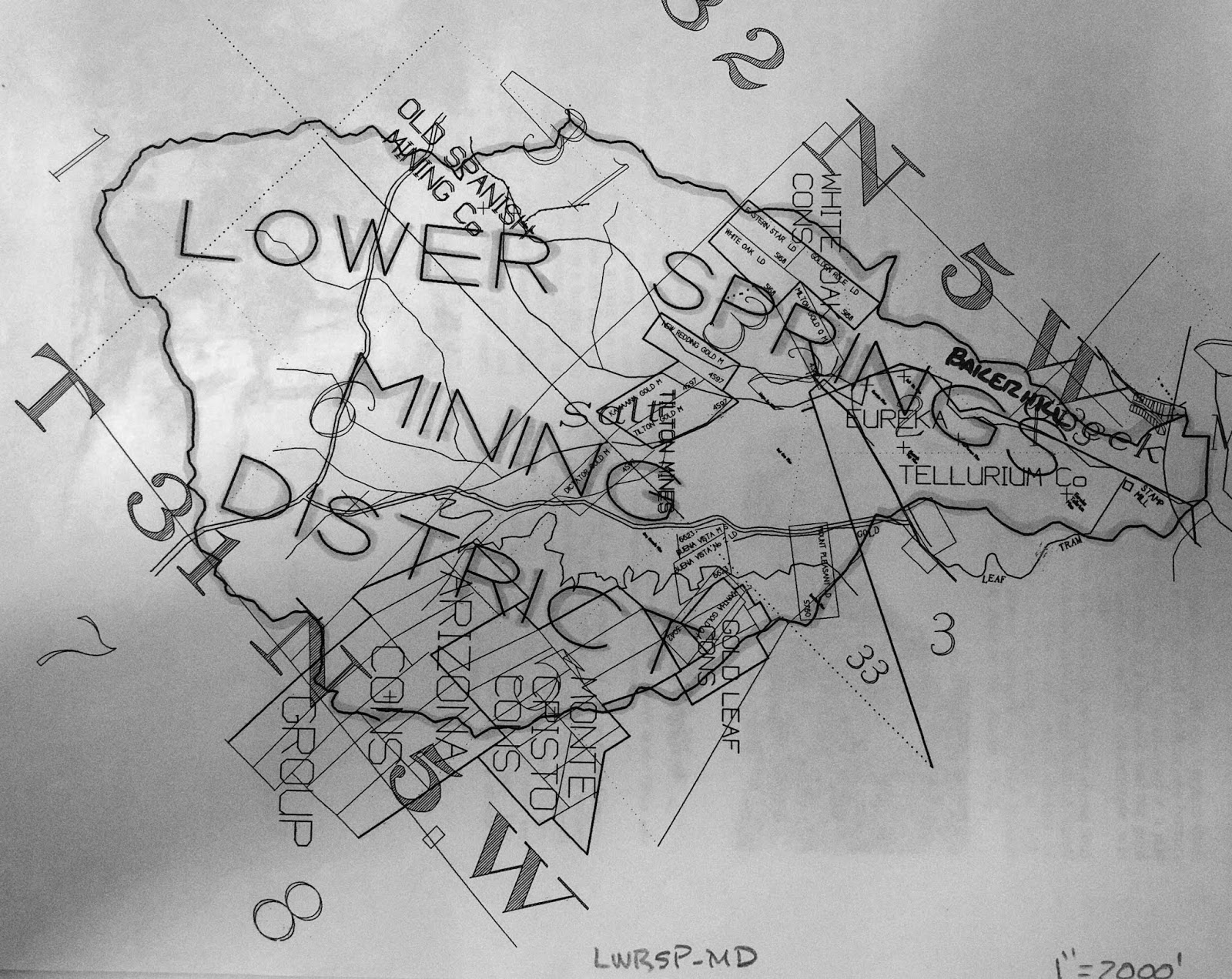
Above: This undated surveyed map shows the boundaries of the Lower Springs mining district and some of the mines included. Please note the name: the Old Spanish Mining Co., of course other mines and companies are noted on it as well. 

In the fall of 1854, a brand new trading post was established at Lower Springs by J.D. Dunlap & Company, and they began advertising their general merchandise store in the local media. Two months later, in December of that year, the first rain eventually fell, and miners had an abundance of water to use. The miners started washing their placer mines and they were making one hundred dollars per day by rocker at that time.


Above: an advertisement for J.D. Dunlap & Company at Lower Springs. This ad is from the Saturday, October 21, 1854 edition of the Shasta Courier newspaper.


The construction of the Clear Creek Ditch, sometimes referred to as the Clear Creek Canal, began in December of 1853. Local miners raised the money to back this large project to convey the water of Clear Creek into the nearby dry diggings of Briggsville, Horsetown, Lower Springs, Muletown, Shasta and Whiskeytown. The ditch connected with a large reservoir which was built as a major part of this project.

Local miners celebrated the ditches completion on November 24, 1855. The length of this ditch measured at sixty miles. The reservoir at Middletown covered fifteen acres to a depth of eight feet. Immediately, the water from this ditch began conveying water into the Lower Springs mining district at Salt Creek. The miners at Lower Springs now had an abundance of water to use in their mining claims.

There wasn't much of a ruckus at Lower Springs between the years 1856 and 1857; however, this community managed to stay relevant. The miners in the area focused on their placer mines, and local businesses advertised their companies in the local media. However, in July of 1857, Swasey’s hotel was still owned by Benjamin Swasey, but it was now under new management. A man by the name of Willam H. Bond was hired by Swasey to manage the hotel for him. Swasey still ran his mercantile store but his extra time was focused on being the public administrator of Shasta County, which is part of the reason he couldn’t manage both the mercantile store and the hotel by himself.


Above: an advertisement for the Administrator's Sale of Real Estate for the estate of T.B. Pritchett, deceased. This estate sale was held on Main Street at Texas Springs, in Shasta County, by Benjamin Swasey, Public Administrator on August 22, 1857. The above ad is from the Saturday, August 8, 1857 edition of the Shasta Courier newspaper.

Two years later, on February 19, 1859, the Shasta Courier newspaper heralded the following article:

“Pottery - The manufacture of pottery has been fairly commenced by Messrs., Bly & Co., at Lower Springs. It is the first manufactory of the kind that we have heard of being established in the Northern part of the State. The first kiln was burned a few days ago. It was entirely successful and the ware is of excellent quality. We have been presented with a large pitcher from this first kiln and we value it highly. It argued well for California to witness the commencement of manufacturing establishments throughout the State - however, humble they may be in their inception. We wish Messrs., Bly and Co., an abundant reward in the pursuit of their laudible enterprise.” (SIC) 

Apparently, the above article by the Shasta Courier newspaper conflicts with previous statements by local historians who claimed that, a man by the surname of Tozure, had owned and operated the first pottery shop at Lower Springs. There's no information to suggest that Tozure was employed by Bly and Company, or that Tozure had become Bly and Company’s successor at Lower Springs. There might have been two different pottery shops at different era's in this community, in operation, because the above article suggest otherwise.

This quiet burg was interrupted one day, in January of 1863, by an affray started by Lawrence O' Connell who assaulted William Thompson over a bottle of strychnine whiskey. This is one incident that the local media frenzied over. It was Thompson who was severely beaten by O’ Connell that day, and after the violent dispute, O'Connell immediately departed Lower Springs for Latona. Thompson traveled to Shasta where he pressed charges of assault against his assailant at the Sheriff’s office. O’Connell was later arrested at Latona by Sheriff John S. Follansbee, and then, Follansbee escorted him to Shasta where he was jailed.

In June of 1863, Jones & Company struck a fine ledge of gold particles on their mining property at Lower Springs. They believed that this ore would carry a high value at the assayers office and it won them quite a bit of praise in the local media. The ledge was measured at twenty-two feet wide, immediately, Henry Jones and his crew sunk a shaft down twenty feet below the surface of the earth. 

As they continued to lower the shaft, the ore they sought after revealed better quality. This discovery brought a boom to the community of Lower Springs, and it became one of the first quartz mines in the Lower Springs mining district. Everything until then had been placer mining, in that area, Jones & Company would soon develop the property further with tunnels, drifts and upraises. Its believed that this former placer mine became the quartz mine known as the Old Spanish Mine.

After this quartz mine was dug out, a number of placer mining properties in the Lower Springs mining district were transformed by miners into quartz mines. In November of 1864, Henry Jones who was one of Lower Springs leading citizens was elected as Supervisor of District 1 of Shasta County, the local media referred to Jones as being “eminently qualified for the position”. That month, a number of large quantity of rocks from the Old Spanish Mine at Lower Springs was hauled to the Spring Creek stamp mill on Spring Creek to be crushed so they can obtain the gold from the quartz rocks.

Then on, Saturday, March 4, 1865, the Shasta Courier heralded the following account of a recent discovery made by Henry Jones: 

“A SWEET DISCOVERY - Last week Mr. Jones, of Lower Springs observes s large number of honey bees working upon the willows in that vicinity, and being quite an expert apiarist, he noticed that in leaving the willows they generally flew in the same direction, and by taking observations from some willows in the vicinity of Mr. Wiser’s garden he saw that the course taken by the bees from the two points converged upon a hill about a half mile from Lower Springs, and upon going to the place, he found the bees occupying a log upon the hill. The log was opened and forty pounds of excellent honey taken therefrom and sufficient left for the bees, which Mr. Jones has taken to his house.” (SIC)

A man named Bert Wiser partnered with a another man by the surname of Terry and together they established an excellent vineyard at Lower Springs. Wiser & Terry were well-known purveyors of wine which became a locally renown favorite of the era. Their wine was bottled at their Lower Springs vineyard and then transported to Wiser’s home at Buckeye, in Shasta County. He lived on the Buckeye Ranch where Wiser & Terry kept a rather large cellar that they stored their wine in. Their wine was labeled as Wiser & Terry, Lower Springs, California.

Another serious affray occurred in this community on March 15, 1865, when a shooting of a Chinaman transpired over an apparent purchase of a mining claim and water ditch. The German settler who apparently sold the property to the Chinaman denied the fact that he had sold him the land. Then the German claimed that he didn't realize the area was an anti-Chinese district. After they quarreled- the German shot the Chinaman in the arm and the feud was settled according to reports, but both parties lived, and no one was arrested.

On September 9, 1865, the local media reported the following; 

"We are advised that there are fair prospects for the erection of a small mill at Lower Springs, this fall. - The good work goes on, and if the people will but prospect, the future of Shasta is assured." (SIC) 

The above quote by the Shasta Courier newspaper is referring to a brand new stamp mill to help crush the rock to obtain the ore from the samples they retrieved. The mining company to establish this new stamp mill at Lower Springs was the Union Company who hired a man by the name of L.A. Kelly to be their superintendent at the stamp mill and supervise their daily operations here. The Union Company's stamp mill wasn't in operation until mid-December. It's not known how many stamps this crusher had.

Between the years 1866 and 1870, there were newer quartz mines which were located in the Lower Springs mining district. The quartz rock from these mines were hauled to the Union Company's stamp mill or the Spring Creek stamp mill. The ore from these mines were assayed at high value, and due to this mining boom these lucrative quartz mines brought new settlers to the area. The Union Company actually began to dig and blast through surface rock to make their own quartz mine at their stamp mill property to prospect.

While the decade of the 1870s and 1880s evolved around the mining district at Lower Springs, the (old) gold mining burg flourished once again as work continued in number of mines in the area. One quartz mine in particular is the Old Spanish Mine, which is located in the Lower Springs mining district. Throughout history, this mining burg never established a post office, and it continued to be prominent into the 1890s, and past the turn of the 20th century. Today, Lower Springs Road retains the name of this once thriving gold rush community and present day Swasey Drive was named after forty-niner, Benjamin Swasey.


Above: In January of 1905, this plat map of the Telluride Consolidated Mine was surveyed by Alfred Baltzell, an U.S. Deputy Mineral Surveyor, for its owners Charles Piftschek, and Anton Herzlieb, of Redding. The Telluride Consolidated Mine embraced the Tellurium Quartz Mine, Diagonal Quartz Mining Claim, and the Hill Gravel and Quartz Mining Claim. All of these were located on the property of Piftschek and Herzlieb.


Legend has it that these iconic palm tree's were planted by pioneer, Benjamin Swasey at Lower Springs, and they grew in front of his Swasey hotel. The palm tree's lasted until the decade of the 1970s when the area was developed and they were uprooted. This photograph was taken in 1972. Courtesy of Shasta Historical Society.


RESOURCES:

1850 U.S. Census

Killed By Indians - The Sacramento Transcript newspaper of Sacramento, April 17, 1851

From The Interior - The Sacramento Daily Union newspaper of Sacramento, May 31, 1852

Lower Springs - The Shasta Courier newspaper of Shasta, March 12, 1853

Diggings About Lower Springs - The Shasta Courier newspaper of Shasta, April 2, 1853

The Lower Springs Road - The Shasta Courier newspaper of Shasta, May 7, 1853

The Ball At Lower Springs- The Shasta Courier newspaper of Shasta, January 21, 1854

J.D. Dunlap & Co. - The Shasta Courier newspaper of Shasta, October 21, 1854

Lower Springs - The Shasta Courier newspaper of Shasta, December 23, 1854

A Serious Difficulty - The Shasta Courier newspaper of Shasta, January 13, 1855

Convention of Shasta County Miners Relative to the Chinese Question - The Shasta Courier newspaper of Shasta, January 20, 1855

Clear Creek Ditch - The Sacramento Daily Union newspaper of Sacramento, October 29, 1855

Clear Creek Ditch Finished! - The Shasta Courier newspaper of Shasta, November 24, 1855

Swasey’s Hotel advertisement - The Shasta Courier newspaper of Shasta, July 11, 1857

Slanderous - The Shasta Courier newspaper of Shasta, February 19, 1859

1860 U.S. Census

Supervisor - The Shasta Courier newspaper of Shasta, November 19, 1864

Quartz - The Shasta Courier newspaper of Shasta, November 26, 1864

A Sweet Discovery - The Shasta Courier newspaper of Shasta, March 4, 1865

Shot - The Shasta Courier newspaper of Shasta, March 18, 1865

Still Another Mill - The Shasta Courier newspaper of Shasta, September 9, 1865

Lower Springs - Union Co. - The Shasta Courier newspaper of Shasta, December 9, 1865

New Discovery - The Shasta Courier newspaper of Shasta, January 6, 1866

Struck It - The Shasta Courier newspaper of Shasta, February 10, 1866

Prospecting Mill - The Shasta Courier newspaper of Shasta, March 10, 1866

Buckeye Ranch - The Shasta Courier newspaper of Shasta, April 1, 1865

1866 California Voters Registration

1870 U.S. Census

1880 U.S. Census

California Journal of Mines and Geology, Volume 10 1890, page 632.

Mining District Near Redding’s Limits - Mineral Wealth Magazine, March 15, 1905

Benjamin Swasey Dies At Home In Oakland - The San Francisco Call newspaper of San Francisco, September 20, 1912

My Playhouse Was A Concord Coach, an anthology of newspaper clippings and documents relating to those who made California history during the years 1822-1888, by Mae Hélène Bacon Boggs. Published by Howell-North Press ©1942

Shasta County, California A History by Rosena Giles, published by Biobooks, ©1949.

Lower Springs by Mabel Frisbie - The Covered Wagon, 1957, published by Shasta Historical Society.

In the Shadow of the Mountain A Short History of Shasta County, California, by Edward Petersen ©1965

Gage-Carter Family Stories, Compiled for Lloyd D. Carter, edited by M. Walsh © October 1990 929.2 Gage/Carter in Shasta Historical Society library

Middle Creek & Lower Springs Mining District 622 Mining, available at the Shasta Historical Society