Showing posts with label Market Street. Show all posts

Sunday, October 4, 2026

TODAY THE CITY OF REDDING TURNS 139 YEARS OLD!


A sweet glimpse of the City of Redding’s beginnings! As the City of Redding celebrates its 139th birthday today, October 4th, this advertisement takes us back to 1887. Oswald Grüttner’s Bakery and Saloon (advertised as O. Grittner), at the corner of Market and Tehama streets, advertised “Nice Light Bread,” candy and confections, along with wines, liquors and cigars.

Published just four days after the city’s incorporation documents were officially filed, the advertisement offers a taste of business life in the newly incorporated City of Redding. Happy birthday, City of Redding! Celebrating 139 years and moving forward into the future.

Source: The Republican Free Press, October 8, 1887

Sunday, July 28, 2024

James Parley Eaton (1859-1916); Proprietor and Pharmacist of Eaton’s Emporium Drugstore in Redding.


James Parley Eaton was born in Boone County, Illinois, in 1859 to James Samuel Eaton and Sarah (Tisdale) Eaton. The entire Eaton clan uprooted their family to Shasta County, California, and they settled here in 1861. James Parley Eaton became well-educated in life and started teaching school in Shasta County, but his passion for medicine grew stronger and he became an apothecary and druggist. His business ventures made him very successful in life. In 1903 he established Eaton's Emporium Drug Store in Redding which he controlled for thirteen years before his death in 1916 and he bequeathed this pharmacy to his children who operated it for another fifty-six years until it was closed in the late 1960s, Until the building was demolished to make way for a new shopping mall in Redding in 1972. Find out more in the video above. [Note: this family has no blood relation to the family of the Shasta County Superior Court Judge, Richard B. Eaton.]


Resources:

1860 U.S. Census

James Parley Eaton in the California, U.S. Voter Registers 1866-1898

1870 U.S. Census

1880 U.S. Census

The Republican Free Press newspaper of Redding, November 3, 1883

Our Merchants - The Republican Free Press newspaper of Redding, December 8, 1883

Death of William L. Eaton - The Republican Free Press newspaper of Redding, August 1, 1885

The Republican Free Press newspaper of Redding, August 15, 1885

1900 U.S. Census

James Parley Eaton in the California, U.S., Voter
Registrations, 1900-1868

1910 U.S. Census

A Shasta Pioneer Dies In Oakland - The Courier-Free Press newspaper of Redding, December 2, 1908

Died - The Oakland Tribune newspaper of Oakland, December 2, 1908

Pioneer Eaton Laid To Rest - The Courier-Free Press newspaper of Redding, December 3. 1908

James P. Eaton Is In Hospital- The Courier-Free Press newspaper of Redding, March 23, 1916

Pioneer Druggist Dies At Early Morning Hour - The Searchlight newspaper of Redding, April 14, 1916

Will of J.P. Eaton Is Filed For Probate - The Sacramento Daily Union newspaper of Sacramento, April 16, 1916

First Telephone Operator Sends Congratulations - The Courier-Free Press newspaper of Redding, January 13, 1927

Eaton’s Enlarge Their Drug Store - The Courier-Free Press newspaper of Redding, April 29, 1929

James Parley Eaton in the California Death Index, 1905-1936

Redding Cemetery Records, Section NW, block W, plot 1

James Parley Eaton in the U.S. Finda A Grave Index, 1600s-current. 

Shasta County, California A History by Rosena Giles, published by Biobooks, ©1949.

Shasta County, California Marriages, 1852-1904

Images of America: Redding by Shasta Historical Society with Al M. Rocca ©2004. Published by Arcadia Publishing. ISBN: 0-7385-2934-6

EP-002 Eaton, James Samuel, Pioneer Plaque File available at the Shasta Historical Society.

Shasta Historical Society Pioneer Record: James Samuel Eaton, dated April 23, 1943

Shasta Historical Society Pioneer Record: Mary Winifred Eaton, dated April 23, 1943


Friday, January 27, 2023

Redding's Chevrolet Automobile Dealership: Thatcher & Lowden.


Above: this circa 1950s photograph was taken by Broderick Haskell, of Redding, which shows the exterior of the second Thatcher and Lowden building located at 1724 California Street. Courtesy of Shasta Historical Society.

Shasta County natives Howard Vilas Thatcher (1900-1968) and his business partner Edward Harold Lowden (1900-1979) was deeply rooted in Shasta County, California, descending from pioneer stock in the region. Thatcher and Lowden were schoolmates of each other until they graduated from Shasta Union High School together in 1918. They had a lifelong friendship together. Eventually, they acquired this car dealership on a transfer from D.D. Desmond and son, early on, in 1929 and during February of 1929, they celebrated the grand opening of their brand-new Chevrolet automobile dealership, parts service, and store which featured Firestone tires and accessories. A business which they called Thatcher & Lowden it was located at 711 Market Street in Redding. 

By 1931 the address of this location was modernized to 1734 Market Street. This lot had two buildings on this property which they utilized, and eventually, they outgrew that location and relocated their business in 1939 to 1724 California Street, at the corner of California and Placer Streets as seen in the above photograph. According to the July 7, 1939, Redding Record Searchlight newspaper, it reported that "they purchased the lot across the street from their sales room and offices on California Street and began the construction of their new station which will be opened Saturday morning. On the west end of the lot is a brick and steel building 50x220. The north portion of the structure will be used for new car storage. Directly in front of it is a used car lot 120 feet wide." [SIC]

In 1941, Thatcher and Lowden employed my paternal grandfather, Myles Kidder Tuggle (1920-2007) as a mechanic and Tuggle began working for the above company at that time. During the year 1961, Lowden sold his interest of their business to Thatcher. Thatcher promoted his son Mark Thatcher (1928-1972) as a co-owner of the company, and he changed the name to Thatcher & Son. Mark previously had eleven years of employment with his father's company, and he held a manager's position within the company as well. Later on, the elder Thatcher retired and sold the business in May of 1964 to John W. Geer of San Francisco. Thatcher’s automotive dealership served the City of Reddling for thirty-five years and is still well-remembered by longtime residents. Afterwords, it was Lowden who became associated in the Lowden medical building, which was located at 2020 Court Street in Redding, which was named for him as well.


Above:  an interior view of Thatcher and Lowden's store at 1724 California Street. Note the Firestone merchandise and advertising. Date unknown. Photographer: Broderick Haskell. Courtesy of Shasta Historical Society.


Resources: 

1910 U.S. Census 

1918 The Shasta Daisy Shasta Union High School Yearbook

Shasta High School Has Many Graduates - The Sacramento Daily Union newspaper of Sacramento, June 10, 1918

1920 U.S. Census 

Chevrolet Agency Is Taken Over by Thatcher & Lowden - The Searchlight newspaper of Redding, February 6, 1929

The Searchlight newspaper of Redding, February 6, 1929

The Courier-Free Press newspaper of Redding, April 18, 1929

1930 U.S. Census 

1931 City of Redding Directory 

1938 City of Redding Directory 

Thatcher & Lowden Open Finest OneStop Service Station in the North - The Courier-Free Press newspaper of Redding, July 7, 1939

1940 U.S. Census 

U.S. WWII Draft Cards Young Men, 1940-1947 for Myles Kidder Tuggle, dated: July 1, 1941.

1950 U.S. Census

Lowden To Manage Properties - The Redding Record Searchlight newspaper of Redding, January 5, 1961

Howard Thatcher To Retire - Sells Auto Firm to SF Man - The Redding Record Searchlight newspaper of Redding, May 2, 1964

Howard Vilas Thatcher Obituary - The Redding Record Searchlight newspaper of Redding, March 26, 1968

1961 City Of Redding Directory


Sunday, May 16, 2021

Market Street Steam Whistle Inauguration Block Party


The Redding Chamber, Viva Downtown, and K2 Development Companies would like to invite the public to witness the inauguration of the Downtown Redding Steam Whistle on Friday, May 21, 2021!


Wednesday, February 24, 2021

CELEBRATING THE GRAND REOPENING OF MARKET STREET IN DOWNTOWN REDDING TODAY!

Celebrate the grand reopening of Market Street in downtown Redding today. The Fences are removed, the streets are set and history will be made at 11:00 a.m. as Market, Butte and Yuba Street reopen to the public.

Tune in to Viva Downtown on Facebook for a live reopening ceremony for the Downtown Redding Streets Circulation Project. 

After 12 p.m. cars will officially have access to drive down the streets and see their beautiful Downtown Redding. 

Visit www.city of redding.org/downtown 

The City of Redding


Thursday, December 3, 2020

HARRY WARD GLOVER AND THE GLOVER HOUSE OF REDDING


Harry Ward Glover stands beside his building in front of Glover's Garage on the south-west corner of Market and Placer Streets in Redding. Circa 1920's. Courtesy of Shasta Historical Society.


Harry Ward Glover, a native of Oakland, Alameda County, California was born on May 8, 1879 to English parents James Glover and Sarah (Hyde) Glover. His family lived in Sacramento in 1880 where his father was employed in stamping to provide for his family. Harry was the youngest of two children born to them. His older brother Herbert was born to his parents about two years before him.

At the age of 21, in 1900, Harry was living in Redding as a boarder under the household of Daniel F. Adams, a local hostler in the area, Adams was married to his wife Bella. At this time Harry was single and he was working as a blacksmith, eventually he began dating Christine Sutherland and they were married in Redding on September 29, 1904. Together the newlyweds purchased a house at 1308 Pine Street which was erected in 1900, and it became their home.

In 1906, Harry was elected as a Shasta County Deputy Assessor as well as becoming Redding’s Fire Chief, on June 15, 1906. Glover was succeeded as Redding's Fire Chief by Eugene A. Urban on December 17, 1906. Then in 1907 Harry purchased Peter Glaszer's blacksmith shop at the southwest corner of Market and Placer Streets. Glover closed the blacksmith shop and turned it into a garage in 1912, and he became an agent for Hupmobile, Maxwell, Mitchell, Star and Studebaker automobiles. On April 15, 1912, Harry Ward Glover was elected as the tenth mayor of the City of Redding, and he served the position honorably until April 20, 1914 when he was succeeded by L.F. Morton. 

When the 1920 U.S. Census was enumerated on January 8, 1920, for their neighborhood in Redding, it showed that Harry and Christine had a daughter during the interim named Maida who was eight years old at that time. Ten years later, when the 1930 U.S. Census was recorded it documented the Glover family was still living at 1308 Pine Street. During the 1930's, Harry was active within the local chapter of the Redding Kiwanis club and he served as president of this club as well.

Years later, Glover's dealership closed down when he retired. Harry died in Redding on June 10, 1946. His wife Christine (Sutherland) Glover survived her husband by three years and died on March 4, 1949. This residential house still stands and it's now home to commercial offices next to the iconic Damburger restaurant of Redding.


Above: Glover's Garage on the south-west corner of Market and Placer Streets in Redding. Circa 1920's. Courtesy of Shasta Historical Society.


Above: the present day Glover house at 1308 Placer Street in Redding is now a commercial building and is located on the right side of Damburger. This photograph was taken by Jeremy Tuggle on November 28, 2020.


RESOURCES: 


1880 U.S. Census

1900 U.S. Census

1904 City of Redding Directory

1910 City of Redding Directory

1910 U.S. Census

U.S. World War I Draft Registration Cards, 1918 for Harry Ward Glover.

1920 U.S. Census

The Courier-Free Press newspaper of Redding, January 4, 1925 on file in VF 979.234 Town Redding - Historical Information, available at the Shasta Historical Society.

1930 U.S. Census

1938 City of Redding Directory

1940 City of Redding Directory

1940 U.S. Census

U.S., World War II Draft Registration Cards, 1942 for Harry Ward Glover.

California U.S., Death Index 1940-1997 for Harry Ward Glover

California U.S., Death Index 1940-1997 for Christine (Sutherland) Glover

City of Redding Mayor's Since 1887

Glover's Garage Leased by Gene Franck and Wife - The Courier-Free Press newspaper of Redding, January 7, 1940

The Sacramento Bee newspaper of Sacramento, March 5, 1949

Wednesday, June 10, 2020

The Temple Hotel

On June 12, 1891, the San Francisco Call newspaper published the following column about the future Temple Hotel and Masonic Lodge of Redding:

“Another Masonic Temple

The Redding Lodge Branching Out In Grand Style.

The Masonic Building Association of Redding has so far completed arrangements as to order the signing of the contract for the erection of the Masonic Temple in that place. It will be a four-story edifice, the two lower stories for rent, and third floor for Masonic uses, with lodge-rooms ample for all higher degrees, Knights Templars, etc., banquet-rooms and library rooms. It will be the finest building of its kind north of San Francisco. The Masons of Redding are hopeful that the building will be completed by September or October, before the Grand Lodge meeting. The Grand Lodge will be asked in due time to lay the cornerstone, with the Masonic fraternity and military assist. The Redding Lodge intends that it shall be the pride of the fraternity and the event of all Masonic events in the northern portion of the State.”

The Temple Hotel’s cornerstone was laid on August 6, 1891, by the Redding Lodge of Masons for the Masonic Building Association, on the southeast corner of Tehama and Market Streets. In 1894 the construction on the Temple Hotel was completed and the Masonic Building Association opened their new hotel and lodge. It was a gothic style four-story building with a basement and it featured the Masonic symbol at the top of the building. The hotel included one hundred rooms for its guests and one bathroom in the entire building, however, porcelain potties were provided under each bed for their use. The third and fourth floors of the building were reserved for Masonic members. The Masons utilized the majority of the hotel. At one point, the Masonic Building Association began transporting travelers from the Temple Hotel to the Redding Depot on Yuba Street with their own wagon and it remained a custom of the hotel for many years.

The Masonic Building Association employed Henry Clineschmidt to conduct the everyday business of the hotel and Masonic Lodge. His wife Nancy (Ritchie) Clineschmidt assisted her husband when he needed her help, and of course additional employees were hired. The Clineschmidt’s were permanent residents of the hotel.


Above: the Temple Hotel of Redding, date unknown. Courtesy of Shasta Historical Society.

The hotel included a barroom which was stocked with the finest liquor and cigars. The Masonic Building Association hired F.A. Nauman to tend their bar. Nauman was still employed by them in 1898. By the following year the Temple Hotel was advertised as a first class establishment with first class table service and airy and pleasant rooms. The hotel room rates were one dollar per day and upwards while meals were offered at twenty-five cents a plate.

After the turn of the century, the Temple Hotel included the Temple Barbershop owned and operated by W.J. Scott, which was located on the main floor. It was still in business by 1904; however, it was a short-lived business venture. The barroom inside the hotel always kept busy. Two years later, on January 2, 1906, the Temple Hotel and Masonic Lodge were sold by the Masonic Building Association to Henry and Nancy (Ritchie) Clineschmidt for a total of $24, 000. Now the Clineschmidt’s not only operated the hotel - they owned it.

Over the years the hotel hired a number of employees to work as bell hops for both day and night shifts and night clerks for the hotel. In 1907, a popular night clerk at the Temple Hotel, Harry Grant, disappeared after robbing the cash register of $40. The story made headlines, but Clineschmidt chose to not press charges against the young man. Henry Clineschmidt and his wife continued to operate the hotel until her death May 13, 1918, and his death February 1, 1919. At this time his son Henry Clineschmidt Jr., along with his wife Luella, became the owners.

By 1931 the Temple Hotel had a registered address at 1401 Market Street. During the 1930s, the Clineschmidt’s brought in new businesses to the main floor of the hotel. These included the Temple Barbershop, whose proprietors were Elliott & Height, and the Temple Hotel Beauty Shop, which was owned and operated by Ell Feuz Eliz Carney, and the barroom became the Temple Lounge, which was owned and operated by A.V. Pearson.

In 1940 the Temple Lounge changed hands and Charles Bragg became the new proprietor. In 1948 the Temple Hotel was one of four major hotels in the area; Redding also had six smaller hotels in operation at that time. By 1951 owning and operating the hotel became an extended family affair with Henry Jr.’s brother Robert L. Clineschmidt stepping in to help his brother and sister-in- law. The Clineschmidt’s resumed control of the Temple Lounge. Matters at the Temple Hotel and Masonic Lodge stayed the same through-out the 1950s and into the 1960s.

The Masons still used the hotel and lodge for a number of events through the years. In 1964, the Temple Hotel was torn down as part of the first phase of the downtown revitalization plan of the 1960s to create the downtown Redding Mall, which wasn’t built until 1972. Today, the only thing left of the Temple Hotel is the basement which was used to store choice wines, bourbon and other alcoholic beverages for sale in the Temple Lounge.


RESOURCES:

Another Masonic Temple – The San Francisco Call newspaper of San Francisco, June 12, 1891

New Masonic Temple – The Sacramento Daily Union newspaper of Sacramento, August 7, 1891

The Red Bluff News newspaper of Red Bluff, March 4, 1898

1899 City of Redding Directory

Redding Hotel Man Assaults A Constable – The San Francisco Call newspaper of San Francisco, April 5, 1902

Masonic Hall Is Sold For Big Price – The Sacramento Union newspaper of Sacramento, January 3, 1906

Hotel Man Is Arrested – The Sacramento Union newspaper of Sacramento, April 6, 1906

Redding – The Chico Record newspaper of Chico, June 5, 1906

Night Clerk Gone – The Sacramento Union newspaper of Sacramento, May 5, 1907

1931 City of Redding Directory

1938 City of Redding Directory

1940 City of Redding Directory

1948 City of Redding Directory

Henry Clineschmidt Sr., Find A Grave Memorial

Images of America: Redding by Shasta Historical Society with Al M. Rocca ©2004. Published by Arcadia Publishing. ISBN: 0-7385-2934-6


Monday, February 17, 2020

A REDDING BUSINESS MAN, MANLEY MORRISON BROWN

A farmer by the name of Ephraim Brown, and his wife Lorilla (Lillie) Brown, brought their family out west from Cortland County, New York in 1866 and they settled at French Gulch, Shasta County, California. Ephraim continued to pursue his career as a farmer at their new place. Ephraim and Lorilla remained in French Gulch. Ephraim died in 1875 and his wife Lorilla died in 1901, they are both buried in the French Gulch Cemetery. To this union, seven children were born between 1825 and 1844, respectfully. Five males and two females. Their names are the following:

1. Elsie Brown (1825-1907) married Alfred G. Bennett

2. William L. Brown (1830-1915) (Was a butcher at Redding and a resident of French Gulch in 1880.)

3. Zenas Lillie Brown (1830-?) married Louise Bastraum (Was a ferryman at Buckeye in 1877.)

4. Morrill Clay Brown (1833-?) (Was a farmer at French Gulch in 1880.)

5. Cyenas L. Brown (1836-?) (Was a farmer in French Gulch in 1880.)

6. Manley Morrison Brown (1838-1901) married Lucetta Russell

7. Caroline Brown (1844-1927) married William Watson

While some of their grown children wanted to mine for gold. French Gulch was a booming mining community and gold fever was strong there during the late 1860s, which also had a mining district named after the town. Manley Morrison Brown, who is the main subject of this article, was born on February 22, 1838 in New York. He married his wife Lucetta Russell in 1864. Then he registered to vote on April 20, 1867, in French Gulch at the age of twenty-nine. This is where he lived and worked as a miner mining for gold.

Three years later, Brown is living with his own family in Lewiston, Trinity County, California where he was working as a laborer in a local market. At that time, Manley and Lucetta had a daughter born to them named Ella. Manley’s older brother William was also living with them, at the age of forty, and he was noted as a cattle driver.


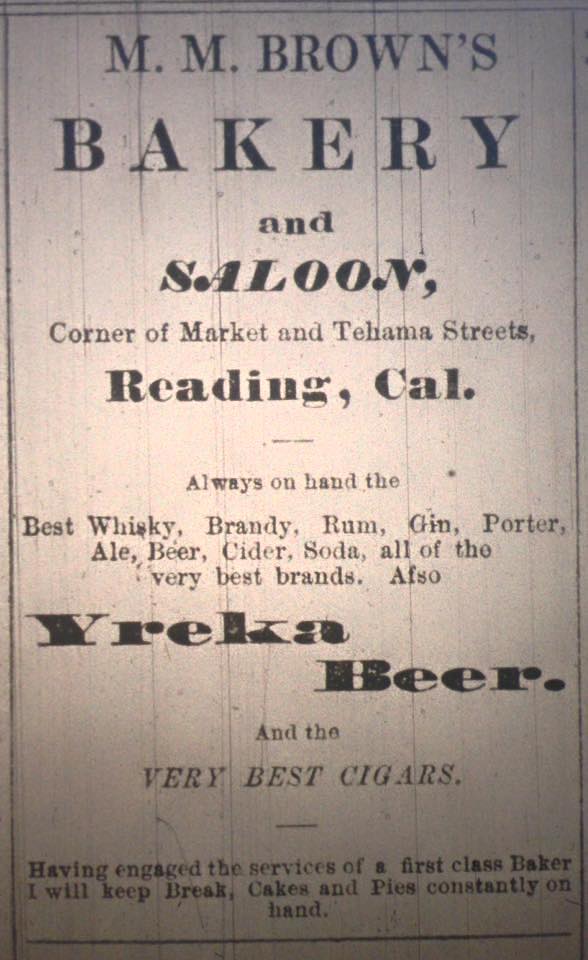
Above: an advertisement for Manley Morrison Brown's Bakery and Saloon at Reading (Redding), California. From the August 8, 1878, edition of the Reading Independent newspaper of Redding.

By the age of thirty-six, in 1875, Manley was employed as a ferryman and living at the town of Buckeye with his family, minus William Brown. His career as a ferryman was short lived and his family relocated to Redding. Two years later, Manley opened a bakery on the corner of Market and Tehama Streets in Redding. His bakery was called M.M. Brown's Bakery and Saloon.

Manley M. Brown sold delicious cakes and pies which he made fresh himself. Brown was also in competition with some of the saloons in town because he also served alcohol, cigars and the locally renowned Yreka Beer at his bar inside the bakery. Then on September 5, 1878, the Reading Independent newspaper reported the following:

"Manly Brown has sold his dwelling, saloon and bakery to Grittner,of Igo. Manly made a nice profit on this trade, but we doubt if he can put the sum received - $2,000 - where it will do more good. We understand that Mr. G. is a first-class baker." (SIC)

While in Redding his daughter Ella attended the Redding Public School. After he sold his business he took some time to travel locally visiting family and friends in French Gulch and Shingletown. Then on, October 2, 1879, the local newspaper mentioned the following transaction involving Manley Morrison Brown:

"B.H Scott has sold his business to M.M. Brown and Hank Whitmore - both enterprising men." (SIC) Brown and Whitmore were now the owners of a new meat market in Redding called the “New Meat Market!”. They sold fresh beef, pork, mutton, pork and corned beef. They were located on Market Street one door south of the Good Templars hall.


Above: the “New Meat Market!” proprietors: Brown & Whitmore. This advertisement is from the October 2, 1879 edition of the Reading Independent newspaper of Redding. 


Later on, in February of 1880, Brown purchased Frank Whitmore's interest and became the sole owner of this meat market in Redding. At the time he was running a first-class butcher shop and he decided to bring in his older brother William L. Brown to assist him. It was William who superintended the business affairs in the shop while he lived in French Gulch.

By the time the 1880 U.S. Census was enumerated on June 4, 1880, they had resettled in a house on Pine Street. Manley lived there with his wife Lucetta, daughter Ella, and their young sons Lewis and Dewit. He also had a servant living in the household by the name of Belle Mallom who was also a cook. It’s more than likely that Manley’s young sons attended school in Redding as well, like his daughter did.

By 1886, Manley relocated his family from Redding to Sims in the Sacramento River Canyon and he became a merchant there. Sims was a little community sometimes referred to as Southern. Later on, Manley relocated his family north to Dunsmuir, in Siskiyou County.

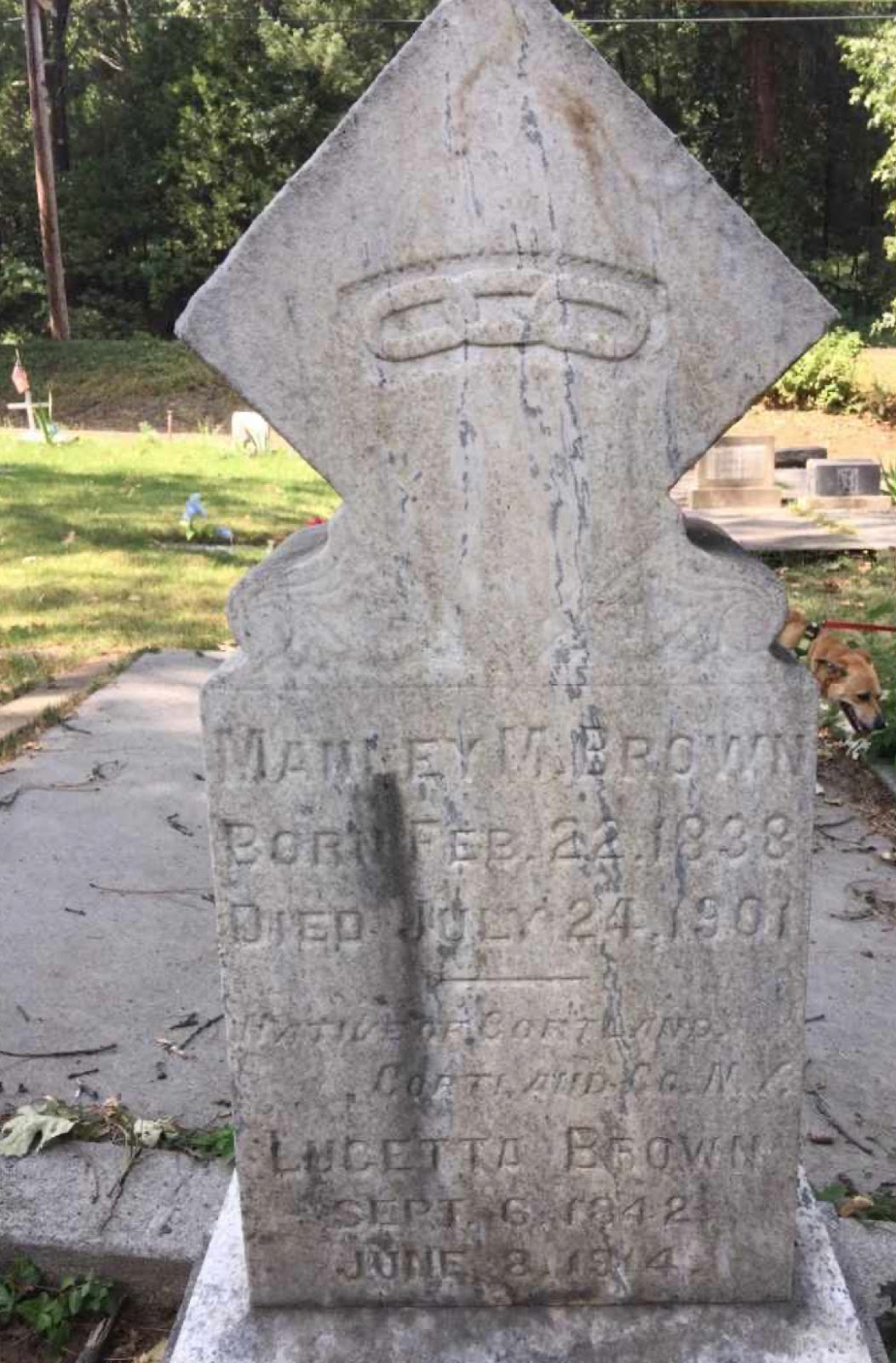
Then in July of 1900, Dunsmuir had a destructive fire that caused approximately $12,000 in damages and he lost his home and an additional building that he owned in that ravaging fire. Both of his places were covered by insurance. The following year, the pioneer died on July 24, 1901 at the age of sixty-three. He is buried in the Dunsmuir City Cemetery next to his wife, Lucetta, who survived him and died in 1914.


Above: Brown burial plot at the Dunsmuir City Cemetery. Photograph taken by Jeremy Tuggle on May 14, 2016.


Above: the headstone of Manley Morrison Brown and Lucetta (Russell) Brown at Dunsmuir City Cemetery. Photograph by Jeremy Tuggle on May 14, 2016.


RESOURCES:


California Voters Register, 1866

California Voters Register, 1867

1870 U.S. Census

California Voters Register, 1875

1880 U.S. Census

California Voters Register, 1886

The Reading Independent newspaper of Redding, August 8, 1878

The Reading Independent newspaper of Redding, September 5, 1878

The Reading independent newspaper of Redding, October 17, 1878

The Reading Independent newspaper of Redding, April 17, 1879

The Reading Independent newspaper of Redding, September 3, 1879

The Reading Independent newspaper of Redding, October 2, 1879

School Report - The Reading Independent newspaper of Redding, December 11, 1879

The Reading Independent newspaper of Redding, February 6, 1880

Costly Fire At Dunsmuir - The Press Democrat newspaper of Santa Rosa, July 18, 1900

Mrs. Brown, Pioneer, Dies In Dunsmuir - The Sacramento Union newspaper of Sacramento, June 10, 1914


Tuesday, December 3, 2019

Redding's Christmas Tree: A Local Tradition Since 1919


A crowd gathers to attend the lighting of the Redding Christmas tree in 1933. The tree is topped with a neon star. Courtesy of Shasta Historical Society.


This holiday favorite was originated in 1919 by the Pacific Gas & Electric Company (PG&E), who cut the first evergreen to be placed on display in the city from McComber Lake in Shasta County. The tree was then transported by truck to the intersection of Market and Yuba Streets in downtown Redding for its placing. The tree could be of any size if they were fully branched without missing spaces. The Christmas tree would often stay standing until after the New Year had arrive, then it was dismantled.

Each year, the tree was crowned with a beautiful neon star on the top of the tree. Then in December of 1929, the Redding Christmas tree was measured at 73 feet high, and it was donated to the PG&E by two residents from La Moine. The date of December 20th, 1929 was selected for the big party at the intersection of Market and Yuba Streets. 

To help the Pacific Gas & Electric Company, a general committee was organized about 1930 which was comprised of Mayor William Menzel, Chairman; Ben Mason, and K.A. Walker. This committee would organize the upcoming Christmas tree festivities and other Christmas events. New delegates would be chosen to this committee in the future as well. In 1930, twenty-five hundred boxes were ordered to place gifts inside them for the children of Shasta and Trinity Counties in Redding, and gifts were purchased to be placed inside these boxes. 

Officials selected November 28th, 1930 for the beginning of the holiday season, in which Redding stores celebrated by decorating their window displays and buildings for Christmas. Also, some stores reduced their prices as well. Stores along Market Street stayed opened later to attract as many customers as they could. Hundreds of people gathered to be present for the highlights that evening while Redding lacked a Christmas tree. It was S.G. Nelson of the McCormick-Saeltzer Company who donated the Christmas tree which he planned on cutting down with the help of W.D. Simons, Earl Lee Kelley, K.A. Walker, Dr. H.C. Erno, Ben Mason, James Holt, Mayor William Menzel, Augustas H. Gronwoldt and Lyle Sarvis. The tree was transported to Redding from La Moine by the Pacific Gas & Electric Company in one of their trucks. Later, the Christmas tree was dedicated on December 15, 1930.

Each year, new ideas were presented, and the dates were pushed back earlier, or moved forward later for the lighting of the Redding Christmas tree and other festivities to be included during this joyful event. The intersection of Market and Yuba Streets was used up until 1970 (a total of fifty-one years) according to several Shasta Historical Society members who remembered it well. The Christmas tree was relocated around that time period to the parking structure on California Street (which is now being demolished). The construction of the downtown Redding Mall is the reason why the Christmas tree was relocated there. The downtown Redding Mall was opened by August of 1972.

After forty-nine years, the Christmas tree will be back in its original location at Market and Yuba Streets on December 6, 2019 which will be dedicated that night at Winter Fest. Older residents still recall and cherish their memories of having the Christmas tree at that location. This time, a whole new generation will be able to create memories with their families and loved ones at the original site. This year also marks the one hundredth anniversary of this Christmas tradition. 


The green paint on the ground represents where the Christmas tree will be dedicated at Market and Yuba Streets on December 6, 2019 during Winter Fest. This photograph was taken by Jeremy Tuggle on November 7, 2019.


RESOURCES:

Redding To Have Giant Christmas Tree For All Children Of The County - The Courier-Free Press newspaper of Redding, December 11, 1925

Redding Community Tree Is 73 Feet High - The Courier-Free Press newspaper of Redding, December 16, 1929

Christmas Party's Leaders Named - The Courier-Free Press newspaper of Redding, November 22, 1930

Christmas Season Opens At 7:30; Visit Redding Stores Tonight - The Courier-Free Press newspaper of Redding, November 28, 1930

Christmas Opening Crowds Local Stores - The Courier-Free Press newspaper of Redding, November 29, 1930

Party Organized To Get Christmas Tree For Christmass Fete - The Courier-Free Press newspaper of Redding, December 9, 1930

Christmas Tree Put Up On Monday - The Courier-Free Press newspaper of Redding, December 15, 1930

The Covered Wagon 1954, published annually by Shasta Historical Society.

The Christmas Tree - The Shasta Shopper, December 17, 1987

Redding's Christmas Tree is finally coming home - and staying downtown, by David Benda, The Record Searchlight newspaper of Redding, November 2, 2019

A Timeline of Redding Development Growth Destruction and Rebirth by David McCullough

Thursday, August 15, 2019

The Pacific Telephone and Telegraph Company Building; and the History of the Telephone in Redding


Above: 1629 Market Street in Redding, the Pacific Telephone and Telegraph Company building. This photograph taken by Jeremy Tuggle on August 3, 2019.

The building at 1629 Market Street in Redding was the official headquarters of the Pacific Telephone and Telegraph Company, which is still in use to this day, according to Redding Electric Utility. This building is located in between Yuba and Placer Streets on the east side of Market Street. This building often attracts the attention of the public regarding its history and use. I’ve received quite a number of inquiries about it over the years and have retold its history each time.

The building itself is a commercial building and has an intriguing architectural design, called Tudor Gothic. The architect of this building was J.P. Brennan who erected the building at a cost of $60,000. The first process towards the erection of this building occurred on March 13, 1926 when a topographical and delineative survey was conducted on the one-hundred-foot lot for the purpose of furnishing information to the architect to design the plans for the building.

Then on April 30, 1926 it was announced by George Wahl, manager, of the Redding Pacific Telephone and Telegraph Company, that the plans were completed. Wahl also mentioned to the local media that the actual start of construction would begin in May of that year. It was also reported that their new building was going to be a first-class semi-fireproof one-story structure with a basement.

During May of 1926 the initial construction took place and continued for the next eight months. Then on, January 12, 1927 the building was dedicated, and it opened for business the same day. The Pacific Telephone and Telegraph Company was the second telephonic service company in Redding which dates to 1898 when their original location was inside the Swasey building on Yuba Street between Market and California Streets. In 1907, the company relocated into a building at 504 California Street. After spending twenty years in their California Street location their new building on Market Street was ready for them to move in, and on January 12, 1927 it also marked forty-seven years of telephone progress in the City of Redding.


In 1978, the Western Electric Company began operating their business in the basement of this building, according to the City of Redding Directory, this company's time was cut short in this building. During the 1970s the Pacific Telephone and Telegraph Company featured a traffic department and a toll department. Both companies utilized this building until 1980. By 1981 the building became vacant after the Pacific Telephone and Telegraph Company spent fifty-four years in this building. In 1982, they moved to a new location at 1514 Market Street and their name appeared to be shortened to the Pacific Telephone Company at that time. During the early 1990s AT&T Communications moved into this building, and continued telecommunications in the Redding area.


Above: the Bell System logo on the front entrance to the building of 1629 Market Street in Redding. This photograph was taken by Jeremy Tuggle on August 3, 2019.


Above: the full length front of the building at 1629 Market Street in Redding. A view of the business office in the north-east corner of the building. Customers were able to place local and long distance calls here. This photograph taken by Jeremy Tuggle on August 3, 2019.


THE HISTORY OF THE TELEPHONE IN REDDING:

A man named Charles E. Berry, a local tinner, installed the first telephone at Redding in 1880. According the 1880 U.S. Census he resided at 216 East Street with his wife Aarilla and their three children. A crude telephonic instrument was invented by Berry who strung a copper telephone line from his house on East Street to his tinnery shop on Yuba Street. 

Now Berry was able to communicate with his family from work each day. By June of 1881, several of these crude telephones were modeled after Berry’s design, which was never patented, but his design was used around Redding. Among the people and businesses who had them were the following: Doctor O.J. Lawry, a physician and surgeon, who installed a telephone line at his residence to connect with the Gleaves and Averill drug store owned by Redding druggist James M. Gleaves, and Redding dentist, George W. Averill.

Harry Parker who was employed as an operator for the Postal Telegraph Company, also installed a telephone line from the Redding railroad depot to the Gleaves and Averill drug store. Telephonic communications in Redding were booming, and everyone wanted to ride the wave.

By 1884, Berry’s design was improved by Redding resident E. Newton Eaton, a brother to Redding druggist James P. Eaton, who according to the local media “constructed a single wire line using iron wire between the store of Gilbert, Miller and Eaton and the residences of S.J.R Gilbert, Dr. Miller and James P. Eaton. The instruments were made of tin, with an opening in front which was the transmitter and receiver across back of the box, which had been left open. A piece of rawhide was stretched to form the diaphragm and the end of the wire was run thru the diaphragm in the center and fastened inside the box. Later, the rawhide was replaced by a piece of drumhead which Eaton secured for the purpose and which improved the instrument. No batteries were used. The sound being carried purely by the vibrations from the diaphragm. A code of taps for signals was arranged and this served the purpose of the phone bell.” (SIC) E. Newton Eaton had stated that the transmission of the voice was fine, it was clear, and it carried down the line.

However, sometimes an electric shock was generated between the users of this crude device. Five years later, E.W. “Pike” Roney constructed a grounded telephone circuit for the Enright Lumber Company at Bella Vista which was installed between that town and their yard in Redding. This was a line used by company officials only. The installation process that Roney used to create this telephonic line was: “black iron balling wire, salamoniac batteries and Bell company instruments secured from the Bell Telephone Company. Another instrument was connected to this line and located in the apartment of Vuave, assistant superintendent for Enright”. (SIC)

Preceding the Pacific Telephone and Telegraph Company in Redding was the Sunset Telephone and Telegraph Company which had their initial start in 1894. This company began using what’s known as the village or automatic system which proved inefficient. Telephone customers who used this system had to handle the switching by themselves in Redding. There were no official switchboard operators then. Later, a switchboard was installed in Eaton’s Drug store which was then located in the Bergh building on California Street and owned by James P. Eaton. The first official switchboard operator who handled the above switchboard was Redding resident Arvilla (Thompson) Paulsen, a daughter of Philip C. Thompson and Ida (Kelley) Thompson.

In 1897, there was 87 telephones in operation and connected to this switchboard. As the “hello” boom flourished in Redding the Sunset Telephone Company promoted their telephone services even more and brought the tally to 100 telephones in operation by the end of that year. In May of 1898, telephonic communications were enhanced when the San Francisco to Redding line was connected by long distance. Later, the Redding to Portland line began serving the public. A year later the City of Redding had 135 telephones in operation. Rapid growth of telephonic systems in Redding has changed drastically over the years far exceeding the initial design by Alexander Graham Bell in 1876, when he received a patent for it that year. 


Resources:

1880 U.S. Census (Note: Charles E. Berry is also found as Charles E. Bong but has been corrected on Ancestry.com as Charles E. Berry.)

1881, History and Business Directory of Shasta County, California

Early Installations and Telephone Development in Redding and Shasta County, written by Tessie Coughlin, December 12, 1924. On file at the Shasta Historical Society  in VF 621.0 Utilities.  (621.382 Call Number)

Telephone Co. Can Now Build On Hoff Lots - The Courier-Free newspaper of Redding, January 8, 1926

First Work Is Done Towards Erection Of Telephone Building - The Courier-Free Press newspaper of Redding, March 13, 1926

$60,000 Pacific Telephone, Telegraph Building To Be Erected In Redding - The Courier-Free Press newspaper of Redding, April 30, 1926

Contract For Construction Of Telephone Building Let - The Courier-Free newspaper of Redding, May 24, 1926

New Building Marks 47 Years Of Telephone Progress Here - The Courier-Free Press newspaper of Redding, January 11, 1927

The Telephone Company Occupies Its New Building Wednesday, January 12th - The Courier-Free Press newspaper of Redding, January 11, 1927

New Telephone Building, Costing $60,000, Opened - The Courier-Free Press newspaper of Redding, January 12, 1927

First Telephone Operator Sends Congratulations – The Courier-Free Press newspaper of Redding, January 13, 1927

History of Telephones in Shasta County by Peggy Kesterson. On file at the Shasta Historical Society in VF 621.0 Utilities, 1973-1974.

1938 City of Redding Directory

1948 City of Redding Directory 

1958 City of Redding Directory 

1968 City of Redding Directory

1970 City of Redding Directory

1973 City of Redding Directory

1974 City of Redding Directory

1977 City of Redding Directory

1978 City of Redding Directory

1981 City of Redding Directory

1982 City of Redding Directory

1984 City of Redding Directory

1985 City of Redding Directory

1986 City of Redding Directory

1988 City of Redding Directory

1990 City of Redding Directory

1991 City of Redding Directory


Friday, January 11, 2019

ABANDONED, UNCOVERED AND THEN RE-INTERRED: A REDDING CEMETERY


Believe it or not, this location at 2146 Pine Street in between Market and Pine Street in Redding was home to Redding's first cemetery. It's on the flatter surface of this knoll. This photograph was taken by Jeremy Tuggle on December 12, 2018.

Redding was established by the California & Oregon Railroad, a division of the Central Pacific Railroad, on June 15, 1872. Once the construction of the railroad resumed north from Anderson, the railroad company decided to bypass this burial ground, and make its way north to Poverty Flats where the construction stopped that year. This cemetery was now on the outskirts of the brand new town at the southern end. 

The first streets in town which were laid out by the railroad company was North, South East and West Streets followed by the nearby counties Placer, Tehama, Butte, and Yuba Streets. While Redding grew larger with additional streets and the development of Pine and Market Streets it brought more commercial businesses and private residences to town. The town grew into a flourishing city and this cemetery became an oft-forgotten location. It's a site of historical importance because it was Redding's first cemetery which a lot of people tend to over-look in Redding's early history. Over the years, the cemetery has been called the Redding Abandoned Cemetery. Today, the site is the former home of Biggins Lighting who just recently relocated to Larkspur Lane in Redding.

Since the cemetery's establishment in 1867, this piece of land became the final resting place of some of our counties early pioneer settlers for nearly thirty-nine years when it became abandoned and then rediscovered in 1906. At Shasta Historical Society, there are volumes of interment records for Shasta County cemeteries and among these are the records for this cemetery. It was Samuel Dinsmore, a young man, who died on April 24, 1867, at Dinsmore's ranch due to consumption at the age of twenty-five and he became the first interment into this newly established cemetery. Samuel Dinsmore was the eldest of four children born to John W. Dinsmore and Arabella (MacGlashon) Woodrum-Dinsmore. 

Together, the John W. Disnmore family arrived in Shasta County in 1852, and they settled at Shingletown. John W. Dinsmore was a millwright who is noted with erecting the Dry mill at Shingletown in 1853, with his partner Merriman Ferrel, a brother to his future son-in-law. Then in 1857, John W. Dinsmore purchased land from Major Pierson B. Reading, this land was part of the Rancho Buena Ventura land grant. According to Shasta County historian Madge R. Walsh, "Dinsmore located his home, the Four Mile House, about four and a half miles east of Shasta, on the west side of the stage road where it divided to go east to Green's Ferry, or south to Tehama via Canyon House. He had built his house before paying for the property, as it was already extant when the deed was recorded. Today, the site is about a quarter mile west of the junction of Highway 299 W and Ridge Drive." 


The headstone of Samuel Dinsmore whose remains were re-interred into the Redding Cemetery (now Redding Memorial Park). His name is misspelled as Samnel. He is buried next to his sister Angeline (Dinsmore) Ferrel (whose surname is misspelled as Ferrell. Ferrel is the correct spelling. There are no dates on this headstone. This photograph was taken by Jeremy Tuggle August 28, 2014.

Later that year, Arabella Ferrel, a niece of Samuel Dinsmore, and a daughter of Henry Clay Ferrel and Angelina (Dinsmore) Ferrel died at Balls Ferry, at the age of eleven from congestive chills on July 27, 1867. Henry Clay Ferrel is my paternal great-great-great uncle, and his daughter became the second interment at this former cemetery. Henry C. Ferrel, was a native of Ohio, and he arrived in Shasta County in 1853. He was married in 1854 to Angelina Dinsmore. In 1860, they were living at Shasta, Henry C. Ferrel was a miner by trade.


This is the headstone of Arabella Ferrel, a daughter of Henry Clay Ferrel and Angelina (Dinsmore) Ferrel who was re-interred at the Redding Cemetery (now Redding Memorial Park). The Ferrel surname is spelled correctly here. THIS IS NOT THE FIRST BURIAL IN REDDING MEMORIAL PARK.  Note: Redding Memorial Park was established in the 1890s. This photograph was taken by Jeremy Tuggle on August 28, 2014


The death notice of Joseph W. Brackett who died March 27, 1875 at Redding, he was a local lawyer. He was a son of Joseph Warren Brackett and Lydia (Miller) Brackett. His funeral was conducted under the supervision of the Masonic fraternity, of which he was a member. He was survived by his wife and a large family to mourn his loss. Taken from the Shasta Courier newspaper, Saturday, April 3, 1875.

The following is a confirmed listing of burials which took place between the years 1875 and 1877 and all of them were re-interred into the Redding Cemetery (now Redding Memorial Park);

Joseph W. Brackett died March 27, 1875
Emory Farhner died March 20, 1876
Ethol F. Wood died February 15, 1877
Annie Guilbert died July 20, 1877  (has no death notice, nor headstone.)

Six years after the turn of the 20th Century on February 13, 1906, the Redding Water Company rediscovered parts of the original cemetery when they were lowering the manes in that section of Redding. The majority of these burials above were re-interred into the Redding Cemetery (now Redding Memorial Park), that year. It was heralded across the state as a gruesome discovery, as their employees were finding the original coffins which were still intact and the headstones.

The local media claimed there were seven burials which had been unearthed, and only six of those seven burials are named in the cemetery records at the historical society. So who was the seventh burial? More research may uncover the answer to that question while it remains a mystery.

It’s possible that there might be additional burials at the former site of the Redding Abandoned Cemetery, only ground penetrating radar could tell us if there are any anomaly’s underground that shouldn’t be there today. It’s not clear if they recovered all of the burials because some references give this cemetery a much larger perimeter. It’s definitely, a location of historical interest that doesn’t get a lot of exploration, the next time you drive-by this former cemetery take a look as you're passing 2146 Pine Street.


The death notice of Emory Farhner, son of John Farhner, who died due to drowning in a small creek which ran through Redding and near the railroad tracks. Taken from the Shasta Courier newspaper on Saturday, March 25, 1876. 


The headstone of Ethel Florence Wood a daughter of William A. Wood and Mattie Wood. This photograph was taken by Jeremy Tuggle on August 28, 2014.


RESOURCES:


Death Notice - Samuel Dinsmore - The Shasta Courier newspaper of Shasta, April 27, 1867 

Death Notice - Arabella Ferrell - The Shasta Courier newspaper of Shasta, August 3, 1867

Death Notice - Joseph W. Brackett - The Shasta Courier newspaper of Shasta, April 3, 1875

Death Notice - Ethel Florence Wood - The Shasta Courier newspaper of Shasta, February 24, 1877

Ditch Men Make Grewsome Finds - The Press newspaper of Redding, February 13, 1906.

Finds Coffins And Headstones In The Streets Of Redding - The San Francisco Call newspaper of San Francisco, February 14, 1906

Shasta Historical Society Cemetery Records (Small Cemeteries) - Redding Abandoned Cemetery, page 299, available in the archives of Shasta Historical Society.
Shasta County Cemteries compiled by Ronald Joliff

DP-015 Dinsmore, John W. Pioneer Plaque file available on file at the Shasta Historical Society in Redding

The Dinsmore Family by Madge R. Walsh

Selected sawmills of the Shingletown area by Jeremy M. Tuggle, Record Searchlight newspaper of Redding, February 4, 2017.