Showing posts with label Pine Street. Show all posts

Thursday, December 3, 2020

HARRY WARD GLOVER AND THE GLOVER HOUSE OF REDDING


Harry Ward Glover stands beside his building in front of Glover's Garage on the south-west corner of Market and Placer Streets in Redding. Circa 1920's. Courtesy of Shasta Historical Society.


Harry Ward Glover, a native of Oakland, Alameda County, California was born on May 8, 1879 to English parents James Glover and Sarah (Hyde) Glover. His family lived in Sacramento in 1880 where his father was employed in stamping to provide for his family. Harry was the youngest of two children born to them. His older brother Herbert was born to his parents about two years before him.

At the age of 21, in 1900, Harry was living in Redding as a boarder under the household of Daniel F. Adams, a local hostler in the area, Adams was married to his wife Bella. At this time Harry was single and he was working as a blacksmith, eventually he began dating Christine Sutherland and they were married in Redding on September 29, 1904. Together the newlyweds purchased a house at 1308 Pine Street which was erected in 1900, and it became their home.

In 1906, Harry was elected as a Shasta County Deputy Assessor as well as becoming Redding’s Fire Chief, on June 15, 1906. Glover was succeeded as Redding's Fire Chief by Eugene A. Urban on December 17, 1906. Then in 1907 Harry purchased Peter Glaszer's blacksmith shop at the southwest corner of Market and Placer Streets. Glover closed the blacksmith shop and turned it into a garage in 1912, and he became an agent for Hupmobile, Maxwell, Mitchell, Star and Studebaker automobiles. On April 15, 1912, Harry Ward Glover was elected as the tenth mayor of the City of Redding, and he served the position honorably until April 20, 1914 when he was succeeded by L.F. Morton. 

When the 1920 U.S. Census was enumerated on January 8, 1920, for their neighborhood in Redding, it showed that Harry and Christine had a daughter during the interim named Maida who was eight years old at that time. Ten years later, when the 1930 U.S. Census was recorded it documented the Glover family was still living at 1308 Pine Street. During the 1930's, Harry was active within the local chapter of the Redding Kiwanis club and he served as president of this club as well.

Years later, Glover's dealership closed down when he retired. Harry died in Redding on June 10, 1946. His wife Christine (Sutherland) Glover survived her husband by three years and died on March 4, 1949. This residential house still stands and it's now home to commercial offices next to the iconic Damburger restaurant of Redding.


Above: Glover's Garage on the south-west corner of Market and Placer Streets in Redding. Circa 1920's. Courtesy of Shasta Historical Society.


Above: the present day Glover house at 1308 Placer Street in Redding is now a commercial building and is located on the right side of Damburger. This photograph was taken by Jeremy Tuggle on November 28, 2020.


RESOURCES: 


1880 U.S. Census

1900 U.S. Census

1904 City of Redding Directory

1910 City of Redding Directory

1910 U.S. Census

U.S. World War I Draft Registration Cards, 1918 for Harry Ward Glover.

1920 U.S. Census

The Courier-Free Press newspaper of Redding, January 4, 1925 on file in VF 979.234 Town Redding - Historical Information, available at the Shasta Historical Society.

1930 U.S. Census

1938 City of Redding Directory

1940 City of Redding Directory

1940 U.S. Census

U.S., World War II Draft Registration Cards, 1942 for Harry Ward Glover.

California U.S., Death Index 1940-1997 for Harry Ward Glover

California U.S., Death Index 1940-1997 for Christine (Sutherland) Glover

City of Redding Mayor's Since 1887

Glover's Garage Leased by Gene Franck and Wife - The Courier-Free Press newspaper of Redding, January 7, 1940

The Sacramento Bee newspaper of Sacramento, March 5, 1949

Monday, February 17, 2020

A REDDING BUSINESS MAN, MANLEY MORRISON BROWN

A farmer by the name of Ephraim Brown, and his wife Lorilla (Lillie) Brown, brought their family out west from Cortland County, New York in 1866 and they settled at French Gulch, Shasta County, California. Ephraim continued to pursue his career as a farmer at their new place. Ephraim and Lorilla remained in French Gulch. Ephraim died in 1875 and his wife Lorilla died in 1901, they are both buried in the French Gulch Cemetery. To this union, seven children were born between 1825 and 1844, respectfully. Five males and two females. Their names are the following:

1. Elsie Brown (1825-1907) married Alfred G. Bennett

2. William L. Brown (1830-1915) (Was a butcher at Redding and a resident of French Gulch in 1880.)

3. Zenas Lillie Brown (1830-?) married Louise Bastraum (Was a ferryman at Buckeye in 1877.)

4. Morrill Clay Brown (1833-?) (Was a farmer at French Gulch in 1880.)

5. Cyenas L. Brown (1836-?) (Was a farmer in French Gulch in 1880.)

6. Manley Morrison Brown (1838-1901) married Lucetta Russell

7. Caroline Brown (1844-1927) married William Watson

While some of their grown children wanted to mine for gold. French Gulch was a booming mining community and gold fever was strong there during the late 1860s, which also had a mining district named after the town. Manley Morrison Brown, who is the main subject of this article, was born on February 22, 1838 in New York. He married his wife Lucetta Russell in 1864. Then he registered to vote on April 20, 1867, in French Gulch at the age of twenty-nine. This is where he lived and worked as a miner mining for gold.

Three years later, Brown is living with his own family in Lewiston, Trinity County, California where he was working as a laborer in a local market. At that time, Manley and Lucetta had a daughter born to them named Ella. Manley’s older brother William was also living with them, at the age of forty, and he was noted as a cattle driver.


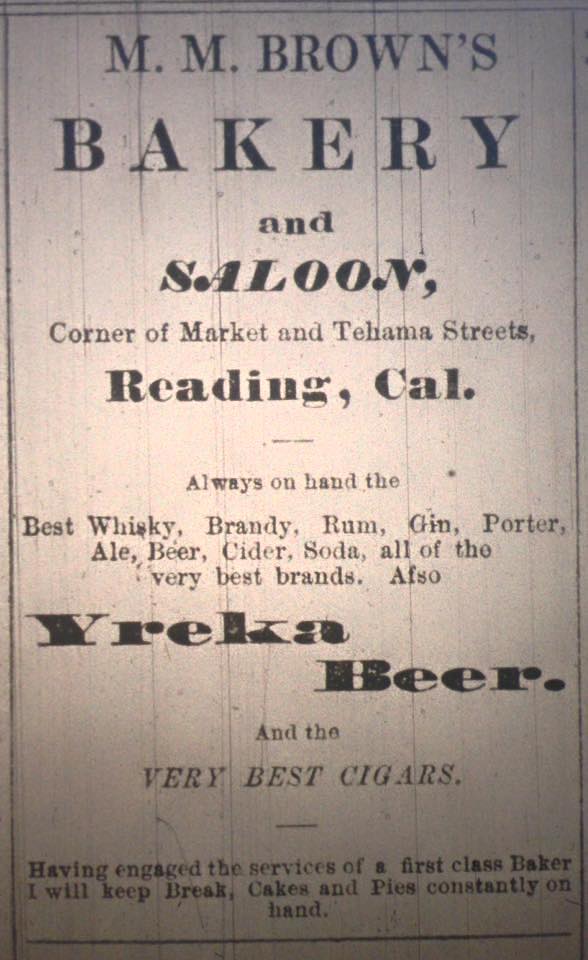
Above: an advertisement for Manley Morrison Brown's Bakery and Saloon at Reading (Redding), California. From the August 8, 1878, edition of the Reading Independent newspaper of Redding.

By the age of thirty-six, in 1875, Manley was employed as a ferryman and living at the town of Buckeye with his family, minus William Brown. His career as a ferryman was short lived and his family relocated to Redding. Two years later, Manley opened a bakery on the corner of Market and Tehama Streets in Redding. His bakery was called M.M. Brown's Bakery and Saloon.

Manley M. Brown sold delicious cakes and pies which he made fresh himself. Brown was also in competition with some of the saloons in town because he also served alcohol, cigars and the locally renowned Yreka Beer at his bar inside the bakery. Then on September 5, 1878, the Reading Independent newspaper reported the following:

"Manly Brown has sold his dwelling, saloon and bakery to Grittner,of Igo. Manly made a nice profit on this trade, but we doubt if he can put the sum received - $2,000 - where it will do more good. We understand that Mr. G. is a first-class baker." (SIC)

While in Redding his daughter Ella attended the Redding Public School. After he sold his business he took some time to travel locally visiting family and friends in French Gulch and Shingletown. Then on, October 2, 1879, the local newspaper mentioned the following transaction involving Manley Morrison Brown:

"B.H Scott has sold his business to M.M. Brown and Hank Whitmore - both enterprising men." (SIC) Brown and Whitmore were now the owners of a new meat market in Redding called the “New Meat Market!”. They sold fresh beef, pork, mutton, pork and corned beef. They were located on Market Street one door south of the Good Templars hall.


Above: the “New Meat Market!” proprietors: Brown & Whitmore. This advertisement is from the October 2, 1879 edition of the Reading Independent newspaper of Redding. 


Later on, in February of 1880, Brown purchased Frank Whitmore's interest and became the sole owner of this meat market in Redding. At the time he was running a first-class butcher shop and he decided to bring in his older brother William L. Brown to assist him. It was William who superintended the business affairs in the shop while he lived in French Gulch.

By the time the 1880 U.S. Census was enumerated on June 4, 1880, they had resettled in a house on Pine Street. Manley lived there with his wife Lucetta, daughter Ella, and their young sons Lewis and Dewit. He also had a servant living in the household by the name of Belle Mallom who was also a cook. It’s more than likely that Manley’s young sons attended school in Redding as well, like his daughter did.

By 1886, Manley relocated his family from Redding to Sims in the Sacramento River Canyon and he became a merchant there. Sims was a little community sometimes referred to as Southern. Later on, Manley relocated his family north to Dunsmuir, in Siskiyou County.

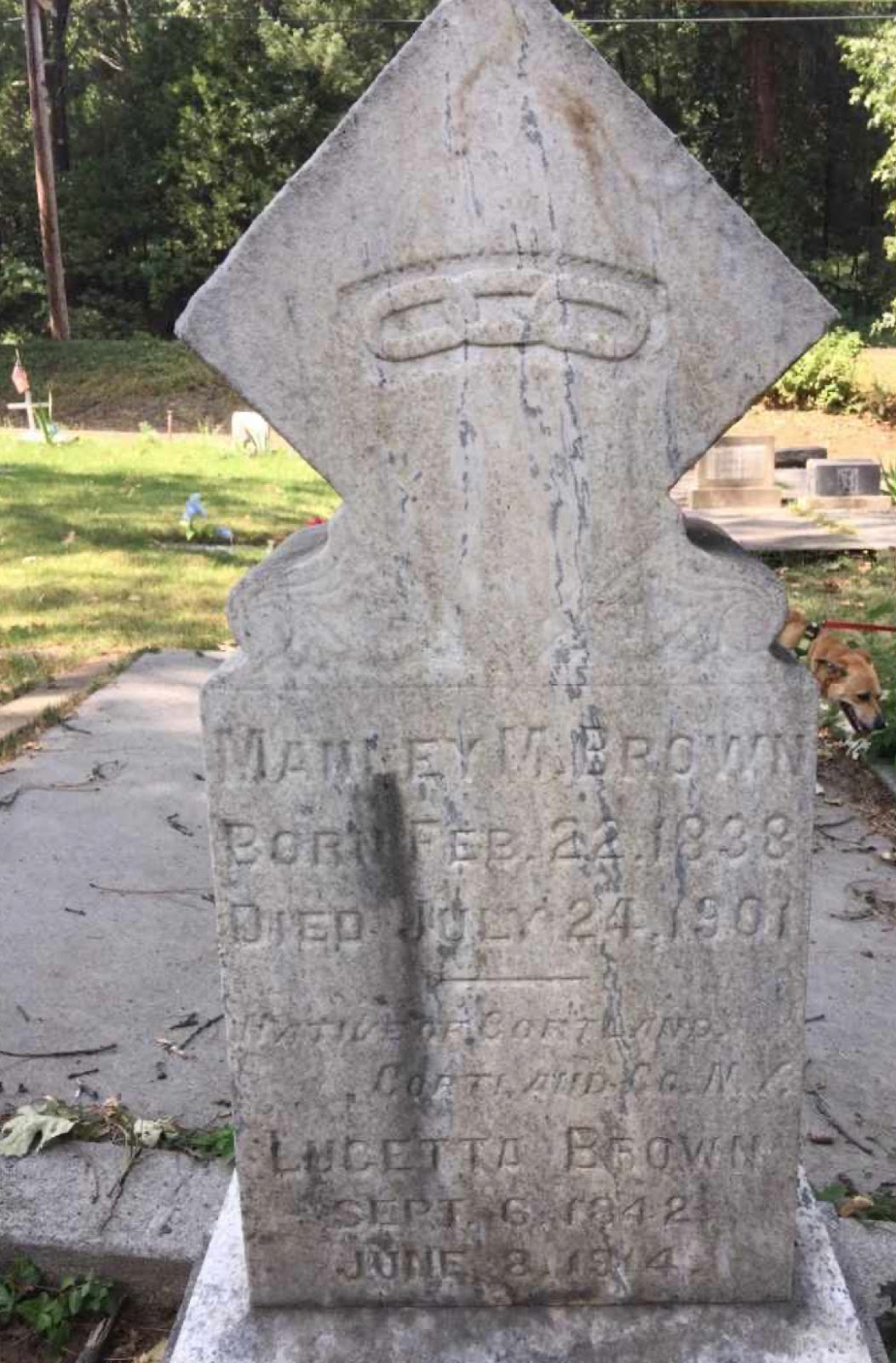
Then in July of 1900, Dunsmuir had a destructive fire that caused approximately $12,000 in damages and he lost his home and an additional building that he owned in that ravaging fire. Both of his places were covered by insurance. The following year, the pioneer died on July 24, 1901 at the age of sixty-three. He is buried in the Dunsmuir City Cemetery next to his wife, Lucetta, who survived him and died in 1914.


Above: Brown burial plot at the Dunsmuir City Cemetery. Photograph taken by Jeremy Tuggle on May 14, 2016.


Above: the headstone of Manley Morrison Brown and Lucetta (Russell) Brown at Dunsmuir City Cemetery. Photograph by Jeremy Tuggle on May 14, 2016.


RESOURCES:


California Voters Register, 1866

California Voters Register, 1867

1870 U.S. Census

California Voters Register, 1875

1880 U.S. Census

California Voters Register, 1886

The Reading Independent newspaper of Redding, August 8, 1878

The Reading Independent newspaper of Redding, September 5, 1878

The Reading independent newspaper of Redding, October 17, 1878

The Reading Independent newspaper of Redding, April 17, 1879

The Reading Independent newspaper of Redding, September 3, 1879

The Reading Independent newspaper of Redding, October 2, 1879

School Report - The Reading Independent newspaper of Redding, December 11, 1879

The Reading Independent newspaper of Redding, February 6, 1880

Costly Fire At Dunsmuir - The Press Democrat newspaper of Santa Rosa, July 18, 1900

Mrs. Brown, Pioneer, Dies In Dunsmuir - The Sacramento Union newspaper of Sacramento, June 10, 1914


Friday, January 11, 2019

ABANDONED, UNCOVERED AND THEN RE-INTERRED: A REDDING CEMETERY


Believe it or not, this location at 2146 Pine Street in between Market and Pine Street in Redding was home to Redding's first cemetery. It's on the flatter surface of this knoll. This photograph was taken by Jeremy Tuggle on December 12, 2018.

Redding was established by the California & Oregon Railroad, a division of the Central Pacific Railroad, on June 15, 1872. Once the construction of the railroad resumed north from Anderson, the railroad company decided to bypass this burial ground, and make its way north to Poverty Flats where the construction stopped that year. This cemetery was now on the outskirts of the brand new town at the southern end. 

The first streets in town which were laid out by the railroad company was North, South East and West Streets followed by the nearby counties Placer, Tehama, Butte, and Yuba Streets. While Redding grew larger with additional streets and the development of Pine and Market Streets it brought more commercial businesses and private residences to town. The town grew into a flourishing city and this cemetery became an oft-forgotten location. It's a site of historical importance because it was Redding's first cemetery which a lot of people tend to over-look in Redding's early history. Over the years, the cemetery has been called the Redding Abandoned Cemetery. Today, the site is the former home of Biggins Lighting who just recently relocated to Larkspur Lane in Redding.

Since the cemetery's establishment in 1867, this piece of land became the final resting place of some of our counties early pioneer settlers for nearly thirty-nine years when it became abandoned and then rediscovered in 1906. At Shasta Historical Society, there are volumes of interment records for Shasta County cemeteries and among these are the records for this cemetery. It was Samuel Dinsmore, a young man, who died on April 24, 1867, at Dinsmore's ranch due to consumption at the age of twenty-five and he became the first interment into this newly established cemetery. Samuel Dinsmore was the eldest of four children born to John W. Dinsmore and Arabella (MacGlashon) Woodrum-Dinsmore. 

Together, the John W. Disnmore family arrived in Shasta County in 1852, and they settled at Shingletown. John W. Dinsmore was a millwright who is noted with erecting the Dry mill at Shingletown in 1853, with his partner Merriman Ferrel, a brother to his future son-in-law. Then in 1857, John W. Dinsmore purchased land from Major Pierson B. Reading, this land was part of the Rancho Buena Ventura land grant. According to Shasta County historian Madge R. Walsh, "Dinsmore located his home, the Four Mile House, about four and a half miles east of Shasta, on the west side of the stage road where it divided to go east to Green's Ferry, or south to Tehama via Canyon House. He had built his house before paying for the property, as it was already extant when the deed was recorded. Today, the site is about a quarter mile west of the junction of Highway 299 W and Ridge Drive." 


The headstone of Samuel Dinsmore whose remains were re-interred into the Redding Cemetery (now Redding Memorial Park). His name is misspelled as Samnel. He is buried next to his sister Angeline (Dinsmore) Ferrel (whose surname is misspelled as Ferrell. Ferrel is the correct spelling. There are no dates on this headstone. This photograph was taken by Jeremy Tuggle August 28, 2014.

Later that year, Arabella Ferrel, a niece of Samuel Dinsmore, and a daughter of Henry Clay Ferrel and Angelina (Dinsmore) Ferrel died at Balls Ferry, at the age of eleven from congestive chills on July 27, 1867. Henry Clay Ferrel is my paternal great-great-great uncle, and his daughter became the second interment at this former cemetery. Henry C. Ferrel, was a native of Ohio, and he arrived in Shasta County in 1853. He was married in 1854 to Angelina Dinsmore. In 1860, they were living at Shasta, Henry C. Ferrel was a miner by trade.


This is the headstone of Arabella Ferrel, a daughter of Henry Clay Ferrel and Angelina (Dinsmore) Ferrel who was re-interred at the Redding Cemetery (now Redding Memorial Park). The Ferrel surname is spelled correctly here. THIS IS NOT THE FIRST BURIAL IN REDDING MEMORIAL PARK.  Note: Redding Memorial Park was established in the 1890s. This photograph was taken by Jeremy Tuggle on August 28, 2014


The death notice of Joseph W. Brackett who died March 27, 1875 at Redding, he was a local lawyer. He was a son of Joseph Warren Brackett and Lydia (Miller) Brackett. His funeral was conducted under the supervision of the Masonic fraternity, of which he was a member. He was survived by his wife and a large family to mourn his loss. Taken from the Shasta Courier newspaper, Saturday, April 3, 1875.

The following is a confirmed listing of burials which took place between the years 1875 and 1877 and all of them were re-interred into the Redding Cemetery (now Redding Memorial Park);

Joseph W. Brackett died March 27, 1875
Emory Farhner died March 20, 1876
Ethol F. Wood died February 15, 1877
Annie Guilbert died July 20, 1877  (has no death notice, nor headstone.)

Six years after the turn of the 20th Century on February 13, 1906, the Redding Water Company rediscovered parts of the original cemetery when they were lowering the manes in that section of Redding. The majority of these burials above were re-interred into the Redding Cemetery (now Redding Memorial Park), that year. It was heralded across the state as a gruesome discovery, as their employees were finding the original coffins which were still intact and the headstones.

The local media claimed there were seven burials which had been unearthed, and only six of those seven burials are named in the cemetery records at the historical society. So who was the seventh burial? More research may uncover the answer to that question while it remains a mystery.

It’s possible that there might be additional burials at the former site of the Redding Abandoned Cemetery, only ground penetrating radar could tell us if there are any anomaly’s underground that shouldn’t be there today. It’s not clear if they recovered all of the burials because some references give this cemetery a much larger perimeter. It’s definitely, a location of historical interest that doesn’t get a lot of exploration, the next time you drive-by this former cemetery take a look as you're passing 2146 Pine Street.


The death notice of Emory Farhner, son of John Farhner, who died due to drowning in a small creek which ran through Redding and near the railroad tracks. Taken from the Shasta Courier newspaper on Saturday, March 25, 1876. 


The headstone of Ethel Florence Wood a daughter of William A. Wood and Mattie Wood. This photograph was taken by Jeremy Tuggle on August 28, 2014.


RESOURCES:


Death Notice - Samuel Dinsmore - The Shasta Courier newspaper of Shasta, April 27, 1867 

Death Notice - Arabella Ferrell - The Shasta Courier newspaper of Shasta, August 3, 1867

Death Notice - Joseph W. Brackett - The Shasta Courier newspaper of Shasta, April 3, 1875

Death Notice - Ethel Florence Wood - The Shasta Courier newspaper of Shasta, February 24, 1877

Ditch Men Make Grewsome Finds - The Press newspaper of Redding, February 13, 1906.

Finds Coffins And Headstones In The Streets Of Redding - The San Francisco Call newspaper of San Francisco, February 14, 1906

Shasta Historical Society Cemetery Records (Small Cemeteries) - Redding Abandoned Cemetery, page 299, available in the archives of Shasta Historical Society.
Shasta County Cemteries compiled by Ronald Joliff

DP-015 Dinsmore, John W. Pioneer Plaque file available on file at the Shasta Historical Society in Redding

The Dinsmore Family by Madge R. Walsh

Selected sawmills of the Shingletown area by Jeremy M. Tuggle, Record Searchlight newspaper of Redding, February 4, 2017.