Showing posts with label Igo. Show all posts

Monday, August 31, 2026

How Roller Skating Captivated Redding

How roller skating captivated Redding
Originally Appeared On A News Cafe


Photo by Laura Rivera on Unsplash


(Editor’s note: Please welcome to A News Cafe Jeremy Tuggle and his local history column, Tuggle Tales: Unearthing the People, Places, and Stories of Shasta County—Past and Present. )

Skating has a long and fascinating history stretching back thousands of years. The earliest form—ice skating—dates to between 3000 and 4000 B.C., when people in Northern Europe fashioned skates from animal bones to travel across frozen lakes and rivers. Nearly five millennia later, in 1760, the invention of the first roller skates created an entirely new way to glide.

By the early 1880s, roller skating had become one of America’s greatest recreational crazes. Across the western United States, the sound of steel wheels rattling across polished wooden floors echoed through newly opened skating rinks. These lively venues became gathering places where families, young couples, and friends met to socialize, exercise, and enjoy an evening’s entertainment.

Even Redding felt the pull of the new craze. On April 5, 1884, the Republican Free Press lamented the town’s lack of a skating rink: “Our town has been surpassed for once. We have no skating rink. But it is the universal opinion that the roller skate is a wayward little quadruped. It is as frolicsome and more innocent looking than a lamb; but for lowering one’s upright attitude in the community, it is unsurpassed.”
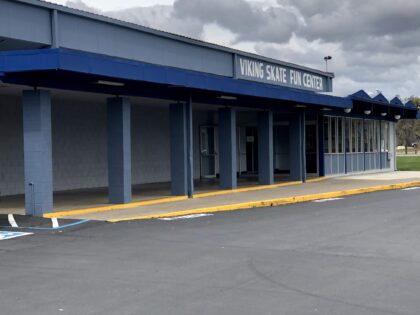


Viking Skate Country in Redding, California, which opened in 1974 and continues a roller-skating tradition in the city dating back to the 1880s. Photograph taken by Jeremy M. Tuggle in 2024.

Ironically, before Redding established its first rink, the neighboring communities of Millville and Igo had already embraced the sport, demonstrating that even small frontier settlements were eager participants in one of the era’s most fashionable recreations.

Plans for Redding’s own rink soon emerged. On April 11, 1885, the Republican Free Press reported that local businessman John George had moved the Chappell & Houston warehouse to the corner of Yuba and California streets, adjacent to the railroad reserve. Curious residents speculated about its purpose, prompting the newspaper to joke: “Some say that the building will be used for a skating rink, others say for a hall. If you are very curious, go ask John.”

Three weeks later, the mystery was solved. On May 2, 1885, Charley George opened Redding’s first skating rink, known as St. George Hall. Predicting great success, the Republican Free Press declared that “roller skating will be the rage for some time to come.” The editor also noted that many young women were quietly practicing before making their public debut, hoping their first appearance would be graceful rather than awkward. To celebrate the occasion, the newspaper published a lighthearted poem:

Roll on, roll on, ye roller skates
Roll on ye ankles, trim and neat;
Roll on ye limbs of purple hose;
Be careful; do not turn up your toes,
Be sure and not roll on your nose.

The prediction proved remarkably accurate. Roller skating quickly became one of Redding’s favorite pastimes, and St. George Hall evolved into a bustling social center where residents gathered as much for conversation and companionship as for exercise. Competition soon followed. In 1887, James Meads opened a second rink inside the Major Opera House on California Street. Although short-lived, it reflected skating’s growing popularity.

By 1889, St. George Hall was under the management of N. B. Howard and continued serving skaters until disaster struck. During the severe snowstorm of January 1894, approximately eighteen inches of snow blanketed Redding, causing the skating rink to collapse beneath the weight. Several other buildings were also damaged or destroyed during the storm, and St. George Hall was never rebuilt.

A decade later, skating returned to Redding. In late October 1904, Redding resident and local hostelry man Thomas Cordi opened a new rink inside the Bush Building on Market Street, formerly occupied by the store of James Young Hardware. Within two years, roller skating had once again swept through Redding. By the autumn of 1906, the Courier-Free Press newspaper of Redding reported that skating had become far beyond a simple pastime—it was the city’s latest social phenomenon. Children, teenagers, businessmen, and adults of every age flocked to the rinks.

At the center of the excitement stood the skating rink inside Armory Hall, built in 1889 on the site now occupied by Shasta Regional Medical Center. There, a newly organized skating club of twenty-five couples held its inaugural meeting. Some members skated with confidence while others struggled through their first uncertain laps, often providing as much entertainment for spectators as the accomplished skaters.

The club elected A. H. Tucker as president, Dr. B.F. Saylor as secretary, and Dr. Potter as treasurer. Every Wednesday evening from 10 p.m. until midnight, the rink was reserved exclusively for club members to practice, socialize, and perfect new skating maneuvers.
When theatrical performances or other events occupied Armory Hall, members gathered elsewhere for card parties and social evenings. No matter where they met, however, conversation invariably returned to skating. One newspaper account told of an enthusiastic but less-than-graceful club member who attempted to demonstrate the advanced “double eagle” maneuver while explaining the importance of balance. His short legs flew into the air, his arms flailed wildly, and he landed flat on the floor.

After nearly eleven seconds, he finally gasped, “Whoof.” Recovering his composure, he sheepishly apologized to a nearby young woman. “Er—I beg your pardon.” “Oh, don’t mention it,” she replied. The pair quietly rejoined the crowd as though nothing unusual had happened.

Such scenes were common at Armory Hall, where beginners and experienced skaters shared the floor with equal enthusiasm and good humor. The Courier-Free Press newspaper jokingly declared that the rink had transformed “one-half of Redding’s population into rolling stock.” The customary greeting on city streets was no longer “How are you?” but “Do you skate?”

The skating craze even reshaped Redding’s social life. Many young women preferred evenings at the rink over dances, theater performances, or buggy rides, claiming they simply could not miss another opportunity to perfect their skating technique. The article concluded that roller skating had become much more than entertainment—nearly everyone had caught what it called the “skating habit.” Armory Hall remained one of Redding’s principal skating venues until it was destroyed by fire in January 1915.

The following year, in 1916, G. M. Klein established a transportable roller skating rink at the corner of Pine and Yuba Streets. Unlike the permanent skating halls that had come before it, Klein’s portable rink could be relocated and adapted as needed, marking a new phase in Redding’s skating culture. Roller skating remained a popular pastime throughout the 1920s and into the 1930s. In February 1928, a new skating rink was constructed at the corner of Tehama and Pine Streets, demonstrating that the pastime remained popular as Redding entered the 1930s. By 1940, another roller skating rink had opened at the corner of East and Yuba Streets, but its existence was brief. On December 2, 1940, the building was destroyed by fire, bringing an abrupt end to one of Redding’s last pre-war skating rinks.

Roller skating experienced a major resurgence following World War II. On October 30, 1947, the Coliseum Skating Rink opened to a large crowd two miles south of Redding on Highway 99. Owned by Troy Jones and W. S. Blazer, the $75,000 facility was promoted as the largest skating rink between San Francisco and Portland, Oregon.

The building measured 70 by 160 feet and contained more than 11,000 square feet of skating floor. Its innovative “spring floor,” constructed of laminated 2×4 framing topped with felt and hardwood maple, provided a smoother skating surface and reduced impact for skaters. The Coliseum accommodated 600 skaters and featured parking for up to 3,000 automobiles on a nine-acre site. Modern lighting illuminated the rink, and plans included a check room, soda fountain, balcony, and installation of a Hammond electric organ.

Open seven days a week, the rink offered afternoon sessions from 2 to 5 p.m. and evening skating from 7 to 11:45 p.m. Beyond skating, the Coliseum was designed as a full entertainment center, hosting dances with name bands, boxing matches, wrestling events, and community gatherings.

The owners of the rink even collaborated with Redding City Lines, a local bus system that offered transportation from Market and Yuba Streets to the skating rink and return trips as well. More than two decades later, history repeated itself, as the Coliseum Skating Rink became one of several Redding-area structures impacted by the devastating December 1968 snowstorm. On December 23, 1968, the storm dumped 16 inches of snow in a single day, setting the all-time calendar-day snowfall record for Redding. Then, on December 24, 1968, an additional 4 inches fell, bringing the storm’s total to 20 inches.
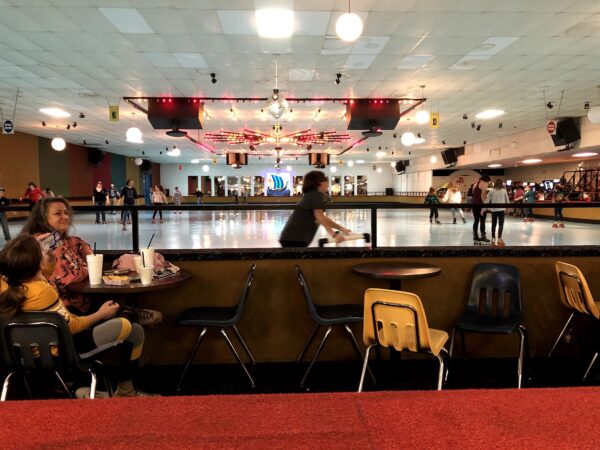


Inside Viking Skate Country in Redding, California, where generations of local residents have gathered to roller skate since the rink opened in 1974. Photograph taken by Jeremy M. Tuggle in 2024.

During what local officials described as the “Big Snow,” heavy, wet snowfall caused widespread structural failures across the region. The Coliseum Skating Rink suffered significant structural damage under the weight of the snow, marking a turning point for aging mid-century recreational facilities.

Finally, in 1974, former state senator Maurice Johannessen opened Viking Skate Country, which became the city’s premier modern skating rink. His wife, Marianne Johannessen, continues to serve as general manager, maintaining a direct link to more than a century of skating history in Redding.

Looking back more than a century later, what began with a single skating rink in 1885 grew into one of Redding’s defining social pastimes. From St. George Hall to Armory Hall, from the Coliseum Skating Rink to Viking Skate Country, roller skating remained a constant thread through generations of community life. Long before movies, radio, and modern entertainment defined leisure, skating rinks brought neighbors together beneath glowing lights—where friendships formed, romances began, and entire evenings were spent simply rolling in circles, sharing in a pastime that left lasting marks on the city’s history.


Resources:

The Free Press newspaper of Redding, December 1, 1883

The Republican Free Press newspaper of Redding, April 5, 1884

The Republican Free Press newspaper of Redding, December 13, 1884

The Republican Free Press newspaper of Redding, January 10, 1885

The Republican Free Press newspaper of Redding, February 7, 1885

The Republican Free Press newspaper of Redding, April 11, 1885

The Republican Free Press newspaper of Redding, May 2, 1885

The Republican Free Press newspaper of Redding, June 6, 1885

Skating Carnival - The Republican Free Press newspaper of Redding, July 11, 1885

The Republican Free Press newspaper of Redding, October 31, 1885

The Republican Free Press newspaper of Redding, November 28, 1885

The Republican Free Press newspaper of Redding, December 12, 1885

The Republican Free Press newspaper of Redding, January 2, 1886

The Republican Free Press newspaper of Redding, August 14, 1886

The Republican Free Press newspaper of Redding, February 12, 1887

The Republican Free Press newspaper of Redding, October 29, 1887

The Republican Free Press newspaper of Redding, December 10, 1887

The Republican Free Press newspaper of Redding, March 3, 1888

The Republican Free Press newspaper of Redding, August 4, 1888

The Republican Free Press newspaper of Redding, November 16, 1889

The Republican Free Press newspaper of Redding, November 23, 1889

The Republican Free Press newspaper of Redding, January 27, 1894

To Start a Skating Rink - The Republican Free Press newspaper of Redding, October 20, 1905

Roller Skating Rink - The Republican Free Press newspaper of Redding, October 23, 1905

The Northern California Rink Association - The Free Press newspaper of Redding, February 5, 1906

A Grand Event - The Free Press newspaper of Redding, February 6, 1906

Skating at the Armory - The Free Press newspaper of Redding, February 16, 1906

Whist And Skating in Contest for Popularity - The Free Press newspaper of Redding, February 20, 1906

The Free Press newspaper of Redding, February 21, 1906

Broke Her Arm - The Free Press newspaper of Redding, February 26, 1906

Roller Skating Is All the Rage - The Courier-Free Press newspaper of Redding, March 5, 1906

Polo on Skates at the Armory - The Courier-Free Press newspaper of Redding, March 26, 1906

The Courier-Free Press newspaper of Redding, April 11, 1906

Armory Hall Has Been Leased for Year - The Courier-Free Press newspaper of Redding, June 14, 1906

Skating Rink to Open Soon - The Courier-Free Press newspaper of Redding, September 13, 1906

The Searchlight newspaper of Redding, October 2, 1906

The Skating Rink - The Courier-Free Press newspaper of Redding, October 19, 1906

Boy Breaks an Arm - The Courier-Free Press newspaper of Redding, October 22, 1906

The Courier-Free Press newspaper of Redding, October 26, 1906

Sprained an Ankle - The Courier-Free Press newspaper of Redding, November 22, 1906

The Skating Habit Has Captured Redding - The Courier-Free Press newspaper of Redding, November 22, 1906

Accident at Rink - The Searchlight newspaper of Redding, December 15, 1906

"Roller Fans" to Have Treat - The Courier-Free Press newspaper of Redding, October 16, 1907

Skating - The Courier-Free Press newspaper of Redding, February 19, 1908

Inter Nos Boys Lease Skating Rink - The Courier-Free Press newspaper of Redding, February 19, 1908

Skating at Armory - The Shasta Courier newspaper of Shasta, January 8, 1909

Skating - The Searchlight newspaper of Redding, November 10, 1909

Skating Rink - The Searchlight newspaper of Redding, April 16, 1913

Skating - The Searchlight newspaper of Redding, November 6, 1913

Skating Rink - The Searchlight newspaper of Redding, December 28, 1914

Armory Hall Is Burned - The Searchlight newspaper of Redding, January 12, 1915

Armory Hall Is Destroyed by Fire -The Shasta Courier newspaper of Shasta, January 12, 1915

Fire That Destroyed Armory Hall Caused Loss of $20,000 - The Searchlight newspaper of Redding, January 12, 1915

Redding Will Have Skating Rink Soon - The Searchlight newspaper of Redding, July 28, 1916

Rink Open This Saturday - The Searchlight newspaper of Redding, August 26, 1916

Skating Rink to Close on Sunday - The Searchlight newspaper of Redding, October 14, 1916

Roller Skating Rink Will be Built Here - The Courier-Free Press newspaper of Redding, May 3, 1922

Skating Rink - The Searchlight newspaper of Redding, February 5, 1928

Civic Auditorium Let for Skating Rink - The Courier-Free Press newspaper of Redding, October 8, 1930

Roller Skating Rink Will Open on Friday - The Courier-Free Press newspaper of Redding, October 9, 1930

Roller Skating Rink to be Opened Tonight - The Searchlight newspaper of Redding, October 10, 1930

Skating Rink May Be Opened at Pavilion - The Searchlight newspaper of Redding, October 4, 1932

Theatrical Groups Used Armory Hall written by Superior Court Judge, Albert F. Ross Jr. - The Record Searchlight newspaper of Redding, March 28, 1964

Today In History - The Record Searchlight newspaper of Redding, January 12, 2016

Today In History - The Record Searchlight newspaper of Redding, June 13, 2016


Saturday, January 7, 2023

A Snapshot of Piety Hill


Above: the town of Piety Hill, date unknown. From the collection of Jeremy Tuggle.


Piety Hill is a fine example of a present-day ghost town, which was located in western Shasta County, California. This town was located about a quarter mile east of the present-day town of Igo, on what is now Cloverdale Road, and northward for 0.7 miles, however, the majority of these historic relics from this community is situated on private property which most of them are viewable by-passing motorists from the roadside. Piety Hill was established in 1849 as a gold mining camp and it eventually boasted of 1,500 residents including 600 Chinese settlers nearby due to the local mining claims in the area producing gold. The Chinese mined and worked their vegetable gardens here, there was no China town at Piety Hill.

In 1853, the lucrative Hardscrabble mine began its production of lucrative minerals by the Dry Creek Tunnel and Fluming Company, which began the construction of a water ditch by Chinese labor that is seen in this YouTube video here. It became a 22-mile-long water ditch which diverted water from the North Fork of Cottonwood Creek, Eagle Creek, Andrews Creek and the South Fork of Clear Creek. Then in 1857, gold pans yielded miners working their mining claims at Piety Hill from $60 to $190 per pan. At that time, the community was home to a few families in the area with children when they organized a school at that place and erected a schoolhouse. It was a booming up-and-coming place to live. In 1858, a man named Eugene Crowell kept a general merchandise store at Piety Hill which was a very successful business venture for him due to the production of gold from the local mining claims.

There are two stories of how Piety Hill received its name. Both are quite interesting and easy to believe. One account is that a family named McKinney moved into the area, having come from Piety Hill, Michigan, and the family members named their new home after their former hometown. Another explanation suggested by some historians is that this mining camp was occupied by religious groups which chose to name the community Piety Hill. Piety Hill does appear on the first official map of Shasta County which was surveyed by Colonel William Magee in February of 1862.

The present-day town of Igo began as the relocated community of Piety Hill. Residents moved in 1866, probably to segregate themselves from Chinese miners who were settling in Piety Hill, but also because people learned there was an ancient river channel under the community, making it reliable for well digging. George McPherson was the superintendent of the lucrative Hardscrabble mine as well. It was their hydraulic mining methods which also played a part in declining Piety Hill's growth while the nearby town of Igo burgeoned with success. 

In 1867, my paternal great-great-great grandfather the Reverend William Samuel Kidder, a pioneer Baptist minister, school teacher, farmer and miner, among other things, was recorded as living at Piety Hill, that year, after relocating his wife and children from French Gulch. His registration is found in the California, U.S., Voter Registers, 1866-1898. His occupation at that time was a post master but Piety Hill lacked a United States Post Office to send and receive mail which this notation meant that Kidder was employed as post master for the French Gulch United States Post Office. My ancestors eventually relocated from Piety Hill to Eagle Creek (now Ono) at a later date.

By 1868, it was generally thought that the local mines in the area of Piety Hill were worked-out but that wasn't the case. McPherson and his men at the Hardscrabble mine cleaned up from its tailings or dump pile several thousand dollars from gold which was the largest assessment of gold ever produced at that location. That year also witnessed the erection of a brand-new sawmill in the area by Petty & Company, yet this lumber mill was a short-lived business venture.

A year later, Shasta County resident Charles McDonald, a well-known stage proprietor operated an express called McDonald's Express which took passengers from Shasta amongst the following western Shasta County communities: Middletown, Centerville, Piety Hill, Horsetown, Janesville (now Gas Point), and Roaring River. Roaring River was the farthest southwest which this stage line traveled to at that time. Later on, in 1870, Alamarin W. Baker, a resident of Eagle Creek (now Ono) operated a stage line called Baker's Shasta & Red Bluff Express which took passengers from Shasta to Red Bluff (in Tehama County), while making stops in between at Piety Hill and Horsetown.

Even though Piety Hill appeared to be in a declining state the local schoolhouse in May of 1871, had forty-one students enrolled into their one-room schoolhouse. The teacher at that time was Joanna T. Casey. While locals were still prospecting the area for new prospects other mining claims were still being patented in the region into the 1880s and 1890s, and by the turn of the twentieth century, Piety Hill suffered quite a loss from local mines failing at their production of ore while very few residents remained at Piety Hill.

In 1915, the Hardscrabble mine at Piety Hill was worked by miners mining away in drifts and toiling away in shafts on the property while utilizing hydraulic mining methods as a source to extract the gold from this mine, which was located in Section 27, 34 and 35, Township 31 North, Range 6 West, 1/2 mile south of Igo, and consisting of 1,700-acres, of patented mineral land. The owners were the Happy Valley Land and Water Company of Olinda. A. E. Bowles was the president of this company. This company owned the old Dry Creek Tunnel and Fluming Company's water ditch, which was then known as the Happy Valley water ditch as seen in the above YouTube video.

Remaining points of interest from Piety Hill include a reservoir, the Dry Creek Tunnel and Fluming Company's water ditch, also known as the Happy Valley water ditch, pieces of structures and depressions in the ground which were from the cellars below the Chinese buildings. Look for these historical relics along Cloverdale Road the next time you drive by in your vehicle. You might be amazed at their existence. The death knell of this community which never established a United States Post Office to send and receive mail came in 1920 when the last two residents of Piety Hill died.


Resources:

Condition of Our Public Schools - The Shasta Courier newspaper of Shasta, January 30, 1858

To Miners - The Shasta Courier newspaper of Shasta, April 3, 1858

S. Of T. - The Shasta Courier newspaper of Shasta, October 23, 1858

Mining Improvement - The Sacramento Daily Union newspaper of Sacramento, May 21, 1861

California, U.S., Voter Registers, 1866-1898

Enterprising - The Shasta Courier newspaper of Shasta, January 25, 1868

Letter From Piety Hill - The Shasta Courier newspaper of Shasta, June 6, 1868

School Report - The Shasta Courier newspaper of Shasta, May 20, 1871

Notice of Application for Patent To Mining Claim - The Shasta Courier newspaper of Shasta, October 4, 1873

Big Interest in Shasta Are Sold - The Sacramento Daily Union newspaper of Sacramento, July 21, 1911

Happy Valley to Be Transferred - The Sacramento Daily Union newspaper of Sacramento, July 30, 1911

U.S., Appointments of U.S. Postmasters, 1832-1971

REPORT XIV OF THE STATE MINERALOGIST - MINES AND MINERAL RESOURCES OF CALIFORNIA - CHAPTERS OF STATE MINERALOGIST’S REPORT BIENNIAL PERIOD, 1913-1914. CALIFORNIA STATE MINING BUREAU, CALIFORNIA STATE PRINTING OFFICE, SACRAMENTO.

Mines and Mineral Resources of Shasta County, Siskiyou County, and Trinity County, by G. Chester Brown, ©1915 published by California State Printing Office.

My Playhouse Was a Concord Coach, an anthology of newspaper clippings and documents relating to those who made California history during the years 1822-1888, by Mae Hélène Bacon Boggs. Published by Howell-North Press ©1942

Shasta County, California A History by Rosena Giles, published by Biobooks, ©1949.

Way Back When - Myrtle McNamar, published by C.A.T. Publishing of Redding, California, 1952. 282 pages.

The Story of Western Shasta written by R.S. Ballou, The Covered Wagon, 1964, published annually by the Shasta Historical Society

Place Names of Shasta County by Gertrude A. Steger revision by Helen Hinckley Jones, ©1966 by La Siesta Press, Glendale, California

Mines and Mineral Resources of Shasta County, California – County Report 6 – by Philip A. Lydon and J.C. O’ Brien ©1974 by California Division of Mines and Geology

Friday, February 12, 2021

WILLIAM B. SMITH (1859-1917)


Above: William B. Smith pans for gold along a rocky creek in the Sunny Hill mining district. From the collection of Jeremy Tuggle.


William B. Smith was born to Gottlieb George Kaylor Smith and Elizabeth Jane (Lamberson) Smith, at Eagle Creek (now Ono) on May 10, 1859, and during the following year the Smith’s settled their family at Horsetown. He was the fourth of ten children born to his parents. William was educated at the Eagle Creek schoolhouse in Eagle Creek.

William grew up to be a life-long miner. He also married Elizabeth Rester at Igo on March 12, 1890, the bride was the daughter of John Rester, and his wife Annie. Their wedding was performed by the Reverend William S. Kidder. To this union there were eight children born to them:

1.  Anna Smith

2. Esther May Smith

3. Louisa Bella Smith

4. Gladys Smith

5. Willie B. Smith

6. Earl Douglas Smith 

7. Ruth Elizabeth Smith

8. Howard Smith

William and his wife Elizabeth purchased a residence at Sunny Hill, a few miles from the town of Ono. This is where most of his mining was done in the boundaries of the Sunny Hill mining district of Shasta County. He was a family man and he was a mining partner of Valentine Doll, who was also his brother-in-law, and married to William’s sister, Harriett.

By December of 1897, William B. Smith and Valentine Doll issued advertising Proof Of Labor notices in the local media for the Manzanita and Honeycomb Quartz Mines in the Sunny Hill mining district. There is a real estate transfer in April of 1898, stating the following:

"W.B. Smith and Elizabeth Smith to V. Doll and Hattie E. Doll, F. Barlow. H.A. Root and D.E. Alexander - Bond for deed $3,800 Honcycomb Mine, extension of Honeycomb Mine with mill right, ditch, and water right at Jerusalem Creek, Sec. T.30 N., R., 8., W., also two placer claims included."

William died on November 27, 1917, at Sunny Hill due to an illness of the stomach. There was no doctor present at the time of his death so the coroner was called in from Redding to perform a coroners investigation on his body. William B. Smith is buried at the Redding Cemetery (now Redding Memorial Park) next to his son Willie B. Smith.

William’s wife Elizabeth (Rester) Smith survived her husband by six years. She died on October 14, 1923, she is buried in the same cemetery as her husband. 

Note: Gottlieb George Kaylor Smith and Elizabeth Jane (Lamberson) Smith are the author’s great-great-great-great maternal grandparents, and William B. Smith is my great-great-great maternal uncle. I descend through his sister Harriett Emma (Smith) Doll.


Above: the headstone of William B. Smith at the Redding Memorial Park, in Redding. This photograph was taken by Jeremy Tuggle on January 10, 2021.


Resources:

1860 U.S. Census

1870 U.S. Census

1880 U.S. Census

Married - The Searchlight newspaper of Redding, March 22, 1890

Proof Of Labor - The Daily Free Press newspaper of Redding, December 1, 1897

Bond For A Deed - The Daily Free Press newspaper of Redding, April 16, 1898

Proof Of Labor - Honeycomb and Manzanita Quartz mines dated December 27, 1899

1900 U.S. Census

Proof Of Labor - Honeycomb and Manzanita Quartz mines dated January 8, 1901

The Searchlight newspaper of Redding, August 30, 1908

1910 U.S. Census

William B. Smith Dies At Sunny Hill - The Searchlight newspaper of Redding, November 28, 1917

Resident Of Ono, Shasta County, Dies - The Sacramento Union newspaper of Sacramento, November 29, 1917

1920 U.S. Census

Calvin Jefferson Smith, Mining Man written by Thelma Phillips Smith, The 1986 Covered Wagon, published annually by Shasta Historical Society, pages 42-45.

Valentine Doll written by Jeremy M. Tuggle, The 2011 Covered Wagon, published annually by Shasta Historical Society, pages 43-49. 

SP-037.1 Smith, Gottlieb George Kaylor, Pioneer Plaque File available at the Shasta Historical Society.


Monday, September 28, 2020

The Zogg Fire Destroys Two Landmarks in the Historic Town of Ono


Above: this clapboard style building was erected in 1935 at Ono to house the meetings and events of the Ono Grange No. 445. This photograph was taken by Jeremy Tuggle on July 4, 2018.


Confirmation from the Redding Record Searchlight newspaper confirms that the Zogg Fire which erupted into flames on the afternoon of September 27, 2020, on Zogg Mine Road in Igo destroyed two landmarks in the historic nearby town of Ono. The Ono Grange No.445 was instituted on March 26, 1930, at Ono which empowered them to act under the bylaws of the National Grange for a permanent charter or warrant confirming a perpetual right of succession, and securing them the privilege's of a regular constituted grange. 

The first meeting of the Ono Grange No. #445 was held in a rented building on Buell Road in Ono on April 2, 1930. The first master was James J. Barr Sr., [the husband of my paternal great-great-great aunt Edna L. (Kidder) Barr], and the first secretary of this grange was Lena Driscoll. The charter members of this new establishment were: James J. Barr Sr., Mrs. Martin Driscoll, Olive Miller, David Miller, Marshall Gill, Richard Edmonds, Bob Jordan, W. Kingsbury, May Kingsbury, C.M. Murphy, Joseph N. Moon, Pauline Stevens, Eugenia Graham, Sydnie Jones, Nelly Murphy, Mrs. Addie B. Graves, Charles Plumb, Mabel Fowler, Frankie Fowler, and Mrs. Julia Edmonds.

In February of 1934 negotiations began with the members of the grange and Ono resident David Boyer to purchase a piece of property that Boyer owned near the channel of Eagle Creek for the future Ono Grange Hall. Yet, Boyer decided to donate the land for the grange to use, and on May 25, 1934, the construction began on the new Ono Grange Hall.


Above: the siding of the Ono Grange Hall. This photograph was taken by Jeremy Tuggle on July 4, 2018.


Above: the siding of the Ono Grange Hall. This photograph was taken by Jeremy Tuggle on July 4, 2018.

The Ono Grange Hall was completed in 1935. Many people joined the new association which provided assistance to farmers, denotes a marked change in the economy of the area, away from mining toward farming and ranching. Through the years, the Ono Grange Hall remained an active gathering place for the people in the community, and many events and community fundraisers were held there. The building served the community for eighty-five years, until it was destroyed by the ravaging Zogg Fire on September 27, 2020.

Another landmark which was destroyed by the ravaging Zogg Fire on September 27, 2020, was the Ono Store and Stopping Place, also known as the Ono Store and International Cafe, which formerly marked the center of Ono. The store was built in the 1950s by Lamar and Aletha Green, opposite of what used to be David Miller's merchandise store. Since the Green's owned and operated the establishment it has been through various owners over the years. I'm sure that more fire ravaged landmarks of the Igo and Ono areas will be announced if any once the area reopens to the public. As of 8:30 A.M., on September 28, 2020, this fire has exploded to 15,000 acres. The fire is being driven by the wind. Praying for Igo and Ono. Thank you, to the fire fighters and our first responders!


Above: The Ono Store and International Cafe. This photograph was taken by Jeremy Tuggle on July 4, 2018.


Above: the early stages of the Zogg Fire in Igo filmed by Jeremy Tuggle on September 27, 2020.


Above: the early stages of the Zogg Fire in Ono filmed by Jeremy Tuggle on September 27, 2020


RESOURCES:


Patrons of Husbandry Charter - Ono Grange No. 445, instituted March 26, 1930

A History of the Grange by Merla F. Clark

A Journey Through Time: Ono and the Bald Hills by Jeremy M. Tuggle, with an introduction by Al M. Rocca; copyright 2008, published by Preserving Memories, in Charlotte, North Carolina. ISBN Number: 978-0-9742576-8-6

http://onogrange.org/

Monday, June 24, 2019

The Historic Igo Schoolhouse


The historic Schoolhouse located at the Shasta District Fairgrounds in Anderson. This photograph was taken by Jeremy Tuggle on June 19, 2019.

In 1872, Igo pioneer and resident Charles N. Kingsbury, an active miner and a native of New York, erected a one room school house which was used as a school in the town of Igo on the property of the present Igo-Ono School. The wood was hauled into Igo from Shingle Creek at Shingletown. It included a well and an out-house.

The school lacked running water and electricity. A wood stove was used to heat the one room school house during the winter months and cold rainy days. One teacher educated the students from grades kindergarten through eighth grade. Some years the teacher taught A board of trustees was established to preside over financial affairs, repairs and to help guide the school into the future. Being a trustee of the school was a paid position just like the teachers did.


An interior pic. This photograph was taken by Jeremy Tuggle on June 19, 2019.

In 1941 the town of Igo received their first electricity, and so did the school house. The decade of the 1950s brought a new feature to the school house, running water. It was utilized by the Platina Union School District until 1960 when the last class was taught by Mrs. Lucy Plumb. In 1970 the building was relocated by truck to Anderson at the Shasta District Fairgrounds.

Original restoration took place by the Shasta Historical Society between the years 1989-1991. Since that time the organization has made many additional restorations to the building so it can be enjoyed by future generations to come and up to code on safety regulations. The Shasta Historical Society keeps the historic Igo Schoolhouse open during the Shasta District Fair, and some times during Anderson Explodes. 


The original stove wood still housed inside the building. This photograph was taken by Jeremy Tuggle on June 19, 2019.


Teachers:

*Note: Teachers prior to 1901 are not well documented.


1901 - A.E. Downing

1904 - Mrs. L. Cunningham

1905 - Mary Stevens

1906 - Mrs. Alex Cox

1907 - Maude M. Sears

1908 - Addie Baker

1909 - Mrs. Mary Kingsbury

1910-1912 - Mrs. Lulu Swanson

1913-1915 - Pauline Rimer

1915-1918 - Mrs. Pearl Miller

1919 - Mrs. Sydnie Jones

1920 - Arleta Hubbard

1921-1944 - Mrs. Sydnie Jones

1944-1958 - Mrs. Amy Jones

1958- 1960 - Mrs. Lucy Plumb


RESOURCES:


The Igo Schoolhouse 1872-1970 printed by Shasta Historical Society

Igo School printed by Shasta Historical Society

Igo School 371.23 available on file at the Shasta Historical Society in Redding.

Igo School Board Minutes Circa 1964/1965

Don't Close Books Yet On Igo School by Mark DeSio -Record Searchlight newspaper of Redding, June 14, 1989

The Last Days of the Igo Schoolhouse by Donald J. Bagley

The Igo Schoolhouse 371.23