Showing posts with label Clear Creek. Show all posts

Sunday, July 20, 2025

BRINGING HORSETOWN TO LIFE; A SHASTA COUNTY, CALIFORNIA GOLD RUSH SETTLEMENT.


Filmed on location. 

During the California Gold Rush in September of 1849, miners descended into the vicinity of Clear Creek’s rapidly flowing channel in western Shasta County, California, and they started pitching up tents at an alarming rate upon a popular flat of the creek which was producing lucrative gold. From that point on Horsetown began to unveil its lucrative future as a burgeoning mining community which took off and stayed prominent until its demise which made it become one of Shasta County's present-day ghost towns. Come examine the lucrative history of this town site with me as I dive into old records, reports, articles, newspaper clippings and more to bring its history to life as much as possible in this episode of Exploring Shasta County History. 

Picture of Horsetown. Used Courtesy of Library of Congress, Special Collections. Western States, Shasta County, California. Contributor: Historic American Buildings Survey - McPartland, Mary Horsetown, General View, Redding, Shasta County, CA HABS CAL,46-SIRVI,1-

RESOURCES:

1850 U.S. Census

1852 California State Census

The Shasta Courier newspaper of Shasta, April 23, 1853

Rhodes And Lusk’s Express - The Shasta Courier newspaper of Shasta, April 30, 1853

From the Interior - The Sacramento Day Union newspaper of Sacramento, May 4, 1853

Middletown and One Horse Town Road - The Shasta Courier newspaper of Shasta, May 7, 1853

Staging Into Shasta - The Shasta Courier newspaper of Shasta, May 7, 1853

Adam’s & Company’s Express - The Shasta Courier newspaper of Shasta, May 7, 1853

Letter From Briggsville - The Shasta Courier newspaper of Shasta, May 28, 1853

Died - The Daily Alta newspaper of San Francisco, July 7, 1853

The Shasta County Dry Diggings - The Shasta Courier newspaper of Shasta, February 4, 1854

Miners Meeting - The Shasta Courier newspaper of Shasta, March 4, 1854

Mining In Shasta County - The Shasta Courier newspaper of Shasta, April 1, 1854

The Shasta Courier newspaper of Shasta, June 3, 1854

Died - The Shasta Courier newspaper of Shasta, August 19, 1854

Fire at Horsetown  - The Shasta Courier newspaper of Shasta, September 16, 1854

Fire In Horsetown - The Sacramento Daily Union newspaper of Sacramento, September 18, 1854

Notice - The Shasta Courier newspaper of Shasta, November 18, 1854

The Shasta Mines - The Shasta Courier newspaper of Shasta, March 17, 1855

Report - The Shasta Courier newspaper of Shasta, June 9, 1855

Dissolution of Co-Partnership - The Shasta Courier newspaper of Shasta, July 28, 1855

Dissolution of Co-Partnership - The Shasta Courier newspaper of Shasta, August 25, 1855

Died - The Shasta Courier newspaper of Shasta, February 6, 1858 

Births - The Shasta Courier newspaper of Shasta, April 17, 1858 

The Shasta Courie newspaper of Shasta, April 24, 1858

The Shasta Courier newspaper of Shasta, August 13, 1859

1860 U.S. Census

Horsetown Correspondent -The Shasta Courier newspaper of Shasta, January 7, 1860

The Courier in Horsetown - The Shasta Courier newspaper of Shasta, January 14, 1860

The Shasta Courier newspaper of Shasta, March 3, 1860

A Case of Abortion and Death - The Shasta Courier newspaper of Shasta, March 17, 1860

The Shasta Courier newspaper of Shasta, June 23, 1860

The Shasta Courier newspaper of Shasta, July 7, 1860

Northern Argust - The Shasta Courier newspaper of Shasta, August 4, 1860

E. Clampus Vitus - The Shasta Courier newspaper of Shasta, December 15, 1860

Fire In Horsetown - The Shasta Courier newspaper of Shasta, January 12, 1861

Death After Amputation - The Shasta Courier newspaper of Shasta, March 23, 1861

Died From the Effect of the Heat - The Shasta Courier newspaper of Shasta, April 20, 1861

Died - The Shasta Courier newspaper, September 14, 1861

Murder Near Horsetown, Shasta County, By Indians - The Sacramento Daily Union newspaper of Sacramento, June 2, 1862

Robbery Near Horsetown - The Sacramento Daily Union newspaper of Sacramento, September 7, 1863

Died - The Shasta Courier newspaper of Shasta, November 28, 1863

The Late James L. Hart - The Shasta Courier newspaper of Shasta, January 2, 1864

Administrators Sale -The Shasta Courier newspaper of Shasta, March 5, 1864

Large Union Meeting in Shasta - Destructive Fire at Horsetown - The Sacramento Daily Union newspaper of Sacramento, November 1, 1864

St. Valentine’s Day - The Shasta Courier newspaper of Shasta, February 10, 1866

Richards & Co. - The Shasta Courier newspaper of Shasta, October 13, 1866, 

Christmas Tree - The Shasta Courier newspaper of Shasta, December 15, 1866

Killed - The Shasta Courier newspaper of Shasta, February 29, 1868

Simpson & Leiter - The Shasta Courier newspaper of Shasta, October 30, 1869

Horsetown Store - The Shasta Courier newspaper of Shasta, October 30, 1869

Fire - The Shasta Courier newspaper of Shasta, December 18, 1869

1870 U.S. Census

The Sacramento Daily Union newspaper of Sacramento, January 1, 1870

A Shooting Affray - The Marysville Daily Appeal newspaper of Marysville, January 4, 1870

Married - The Shasta Courier newspaper of Shasta, February 5, 1870

Sold Out - The Shasta Courier newspaper of Shasta, April 1, 1871

The Sacramento Daily Union newspaper of Sacramento, January 25, 1872

Murder and Wholesale Robbery - The Sacramento Daily Union newspaper of Sacramento, March 10, 1873

Assaulted - The Shasta Courier newspaper of Shasta, March 22, 1873

The Sentinel newspaper of Red Bluff, November 13, 1875

A Deserted Village - The Trinity Journal newspaper of Weaverville, June 17, 1876

The Weekly Butte Record newspaper of Red Bluff, June 24, 1876

1880 U.S. Census

The San Jose Herald newspaper of San Jose, June 15, 1881

Mike Sweeny Passes Away - The Free Press newspaper of Redding, February 15, 1890

The Daily Free Press newspaper of Redding, December 10, 1895

1900 U.S. Census

The Searchlight newspaper of Redding, June 5, 1900

The Daily Free Press newspaper of Redding, November 19, 1900

The Free Press newspaper of Redding, January 12, 1901

The Free Press newspaper of Redding, January 19, 1901

The Free Press newspaper of Redding, April 20, 1901

In Days of Old - The Free Press newspaper of Redding, November 13, 1903

Nelson Waite Critically Ill - The Searchlight newspaper of Redding, April 8, 1904

Nelson Waite Dead - The Free Press newspaper of Redding, September 6, 1904

Nelson Waite Was Old Indian Fighter - The Free Press newspaper of Redding, September 6, 1904

Dredging In Shasta - The Marysville Democrat newspaper of Marysville, February 3, 1905

Oroville Man Buys Interest in Redding Mine - The Chico Record newspaper of Chico, February 3, 1905

Big Mining Deal in Shasta County - The Chico Record newspaper of Chico, December 23, 1905

Two Big Mines Reopened - The San Francisco Call newspaper of San Francisco, January 7, 1906

The Horsetown Dredger - The Sacramento Daily Union newspaper of Sacramento, April 5, 1907

Two New Dredgers Go in Near Redding - The Marysville Daily Appeal, November 19, 1907

Shasta County Dredgers - The Trinity Journal newspaper of Weaverville, November 23, 1907

Electric Substation Is Burned to Ground - The Sacramento Daily Union newspaper of Sacramento, July 1, 1908

$125,000 Gold Dredger Is Burned in Shasta County - The Los Angeles Herald newspaper of Los Angeles, August 8, 1908

Horsetown Dredger - The Tehama County Daily Republican newspaper of Red Bluff, May 12, 1909

1910 U.S. Census

Shasta County’s Oldest Pioneer Claimed by Death - The Searchlight newspaper of Redding, February 1, 1910

Lived Fifty in Old Shasta Town - The Sacramento Daily Union newspaper of Sacramento, July 15, 1914

Building a Pole Line - The Searchlight newspaper of Redding, June 4, 1915

Horsetown and Briggsville - The Searchlight newspaper of Redding, August 20, 1915

1920 U.S. Census

The Courier Free Press newspaper of Redding, November 19, 1924

Former Resident of Centerville Dies in Her Old Home in Ohio - The Searchlight newspaper of Redding, May 6, 1926

Final Chapter Mining Town - The Madera Tribune newspaper of Madera, July 10, 1928

1930 U.S. Census

Shasta’s Last Dredger Being Torn Down - The Blue Lake Advocate newspaper of Blue Lake, September 6, 1930

My Playhouse Was A Concord Coach, an anthology of newspaper clippings and documents relating to those who made California history during the years 1822-1888, by Mae Hélène Bacon Boggs. Published by Howell-North Press ©1942

Shasta County, California A History by Rosena Giles, published by Biobooks, ©1949.

Echoes of the Dim Past - The Shasta Courier newspaper of Shasta written by Rosena Giles, June 21, 1951

Place Names of Shasta County by Gertrude A. Steger revision by Helen Hinckley Jones, ©1966 by La Siesta Press, Glendale, California

U.S., Appointments of U.S. Postmasters, 1832-1971

Mines and Mineral Resources of Shasta County, California – County Report 6 – by Philip A. Lydon and J.C. O’ Brien ©1974 by California Division of Mines and Geology

Title: Northern Argus[microform] : 1860-1863.
Format: Book Publisher, Date: Shasta County, Calif. : Northern Argus newspaper. Description:
v. Subjects:  Horsetown (Calif.) -- Newspapers.

Monday, July 15, 2024

Oft Forgotten Places in Shasta County

This article might be turned into a series about oft forgotten place names in Shasta County, California, which were formerly up-and-coming places to live in our beautiful region of northern California. Let’s take a look at some of them today and explore their history below...


Above: an 1884-1914 map of Shasta County, California, showing Allen's Station or Allen. The United States Fish Hatchery at Baird on the McCloud River is also shown here. Source: Cal Topo.

Allen’s Station also known as Allen, it was a community which was overshadowed by the townsite of Baird, situated in Section 23, Township 34, North, Range 4 West and a half-mile north of the United States Fish Hatchery at Baird on the McCloud River. It was a settlement, resort and a favorite stopping place during its prime which attracted nationwide travelers. Local resident George Allen established this one-time thriving location in 1872. Years later, in 1881, a man named Intrepid Morse Wiley, became the operator of the resort and stopping place at this location which was also called Allen’s Station. Breakfast, lunch and dinner meals were sold for twenty-five cents a plate and the meals were prepped here by Wiley and his wife. 

It was a first-class hotel and restaurant with an open fireplace and comfortable furniture which made their patrons feel at home while lounging around. Swimming, and fishing were popular here along the river as well. However, it was no match for the new community of Baird becoming the larger community in the area and the Biard United States Post Office came to fruition by the United States Postal Service headquarters in Washington D.C., on April 8, 1878, with Myron Green as the first postmaster. The townsite of Baird and its U.S. Post Office was named in honor of Professor Spencer E. Baird, the first Federal Fish Commissioner. 

Later on, the Baird United States Post Office was discontinued on January 31, 1920, which made the population decline in the area. Eventually it was re-established again on October 16, 1929, and it wasn't until July 17, 1933, when it was discontinued again. Allen's Station and Baird are now under Shasta Lake, and in the end, Baird became an oft-forgotten place as well.


Above: the townsite of Baird, in Shasta County, outgrew the community of Allen's Station.
Courtesy of Shasta Historical Society.

Elderton, was an agricultural community where farming and stock-raising was the main industry which helped establish this community. This community was settled in 1860, and later that year, on October 17, 1860, John C. Divine took charge as the first postmaster of this United States Post Office, and it became a townsite complete with a rural general merchandise store which housed their United States Post Office. The townsite of Elderton was a booming location which was located four miles west of Cottonwood. However, the prosperous growth of the town of Cottonwood merged with this oft-forgotten locality and its United States Post Office became discontinued on September 20, 1862, as Cottonwood burgeoned with success and Elderton's mail route was rerouted to the Cottonwood United States Post Office at that time. 


Above: a list of post offices in California showing those in operation in March of 1853. Kilna (Potter's Ferry) is mentioned in the Shasta County group. It was one of three post offices in Shasta County at that time. From the Shasta Courier newspaper of Shasta, March 26, 1853

During 1852, the Wright Ferry, which was owned and operated by Eugene Wright & Otis Seaman sold their ferry to William Potter Jr., and Potter changed the name of this ferry to Potter’s Ferry which was then located one hundred yards south of the mouth of Spring Creek. Potter then relocated his ferry below the mouth of Rock Creek on the Sacramento River near Middle Creek (north of the present-day site of the Ribbon bridge.) Kilna, was a nearby settlement at the mouth of Middle Creek which was first settled in 1852 and later that year the United States Postal Service headquarters in Washington D.C., established a United States Post Office there on November 10, 1852, with William Potter Jr., as the first postmaster due to its flourishing population. It was located at the site of Potter’s Ferry, which was owned and operated by local ferryman, William Potter Jr., on the Sacramento River at Middle Creek. The town of Kilna boomed overnight and yet just as quickly as the townsite emerged out-of-nowhere it faded into becoming a footnote in history. On October 27, 1853, the United States Postal Service headquarters in Washington D.C., discontinued Kilna’s United States Post Office. William Potter Jr., was the last and only postmaster at this locality. The town of Kilna declined in population and it became deceased just as quickly as it emerged. Years later, a town called Waugh also known as Middle Creek formed at the same location as Kilna, and is now considered a ghost town along the Sacramento River Trail at Middle Creek with a few reminders of its hey-day remaining.


Believe it or not, Shasta County had a thriving mining settlement called Nebraska, which was located on Clear Creek, and situated in between the burgeoning towns of Texas Springs and Briggsville. Nebraska was a thriving community which saw an increase of population from 100 residents to 750 residents in 1855 due to lucrative gold strikes in the area.  Five years later, only two residents remained in this declining community due to the mines not producing lucrative ore, and by 1861 the settlement deceased. Even today, Texas Springs and Briggsville outgrew Nebraska and there are a few relics from those townsites which remain visible to the public eye.


Above: the town of Texas Springs is featured on the official 1862 map of Shasta County. Note: it's called "Texas" instead of Texas Spring and Briggsville is called "Briggs" instead of Briggsville. Nebraska is not mentioned on it had vanished before Colonel William MaGee surveyed this map in February of 1862. It became the first official map of Shasta County.


Pine View, was another booming lumber settlement which was first settled in 1884. It was located eight miles west of Shingletown and fourteen miles north-east of Balls Ferry. Pine View included a one-room schoolhouse which was established there on May 4, 1885, and was utilized to advance the education of the local school children in the area who were taught there by one teacher. The schoolhouse was erected in 1885 on the Balls Ferry to Shingletown Road approximately a half mile east of the Lack Creek bridge.


Later, the Pine View schoolhouse was relocated to an open meadow about a half-mile of Lack Creek bridge. Florence Pugh was the teacher here in 1899 and 1900. The school continued to be utilized until May 9, 1919, when the school was transferred into the Sheridan School District due to a decline in the community’s population which eventually was the death knell of this locality.


RESOURCES: 


List Of Post Offices - The Shasta Courier newspaper of Shasta, March 26, 1853


List Of U.S. Post Offices and Postmasters in the State of California - The San Joaquin Republican newspaper of Stockton, August 18, 1854


Clear Creek Ditch - The Shasta Courier newspaper of Shasta, October 27, 1855


Increase Of Our Population - The Shasta Courier newspaper of Shasta, November 3, 1855


List of Post Offices on the Pacific Coast - The Shasta Courier newspaper of Shasta, October 25, 1862


San Francisco Bulletin newspaper of San Francisco, March 15, 1879


The Free Press newspaper of Redding, March 8, 1884


The Free Press newspaper of Redding, May 10, 1884


Shasta County, California A History by Rosena Giles, published by Biobooks, ©1949.


Place Names of Shasta County by Gertrude A. Steger revision by Helen Hinckley Jones, ©1966 by La Siesta Press, Glendale, California

U.S., Appointments of U.S. Postmasters, 1832-1971

Monday, September 4, 2023

Clear Creek Area Abandoned Gold Mine

 An abandoned gold mine I found on September 4, 2023, on a local trail system in the Clear Creek area of western Shasta County, California. It's a small mine but come check it out with me. Watch the video here:


Filmed on location 9-4-2023.


Saturday, January 7, 2023

A Snapshot of Piety Hill


Above: the town of Piety Hill, date unknown. From the collection of Jeremy Tuggle.


Piety Hill is a fine example of a present-day ghost town, which was located in western Shasta County, California. This town was located about a quarter mile east of the present-day town of Igo, on what is now Cloverdale Road, and northward for 0.7 miles, however, the majority of these historic relics from this community is situated on private property which most of them are viewable by-passing motorists from the roadside. Piety Hill was established in 1849 as a gold mining camp and it eventually boasted of 1,500 residents including 600 Chinese settlers nearby due to the local mining claims in the area producing gold. The Chinese mined and worked their vegetable gardens here, there was no China town at Piety Hill.

In 1853, the lucrative Hardscrabble mine began its production of lucrative minerals by the Dry Creek Tunnel and Fluming Company, which began the construction of a water ditch by Chinese labor that is seen in this YouTube video here. It became a 22-mile-long water ditch which diverted water from the North Fork of Cottonwood Creek, Eagle Creek, Andrews Creek and the South Fork of Clear Creek. Then in 1857, gold pans yielded miners working their mining claims at Piety Hill from $60 to $190 per pan. At that time, the community was home to a few families in the area with children when they organized a school at that place and erected a schoolhouse. It was a booming up-and-coming place to live. In 1858, a man named Eugene Crowell kept a general merchandise store at Piety Hill which was a very successful business venture for him due to the production of gold from the local mining claims.

There are two stories of how Piety Hill received its name. Both are quite interesting and easy to believe. One account is that a family named McKinney moved into the area, having come from Piety Hill, Michigan, and the family members named their new home after their former hometown. Another explanation suggested by some historians is that this mining camp was occupied by religious groups which chose to name the community Piety Hill. Piety Hill does appear on the first official map of Shasta County which was surveyed by Colonel William Magee in February of 1862.

The present-day town of Igo began as the relocated community of Piety Hill. Residents moved in 1866, probably to segregate themselves from Chinese miners who were settling in Piety Hill, but also because people learned there was an ancient river channel under the community, making it reliable for well digging. George McPherson was the superintendent of the lucrative Hardscrabble mine as well. It was their hydraulic mining methods which also played a part in declining Piety Hill's growth while the nearby town of Igo burgeoned with success. 

In 1867, my paternal great-great-great grandfather the Reverend William Samuel Kidder, a pioneer Baptist minister, school teacher, farmer and miner, among other things, was recorded as living at Piety Hill, that year, after relocating his wife and children from French Gulch. His registration is found in the California, U.S., Voter Registers, 1866-1898. His occupation at that time was a post master but Piety Hill lacked a United States Post Office to send and receive mail which this notation meant that Kidder was employed as post master for the French Gulch United States Post Office. My ancestors eventually relocated from Piety Hill to Eagle Creek (now Ono) at a later date.

By 1868, it was generally thought that the local mines in the area of Piety Hill were worked-out but that wasn't the case. McPherson and his men at the Hardscrabble mine cleaned up from its tailings or dump pile several thousand dollars from gold which was the largest assessment of gold ever produced at that location. That year also witnessed the erection of a brand-new sawmill in the area by Petty & Company, yet this lumber mill was a short-lived business venture.

A year later, Shasta County resident Charles McDonald, a well-known stage proprietor operated an express called McDonald's Express which took passengers from Shasta amongst the following western Shasta County communities: Middletown, Centerville, Piety Hill, Horsetown, Janesville (now Gas Point), and Roaring River. Roaring River was the farthest southwest which this stage line traveled to at that time. Later on, in 1870, Alamarin W. Baker, a resident of Eagle Creek (now Ono) operated a stage line called Baker's Shasta & Red Bluff Express which took passengers from Shasta to Red Bluff (in Tehama County), while making stops in between at Piety Hill and Horsetown.

Even though Piety Hill appeared to be in a declining state the local schoolhouse in May of 1871, had forty-one students enrolled into their one-room schoolhouse. The teacher at that time was Joanna T. Casey. While locals were still prospecting the area for new prospects other mining claims were still being patented in the region into the 1880s and 1890s, and by the turn of the twentieth century, Piety Hill suffered quite a loss from local mines failing at their production of ore while very few residents remained at Piety Hill.

In 1915, the Hardscrabble mine at Piety Hill was worked by miners mining away in drifts and toiling away in shafts on the property while utilizing hydraulic mining methods as a source to extract the gold from this mine, which was located in Section 27, 34 and 35, Township 31 North, Range 6 West, 1/2 mile south of Igo, and consisting of 1,700-acres, of patented mineral land. The owners were the Happy Valley Land and Water Company of Olinda. A. E. Bowles was the president of this company. This company owned the old Dry Creek Tunnel and Fluming Company's water ditch, which was then known as the Happy Valley water ditch as seen in the above YouTube video.

Remaining points of interest from Piety Hill include a reservoir, the Dry Creek Tunnel and Fluming Company's water ditch, also known as the Happy Valley water ditch, pieces of structures and depressions in the ground which were from the cellars below the Chinese buildings. Look for these historical relics along Cloverdale Road the next time you drive by in your vehicle. You might be amazed at their existence. The death knell of this community which never established a United States Post Office to send and receive mail came in 1920 when the last two residents of Piety Hill died.


Resources:

Condition of Our Public Schools - The Shasta Courier newspaper of Shasta, January 30, 1858

To Miners - The Shasta Courier newspaper of Shasta, April 3, 1858

S. Of T. - The Shasta Courier newspaper of Shasta, October 23, 1858

Mining Improvement - The Sacramento Daily Union newspaper of Sacramento, May 21, 1861

California, U.S., Voter Registers, 1866-1898

Enterprising - The Shasta Courier newspaper of Shasta, January 25, 1868

Letter From Piety Hill - The Shasta Courier newspaper of Shasta, June 6, 1868

School Report - The Shasta Courier newspaper of Shasta, May 20, 1871

Notice of Application for Patent To Mining Claim - The Shasta Courier newspaper of Shasta, October 4, 1873

Big Interest in Shasta Are Sold - The Sacramento Daily Union newspaper of Sacramento, July 21, 1911

Happy Valley to Be Transferred - The Sacramento Daily Union newspaper of Sacramento, July 30, 1911

U.S., Appointments of U.S. Postmasters, 1832-1971

REPORT XIV OF THE STATE MINERALOGIST - MINES AND MINERAL RESOURCES OF CALIFORNIA - CHAPTERS OF STATE MINERALOGIST’S REPORT BIENNIAL PERIOD, 1913-1914. CALIFORNIA STATE MINING BUREAU, CALIFORNIA STATE PRINTING OFFICE, SACRAMENTO.

Mines and Mineral Resources of Shasta County, Siskiyou County, and Trinity County, by G. Chester Brown, ©1915 published by California State Printing Office.

My Playhouse Was a Concord Coach, an anthology of newspaper clippings and documents relating to those who made California history during the years 1822-1888, by Mae Hélène Bacon Boggs. Published by Howell-North Press ©1942

Shasta County, California A History by Rosena Giles, published by Biobooks, ©1949.

Way Back When - Myrtle McNamar, published by C.A.T. Publishing of Redding, California, 1952. 282 pages.

The Story of Western Shasta written by R.S. Ballou, The Covered Wagon, 1964, published annually by the Shasta Historical Society

Place Names of Shasta County by Gertrude A. Steger revision by Helen Hinckley Jones, ©1966 by La Siesta Press, Glendale, California

Mines and Mineral Resources of Shasta County, California – County Report 6 – by Philip A. Lydon and J.C. O’ Brien ©1974 by California Division of Mines and Geology

Monday, April 18, 2022

Gold Discoveries: the Two Reading Bar's In Northern California.


March 18, 1848 - Major Pierson B. Reading and his Native Americans discover gold on Clear Creek at Reading's Bar, making the second gold discovery in the state, Shasta County’s third major industry begins. Courtesy of Shasta Historical Society.


Major Pierson B. Reading (his surname is pronounced like the color red) was the first European-American settler in Shasta County and he made the second gold discovery in California on Clear Creek in Shasta County, California; after James W. Marshall made his initial gold strike which sparked the California Gold Rush. On March 18, 1848, history was made, and the first of two Reading Bar's were established, the first being on Clear Creek in Shasta County, and the second being established on Reading's Creek in Trinity County, California. In this video the viewer gets to see both locations and learn about the history behind them.


Video filmed on location.


Above: Major Pierson Barton Reading (1816-1868). This Carta de Vista was taken in 1862. Photographer unknown. From the collection of Jeremy Tuggle.

Thursday, January 28, 2021

THE HISTORIC LIME KILNS


Above: the historic lime kiln fully intact, date unknown. Courtesy of Shasta Historical Society.


There are two wood burning lime kilns which were made from natural stone in the Clear Creek area of western Shasta County in between the pioneer towns of Briggsville and Horsetown at Bulgin Gulch (name also found as Buljon Gulch & Bulgin’ Gulch). Since the early 1850s the production of quicklime remained active at this location. The limestone was extracted and fired to quicklime then hydrated into lime to be utilized as the main source for making plaster and mortar for building purposes. Today, both kilns are located on private property.

Among the earliest known owners and operators of this lime kiln operation was Samuel R. Clough, a native of England, who ventured west from Luzerne County, Pennsylvania with his wife Debora (Turner) Clough, and their daughter Mary K. Clough to Shasta County. The family settled at Briggsville about 1855 when Samuel R. Clough partnered with Isaac Parks in the lime kiln industry. Then on, June 20, 1855, a dissolution of partnership was dissolved by mutual consent for their lime kiln business of which Clough took sole possession of.


Above: an advertisement for lime by Samuel Clough, from the September 15, 1855 edition of the Shasta Courier newspaper.


Two years later, Debora (Turner) Clough had the Shasta Republican newspaper of Shasta publish a notarized announcement to the public stating the following facts:

SOLE TRADER

KNOW ALL BY THESE PRESENT, that I, Debora Clough, and wife of Samuel Clough, a resident of Briggsville, in Shasta County, and State of California, do hereby declare my intention to avail myself of an “Act to authorize married women to transact business in their own name as sole traders,” passed April 12, 1852 in conducting the Lime Kiln, and business connected there with about a half mile from Briggsville in said County of Shasta. And I do further declare that the whole sum invested in said business aforesaid does not exceed the sum of five thousand dollars. Witness, my hand in seal at Shasta this 16th day of February, 1858.” (SIC) This announcement was notarized by Homer A. Curtiss, a notary public and resident of Shasta.

It was rather unusual for women to conduct business in the lime kiln industry; and she was a pioneer woman. Eventually, more women exercised their rights as sole traders in Shasta County. Then on, April 12, 1858, a sheriff’s sale took place against Samuel Clough at Briggsville for his personal property. This personal property consisted of “one town lot, thirty feet front and running back one hundred feet, situated in the town of Briggsville, together with a two-story frame dwelling house situated thereon."

By December 4, 1858, Debora (Turner) Clough owed the County of Shasta $8.40 in delinquent taxes which included one house, a lot of lime, and debts in Briggsville. Apparently, she paid them off because the amount didn’t roll over into the following year’s delinquent tax list.

According to the 1860 U.S. Census, the Clough family was living at Shasta, when their district was enumerated on June 5, 1860. It was probably due to the sheriff’s sale of their property two years before at Briggsville which forced them to move to the county seat. Samuel was the head of the family at the age of thirty-four and his occupation was listed as a brick mason. His wife was listed at the age of thirty, with no occupation given which is rather interesting because of her interest in the Sole Traders Act. Their daughter Mary K. Clough was listed at the age of nine years old; it was more than likely that she attended school at Shasta.

Six years later, Debora (Turner) Clough relocated to Idaho, where she married a second time to Stephen J. Pierce. It’s not known what happened to Samuel R. Clough, he seems to have disappeared from historical records. The historic lime kilns on Clear Creek appeared to have been abandoned after the Clough’s operated it.

According to the “Mines and Mineral Resources of Shasta County, California – County Report 6” written by Philip A. Lydon and J.C. O’ Brien, they reported that this lime kiln operation produced small amounts of quicklime prior to 1893. Then in 1926, brief periods of activity occurred at this site, “when a few hundred tons slaked lime were produced and sold for agricultural use. Idled since.

Retraction: In my book, A Journey Through Time: Ono and the Bald Hills, page 17, published by Preserving Memories in Charlotte, North Carolina in 2008. I documented Debora (Turner) Clough’s name as Dana Clough which is incorrect. The correct name is: Debora (Turner) Clough. Sometimes recorded as Deborah. She was born in 1831 in Pennsylvania and Debora (Turner) Clough Pierce died at Emmett, Gem County, Idaho on June 28, 1908 at the age of seventy-seven.


Above: a zoomed in shot of the lime kiln from Clear Creek Road. This photograph was taken by Jeremy Tuggle on January 10, 2021.


Resources:


Dissolution - The Shasta Courier newspaper of Shasta, June 23, 1855

Sole Trader - The Shasta Republican newspaper of Shasta, February 20, 1858

1860 U.S. Census

1870 U.S. Census

1880 U.S. Census

1900 U.S. Census

Place Names of Shasta County by Gertrude A. Steger revision by Helen Hinckley Jones, ©1966 by La Siesta Press, Glendale, California

Mines and Mineral Resources of Shasta County, California – County Report 6 – by Philip A. Lydon and J.C. O’ Brien ©1974 by California Division of Mines and Geology, pages 1-178.

A Journey Through Time: Ono and the Bald Hills by Jeremy M. Tuggle, published by Preserving Memories, Charlotte, North Carolina. 2008 Pages 95. ISBN: 978-0-9742576-8-6


Thursday, May 14, 2020

Nathan A. Townsend: The Man Behind the Historic Townsend Flat Ditch


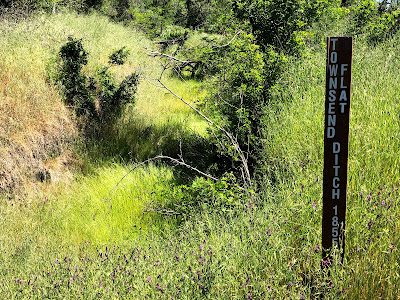
Above: the Townsend Flat Ditch on the left along with its marker on the right. This photograph was taken by Jeremy Tuggle on April 28, 2020.

Nathan A. Townsend was a native of New York who was born about 1824. Townsend arrived and settled at Middletown in Shasta County in 1853. Soon after, Townsend was elected as a member to the Shasta County Democratic Convention at Shasta in June of that year. He always supported the Democrat party in politics and while voting at the polls during election years. He mined on a flat near Horsetown which was named Townsend Flat in his honor.  

Townsend was the owner of the Union Hotel at Middletown in 1854. He was married to his wife May, a native of Illinois, as well. They operated the hostelry together, and aside from the hostelry business, Townsend was also a miner. 


This advertisement states, "Middeltown Ball. A ball will be given at the "Union Hotel", Middletown, on the evening of Tuesday, the 17th October. Every necessary arrangement will be made to make it go off agreeably. - N.A. Townsend". From the Shasta Courier newspaper edition of September 30, 1854.


Townsend claimed ownership to a number of mining claims a half mile below the town of Briggsville in the Clear Creek area.  In 1855, at this location, he built a dam and then he began the construction of a water ditch. This ditch originated on the north side of present day Saeltzer Dam at Clear Creek which is (unrelated to the Townsend dam). Clear Creek Road is not far from this ditch. The ditch stretched for a total of 6.4 miles long and empties into Olney Creek, it was completed that year. It brought him water to his mining claims which was used for the extraction of the gold he sought after.

That same year, the mining settlement of Nebraska situated along the Clear Creek area was coming to fruition with new settlers who were attracted to the local gold mining claims in the area. Nathan Townsend and his wife were among the first settlers of this community which never had a post office to send and receive mail. 

Apparently, Townsend went into partnership with a man named C.M. McKinney, and in May of 1858, they sued John D. Smith for damages to their ditch, dam and mining claims. Its unknown how extensive the damages to their property were. The case of McKinney & Townsend Vs. John D. Smith began that October and by November 6, 1858, the Shasta Courier newspaper published the following: 

"Interesting and Costly Suit - The case of McKinney & Townsend vs. J.D. Smith et al., that has occupied the District Court for about a month, elicited a greater amount of interest than any civil suit ever heretofore tried in our courts. It was rather an expensive affair. The jury fees alone amounted to upwards of $800, while the Clerk's fees amounted to perhaps a greater sum - to say anything of the fees and the sheriff and the lawyers." (SIC)

In December, the case of McKinney & Townsend vs. J.D. Smith was granted a new trial by the presiding judge the Honorable, William P. Daingerfield on motion of the defendants. It was then thought that the case would be tried by the Supreme Court, but eventually it was settled out of court. Additional disputes involving Nathan A. Townsend would soon emerge in the Shasta County Courts over his properties.

Later on, the 1860 U.S. Census records Nathan and Mary living in the county seat of Shasta. Nathan is recorded as "N.A." Townsend. There are no children mentioned on this record living in their residence. Nathan, also recorded $500 in real estate value on this record.  However, a son by the name of Wilbur was born to this union. It's possible there were other children.

The 1860 U.S. Census also records Nathan’s son Wilbur Townsend as “W.A.” Townsend who is living at Horsetown in the household of M. Patterson. Wilbur was working as a cook presumably at the Union Hotel in Middletown. Like his father, he was also a native of New York, and he was married to his wife Martha. Together they had two children, Lewis and Ada. Nathan's son Wilbur Townsend became the owner of the Union Hotel in 1861. 

In 1862, Nathan A. Townsend and his wife, Mary, were residing at Muletown, and in August of that year, he became a Justice of the Peace for that community. Townsend's partner C.M. McKinney was also the target of a lawsuit in the Shasta County District Court by Enos B. Taylor which during the above trial on the 16th of October 1862, on a judgement rendered at the June term of the said court in favor of Taylor for the sum of $5,499.17, with legal interests with the costs taxed in the sum of $143.45, in favor of Taylor. It was Shasta County Sheriff John S. Follansbee who was ordered by the court to sell the following described property at a future date, "The equal undivided one-half of the dam and ditch situate in the county of Shasta aforesaid, known as Townsend's dam and ditch, and which said dam and ditch were constructed for the purpose of taking the waters of Clear Creek from a point below Briggsville, and conveying the same on to mining and agricultural lands below said point. Also, one equal undivided one-half of all the farming claims and mining claims owned and possessed by the said N.A. Townsend, contiguous or in vicinity of said ditch; together with one equal undivided one-half of all the buildings on said premises, and the tools, sluice boxes, and all appurtenances thereunto below." (SIC)

Finally, on November 7, 1862, the above property was sold at auction to the highest bidder in Shasta. Unfortunately, the name of the buyer wasn't released by the local media. After 1863, not much is known about Nathan A. Townsend as he becomes untraceable in the United States Census records and information about him is unknown after this date. Nathan's son Wilbur Townsend relocated from Shasta County to the Nevada Township, in Nevada where his family was living in 1870. 

Years later, the Townsend Flat Water Ditch Company took over Nathan A. Townsend's earlier holdings along Clear Creek and his water ditch after this company was incorporated on December 3, 1890. The Townsend Flat Water Ditch Company dissolved in the early 2000's and most of the property was split up into private ownership under different people and parts of the ditch became the property of the McConnell Foundation. Today, this one hundred sixty-five year old water ditch still remains visible to the passing eye with trail markers marking its path along the Clear Creek Gorge Overlook and Trail, a pet-friendly, 3.5 mile long trail which ranges from easy to moderate along its path. Take plenty of water with you and the appropriate shoes, if you go. 


Above: the Townsend Flat Ditch trail marker. This photograph was taken by Jeremy Tuggle on April 28, 2020.


RESOURCES:

Shasta County Democratic Convention - The Shasta Courier newspaper of Shasta, June 11, 1853

Townsend & Co's Ditch - The Shasta Republican newspaper of Shasta, October 27, 1855

Clear Creek Ditch - The Shasta Courier newspaper of Shasta, October 27, 1855

District Court - May Term - The Shasta Courier newspaper of Shasta, May 22, 1858

Justice Made Cheap - The Shasta Courier newspaper of Shasta, October 9, 1858

Institutions - The Shasta Courier newspaper of Shasta, October 30, 1858

Interesting and Costly Suit - The Shasta Courier newspaper of Shasta, November 6, 1858

New Trial Granted - The Shasta Courier newspaper of Shasta, December 18, 1858

1860 U.S. Census

District Court Calendar - The Shasta Courier newspaper of Shasta, January 14, 1860

Justices and Inspectors of Election - The Shasta Courier newspaper of Shasta, August 17, 1861

Officers Of Election - The Shasta Courier newspaper of Shasta, August 23, 1862

Sheriff's Sale - The Shasta Courier newspaper of Shasta, October 25, 1862

Sheriff's Sale - The Shasta Courier newspaper of Shasta, November 1, 1862

Place Names of Shasta County by Gertrude Steger, published by La Siesta Press, ©1966.