Friday, August 24, 2018

THE HONORABLE JUDGE, AARON BELL (1832-1903)


Pictured above is the honorable Judge, Aaron Bell with his iconic white long beard which gave him the nickname of Billy Goat Bell. This photograph was taken by John C. Franklin, early 1890s. Courtesy of Shasta Historical Society.


Aaron Bell was born in Center County, Pennsylvania on December 2, 1832 to Christiana (Evans) Bell and John Bell Jr., he was the eldest of five children followed by: Edmund Bell, Jesse Bell, Jane Bell and Joseph Bell. Arron became well-educated and he graduated from Duff's Commercial College in 1851, at the age of nineteen, where Aaron majored in law. However, additional perks in California attracted him to venture west during the following spring when he was lured by the placer mines of that state. Aaron Bell arrived in San Francisco in April of 1852.

After a short stay in the city he departed San Francisco heading north towards El Dorado County, where he had learned that the mining scene was booming. He made plans to settle in Hangtown, which is now Placerville. This is where he mined for gold. He became popular amongst his peers while working at the placer mines. Eventually, Bell was chosen to become a deputy to various county positions in that area over a sixteen year span. During his residency there he also became a City Clerk of Placerville. The District Court of El Dorado County admitted him into the Bar in 1864, and he became a professional lawyer. After he was admitted into the Bar he practiced law in Sacramento.

As Bell's career took off he began pursuing cases pertaining to the United States land law. Then in 1871, the pioneer relocated from Sacramento to Shasta where he accepted a paid position as Registrar of the United States Land Office, which was located on Main Street. He still practiced law in Shasta opening an attorney’s office inside the above building. This was a year before the California & Oregon Railroad, a division of the Central Pacific Railroad, established a new town upon Poverty Flats called Redding on June 15, 1872. Bell held this position in Shasta for several years. At Shasta, on January 1, 1874, he married Julia Fipps, a local school teacher, and together they lived in a house on a hill in Shasta at the end of McDonald Alley. Together they began raising a small family of their own.


Above: An advertisement for Aaron Bell, Attorney At Law. His office was located in the United States Land building on Main Street in Shasta. This advertisement is from the January 20, 1877 edition of the Shasta Courier newspaper.


Then on, May 5, 1877, the Shasta Courier newspaper of Shasta reported the following about Bell:

"Aaron Bell, Register U.S. Land office, went below (that means Frisco.) Friday evening to atttend the meeting of the Grand Lodge I.O.O.F., also the reunion of the El Dorado pioneers." (SIC)

In July of 1879, Aaron Bell received the nomination for Judge of the Shasta County Superior Court on the republican ticket at Shasta. If he won this election he would become the first Superior Court Judge of Shasta County. At that time, Shasta was the county seat, and it was a position he sought after, however, he knew he had to resign as Registrar of the United States Land Office. Then on, Saturday, July 26, 1879, the Shasta Courier newspaper reported the following about Aaron Bell:

 “Aaron Bell having received and accepted the nomination for Superior Judge, has forwarded his resignation as Register of the Shasta U.S. Land Office to Washington.- Bell has made a splendid Register, his record as a Government officer is straight as an arrow, and his decision on contested points of land law have invariably stood the test when submitted to the exacting and learned heads of the land department at Washington. We regret to lose him from the place which he has so ably filled, but the position to which he aspired is one which demands the same qualities he has shown in the discharge of the duties of the office he resigns.” (SIC)

Aaron Bell was succeeded by William E. Hopping who became the new Registrar of the United States Land Office. Bell chased his dream of becoming the first Shasta County Superior Court Judge and took part in many campaign speeches along the way. Bell had experience as a lawyer but not as a judge, and his opponent was none other than democratic District Court Judge, Alexander M. Rosborough, a native of South Carolina. Both men were well-respected and popular. After the election ended the registered voters voted, and then the votes were counted. When the final vote was tallied the results showed that Bell swept his competition with an impressive 1,041 votes while Judge Rosborough carried 539 votes. The Honorable Judge, Aaron Bell began serving the position, honorably, until the year 1890.

During the week of January 1, - 10, 1880, Dr. George Silverthorne and Timothy Conklin made a real estate transfer to Judge, Aaron Bell, for a water ditch known as the Horse Creek Ditch in the Pittsburg mining district for a consideration of $200.00. Apparently, Bell owned some mining claims nearby which demanded the use of water to be conveyed from Horse Creek to his mining claims. The water helped him extract the lucrative ore he sought after. During 1881, Judge, Aaron Bell was affiliated with the Hogue Worley Ditch Company who owned a number of water ditches in the Pittsburg mining district. One of the ditches they owned was the Hogue Worley water ditch located on the west side of Horse Creek in the that mining region.

A year later, Judge, Aaron Bell located two placer mining claims which yielded him lucrative results while he worked them during his lifetime. He named first one the Shasta and the second one the Maine. The Shasta was located on May 26, 1882, while the Maine was located on June 13, 1882. Both of these placer mining claims were in the Shasta mining district near Shasta. Five years later, on September 4, 1887, the town of Redding was incorporated as a city and then in 1888 a major county wide vote was held as Shasta the Queen City of the North defended its position as the county seat of Shasta County. Eventually, Shasta was dethroned of the position it held and the City of Redding won the election. Then on, May 19, 1888, the City of Redding became the county seat of Shasta County. It was Judge, Arron Bell who ordered the removal of the county seat to Redding after the vote was held.

In November of that year, Judge Bell began advertising his house and property in Shasta for sell in the Republican Free Press newspaper of Redding. He relocated to Redding with his wife Julia, and their children, Jessie Bell, George Bell, and Harvey Bell, to their new location at the corner of Placer and West Streets in Redding. They were happy to be in their new residence, this building was much larger than their former Shasta residence and it contained nine rooms. During November of 1890 Bell’s term as the Superior Court Judge of Shasta County ended. Bell was succeeded by republican candidate, Edward Sweeney, who became the second Shasta County Superior Court Judge. He returned to practicing law and he opened an attorney’s office inside the Northern California Bank building in Redding. Bell continued dealing with cases pertaining to the United States Land law, as well as additional cases.

Then on, December 17, 1899, his middle child George Bell died at the age of twenty, it was a tragic loss to his family. George was buried in the Redding Memorial Park. Prior to 1899, Bell relocated with his wife Julia to a newer home in Redding when he donated his nine room house on the corner of Placer and West Street to be used as a school for students of the first Shasta County High School in Redding, this high school had no relation to Shasta Union High School which was established in 1923, completely different. Classes were held in his former home until 1901/1902 when a newer building was completed and stood until 1942. It’s not known where Aaron Bell moved to after donating his property to be used as a school. The Bell’s remained in Redding.

Bell became a Director of the Board for the Pioneer Gold, Silver, and Copper Mining Company which was established by Henry C. McClure, a miner, who lived at Copper City, on July 2, 1902. The rest of the Directors of the Board for the above mining company included: Henry C. McClure, Orson E. Nash, Thomas Green, and John R. Hall. They would begin extensive work on the well-known Recorder and Town Creek mines at Bully Hill in the Pittsburg mining district which assayed from $3.50 to $7 in gold and silver that year. Aside from being a lawyer and a mining man, the honorable Judge, Aaron Bell enjoyed a number of fraternal society’s as well. In April of 1855, he joined the Order of the Odd Fellows in El Dorado County, when he relocated to Shasta in 1871 he transferred into the Shasta Lodge of Odd Fellows No, 57, then in December of 1878, Bell joined and became a charter member of the Ancient Order of United Workmen, Shasta Lodge and on May 18, 1881, he joined and chartered the Shasta Council, No. 582, of the American Legion of Honor. In 1882, Bell had been elected as Vice Commander of the American Legion of Honor for California. After holding the position of Vice Commander of this organization he was elected in April of 1883 as Grand Commander of the American Legion of Honor for California the highest office a member can hold within that fraternal society. It was an honor he enjoyed having.

The honorable Judge, Aaron Bell died on Saturday, March 21, 1903 in his Redding home after a brief illness. His funeral was held on Monday, March 23, 1903, and out of respect for Shasta County’s first Superior Court Judge, local government offices and businesses remained closed as his funeral was conducted by the Odd Fellows with assistance from the Ancient Order of United Workmen. It was one of the largest funerals ever held in Redding up-to-this-date. He was buried in the Redding Memorial Park.

To conclude this article, the Shasta Courier newspaper on Saturday, March 28, 1903 reported the following about the deceased pioneer: “The estate of the late Aaron Bell is estimated at $10,000, mainly in stock in the McClure and Mt. Shasta Mining Companies.” The honorable Judge, Aaron Bell also at one point in his life owned a box, shingle and lathe factory which did remarkable business in Shasta County as noted in his pioneer plaque file at the Shasta Historical Society in Redding.


Above: An Aaron Bell letterhead. The Office of Aaron Bell, Attorney At Law, in the Northern California Bank Building in Redding. A note to Mr., David Elting of Edgewood. Dated January 11, 1893 in the hand writing of Aaron Bell. From the collection of Jeremy Tuggle.


RESOURCES:


1866-1884 & 1890 Shasta County Great Registers

The Shasta Courier newspaper of Shasta - September 13, 1879


History and Business Directory - Shasta County - 1881 by B.F. Frank and H.W. Chappell. Redding Independent Book and Job Printing House, Redding, California, ©1881.

Dethroned - The Shasta Courier newspaper, Saturday, May 26, 1888

The Pioneer Gold, Silver and Copper Mining Company - The Daily Free Press, Monday, July 2, 1900

BP-026 Bell, Aaron Pioneer Plaque File on file at Shasta Historical Society.

Shasta Historical Society Pioneer History - Aaron Bell

The Covered Wagon, 1996.

History of the Shasta County Sheriffs, 1851-1990

Timeline:


September 7, 1850 - Michael Oppenheimer

April 14, 1852 - David Corsaut

*David Corsaut was named sheriff following a special election. However, in May 1852, he was suspended after failing to submit the required bond required to secure the office. The Court of Sessions then appointed James M. Coats as sheriff. Corsaut later satisfied the bonding requirement and resumed the office in September 1852.

June 15, 1852 - September 1, 1852 - James M. Coats.

September 1, 1852 - September 1, 1854 - David Corsaut 

September 1, 1854 - September 5, 1855 - William A. Nunnally

September 5, 1855 - September 5, 1857 - John A. Dreibelbis

September 2, 1857 - September 2, 1859 - H. Clay Stockton

September 7, 1859 - September 7, 1863 - John S. Follansbee

September 2, 1863 - September 2, 1867 - William E. Hopping

*Hopping served a second term from November 7, 1882 - February 1892

September 4, 1867 - September 6, 1871 - Thomas Greene

*Greene was appointed Sheriff to complete Hopping’s term on February 15, 1892.

September 6, 1871 - 1881 - Sylvester Hull

November 8, 1892 - 1894 - Albert F. Ross Sr.

*Ross Sr., served a second term from November 3, 1914 - 1919

November 6, 1894 - November 1898 - Thomas J. Houston

November 8, 1898 - November 1902 - Charles H. Behrens

November 4, 1902 - November 1906 - James L. Richardson

*Richardson was appointed to complete the term of Ross Sr., on January 27, 1919.

November 6, 1906- 1914 - James L. Montgomery

November 7, 1922 - 1942 - William W. Sublett

November 3, 1942 - 1946 - Roy Duggins

November 5, 1946 - August 31, 1982 - John Balma

September 1, 1982 - November 8, 1982 - James J. Carter

November 9, 1982 - December 1, 1990 - Pilip Eoff

December 4, 1990 - December 2005 - James “Jim” Pope

June 6, 2006 - December 2019 - Thomas Bosenko

December 2019 - 2021 - Eric Magrini

Present Sheriff: Michael L Johnson

*Last updated: March 15, 2026

RESOURCES: 

Compiled from listings available at Shasta Historical Society in Redding.

History of the office of Shasta County Recorder, 1851-1994

Timeline:

 1851-1851 - John C. Burns

 1851-1852 - Jesse R. Robinson

 1852-1855 - Thomas W. Dawson

 1855-1857 - William S. Jenkins

 1857-1859 - H.J. Van Horn

 1859-1864 - James R. Durick

 1864-1867 - George D. Forbes

 1867-1868 - Samuel Cooper

 1868-1871 - Grant I. Taggart

 1871-1872 - Milton S. Babcock

 1872-1877 - William H. Bickford

 1878-1888 - Franklin C. Tiffin

 1883-1886 - Thomas B. Smith

 1886-1890 - Albert F. Ross Sr.

 1890-1892 - Alexander R. Andrews

 1892-1902 - John R. Lowdon

 1902-1914 - Abraham L. Webb

 1914-1934 - Henry C. Woodrum

 1934-1953 - Winona V. Simmons

 1953-1978 - Mildred Montgomery

 1978-1990 - Marjorie A. Kively

 1990-1994 - Virginia A. Loftus

 1994 - 2006 - A. Cris Andrews

Present Recorder: Leslie Morgan 

*Last Updated: March 15, 2026.


RESOURCES: 

Compiled from listings available at Shasta Historical Society in Redding.

History of the office of Shasta County Assessor, 1852-1994

Timeline:

 1851-1853 - Thomas T. Cabaniss

 1853-1854 - Samuel E. Jack

 1854-1856 - William S. Hughes

 1856-1857 - James C. Hayburn

 1857-1858 - R.B. Snee

 1858-1860 - William H. Angel

 1860-1862 - B. Gartland

 1862-1864 - Caleb Watkins

 1864-1872 - A.P. Ladd

 1872-1876 - D.O. Osborn

 1876-1880 - Quintius N. Atkins

 1880-1886 - William S. Kidder

1886-1890 - Quintius N. Atkins

 1890-1894 - Thomas B. Smith

 1894-1902 - Alexander Ludwig

 1902-1906 - Richard E. Collins

 1906-1922 - M. Dempse Lack

 1922-1934 - Louis L. Garrecht

 1934-1952 - John L. Klukkert

 1952-1960 - Myron R. Harrison

 1960-1974 - Robert O. McMillen

 1974-1978 - James T. Hull

 1978-1994 - Virginia A. Loftus

 1994 - 2006 - A. Cris Andrews

Present Assessor: Leslie Morgan 

*Last updated: March 15, 2026.

RESOURCES: 

Compiled from listings available at Shasta Historical Society in Redding.

Tuesday, August 14, 2018

MAJOR PIERSON BARTON READING (1816-1868): THE FIRST EUROPEAN-AMERICAN SETTLER IN SHASTA COUNTY


Major Pierson Barton Reading (1816-1868). This Carta de Vista was taken in 1862. Photographer unknown. Courtesy of Shasta Historical Society.


Pierson Barton Reading (pronounced like the color red), was born to Pierson Reading and Charity (Guild) Reading in Hunterdon County, New Jersey on November 26, 1816, and in 1830, Pierson departed New Jersey, leaving his family behind at the age of fourteen to live with his step-uncle Charles B. Green in Madison County, Mississippi. 

Then in 1834, Reading begins his career as a cotton broker in Madison County. Three years later, at the age of twenty-one, he goes broke due to the price of cotton crashing at the market. Pierson eventually returns to his family in New Jersey. According to the Reading family lore, and local historians, Pierson marries for the first time even though his first wife’s name is unknown but apparently during their short union a daughter was born to them on August 7, 1842, and they named her Jeanette "Janette” Reading, Jeanette was born in Louisiana. At a later date, he leaves his wife and daughter behind in Louisana for Missouri and Reading eventually becomes divorced.

However, according to my friend David L. Templeman, a great-great grandson of Pierson Barton Reading and Euphan “Fannie” Wallace (Washington) Reading. Templeman claims the following about the presumed first marriage of Major Pierson B. Reading:

"There is absolutely no record of a first marriage. There is a story of Janette's mother dying of yellow fever while in New Orleans, when Janette was a baby. Yet no grave or record can be found. I can only imagine Janette's actual mother was not married to Pierson B. Reading. Perhaps a house servants baby. The spelling of her name is French, which aligns with the New Orleans origin story. Unfortunately, a crew of excited historians spent a lot of time speculating about Janette's origins and have released a couple of unsubstantiated proposals. All hold little or no merit.

The first myth is that Janette is Pierson B. Reading’s illegitimate half sister, through his father Pierson Reading's affair (which is also unsubstantiated). There is a fraudulent letter floating around, written by the "niece of Janette", claiming there was a whole family born to Pierson Sr. (again this is Pierson B. Reading’s father). My grandmother was convinced it was a fraud, a con artist chasing money. The second myth is that Janette is the illegitimate daughter of a Reading or Green cousin in Vicksburg. Personally I like to believe she is my great-great Aunt, daughter of Pierson B. Reading." Templeman is also a keen researcher into his own genealogy.

In May of 1843, at Westport, Missouri, Reading joined a large party of immigrants ranging between five hundred and seven hundred people who were traveling to Fort Hall, in Oregon. This immigrant group was led by Peter H. Burnett, and they ventured across the plains heading west towards Oregon with 113 wagons which carried the supplies they needed to survive the long trek. At this time, Reading became good friends with another man in the group by the name of Samuel Hensley.

In September of that year, the Burnett party arrived at Fort Hall; it took them five months to complete the trip over the rough and rugged terrain as the adventure west ended. Once the immigrants arrived in Oregon a small number of men decided to leave the Burnett party and continue south into California. This new group formed the Chiles-Walker party, and their destination was Sutter’s Fort. After purchasing the necessary supplies needed to descend into California, they departed Fort Hall on September 16, 1843. Besides Reading, the Chiles-Walker Party included the following men: Charles Bradley, Henry Chase, Isaac Chase, James Chase, Joseph B. Chiles, Captain John Grantt, Samuel J. Hensley, William Martin, Milton McGhee, John Myers, Joseph R. Walker, and Squire Williams. It was Walker who led the party.

On Thursday, October 26, 1843, the Chiles-Walker party arrived in the region of what became Shasta County, after passing over the Sierra Nevada Range. On that day, they reached the landmarks which we know today as Pit River Falls and Burney Falls. After stopping at both sites, they continued their journey as they encountered numerous Native Americans along the way, who lived in semi-subterranean homes, they knew the white men were in the area but they avoided them. Eventually, Reading saw his first glimpse of his future home, the Rancho Buena Ventura, and then they continued heading south with his party. California at that time was controlled by Mexico. It was Hensley who suggested to Reading that he should obtain a land grant from the Mexican government for this particular area that they were passing through. On Friday, November 10, 1843, they reached Sutter's Fort (or Fort Nueva Helvetia) owned by Captain John A. Sutter.

In 1844, Pierson applied to receive the above property. Reading’s application for the land grant was signed off by Mexican Governor, Manuel Micheltorena on December 4, 1844. This land grant consisted of 26,632.08 acres of land, which extended from the south at Cottonwood Creek and to the north at Salt Creek in Redding. The grant also stretched three miles west of the Sacramento River. He named his land grant the Rancho Buena Ventura meaning “good fortune” in Spanish. In order to obtain his Mexican land grant Reading had to denounce his American citizenship and become a full-fledged Mexican citizen. This is why most American immigrants in California did not apply for land grants under the Mexican government at that time.


A map of the Rancho Buena Ventura land grant owned by Major Pierson Barton Reading. 


The Rancho Buena Ventura became the second land grant in what is now Shasta County. The first land grant was located on the east side of the Sacramento River which was called the Rancho Buena De Briesgau. It was comprised of 22,000 acres of land, and it was William Bennitz who applied for this land grant which was granted to him on July 26, 1844, by Governor Micheltorena. Bennitz was a native of Breisgau, Germany, which is why his rancho was named De Breisgau. However, Bennitz never settled on his property and due to this reason it was never recognized as an official land grant by the Supreme Court of the United States. Then in, September of 1845, Reading joined the United States military to enlist into the Bear Flag Revolt. He enlisted into John Freemont’s battalion as a Paymaster. Reading worked himself through the ranks and he was eventually promoted to the rank of Major.

During the following year, Pierson becomes an active supporter of the settlers revolt to turn California into a State of the Union and on June 14, 1846, a group of American immigrants and ex-patriots marched on Vallejo’s post in Sonoma to successfully over throw the Mexican Government and they declared Reading’s closest neighbor William B. Ide as President of the new Republic of California.

In 1847, Major Reading returned to live on his Rancho Buena Ventura permanently and he erected an adobe house. Reading became the first permanent white settler of what is now, Shasta County, at that time. (His Adobe House fell to vandals in 1942, but it’s listed on the National Register of Historic Places and is California Historical Landmark No. 10)

It wasn’t long before gold was discovered in California by James Wilson Marshall on January 24, 1848, at Coloma on the American River in a tailrace of a sawmill owned by Marshall and John Sutter. After the reports were confirmed that Marshall found gold, it sparked the California Gold Rush and the rush for riches began as new people arrived in California to search for gold. These new arrivals in California would soon be known as forty-niners.

Major Reading took a trip south to the site where Marshall made his discovery and he noted the same red clay on the property and he determined that it was possible that gold could be found on his own property, or at least near it. Then on March 18, 1848, with the help of the Wintu Tribe of Native Americans, Major Pierson B. Reading discovered gold in Clear Creek at what is now known as Reading's Bar, making the second gold discovery in California. Miners would soon descend upon the Rancho Buena Ventura prospecting for gold and squatting on Major Reading’s property, and placer mining erupted along the creek channels.

While prospecting for gold these miners formed tent communities, and the following are the earliest known communities, which were established in 1849: Churntown, Cottonwood, Horsetown, Lower Springs, Middle Creek, and Reading Springs (Shasta). The first community which was established in what is now Shasta County was Cottonwood. In 1848, Major Reading co-established a general merchandise store with Samuel Hensley in Sacramento which was called Hensley, Reading & Company. The firm only lasted for two years when the partnership dissolved in 1850.

Two years after the advent of the California Gold Rush the Rancho Buena Ventura contained the following livestock: 210 horses, 10 mules, 15 cows, and 30 oxen. Major Reading led a prosperous life in California on the western frontier. Then on, February 18, 1850, the County of Shasta was created as one of the original twenty-seven counties of California. It wasn’t until September 9, 1850, that California was admitted into the Union as the 31st State. Major Reading’s adobe residence became the county seat of Shasta County on, February 10, 1851, it was used for court proceedings and the housing of court related documents but government business was never held there.


Pierson B. Reading of Shasta for Governor. A political advertisement from the Daily Union newspaper of Sacramento, June 7, 1851.


Six months later on, August 15, 1851, Major Pierson B. Reading, Dr. Oliver M. Wozencraft and Captain McWhinney establishes the Treaty of Peace and Friendship at the Rancho Buena Ventura with the surrounding Indian tribes. With this treaty they were hoping the Indians would become friendlier towards the white settlers. It became one of 18 peace treaties which was never ratified by the American Government.

Then on, September 3, 1851, Major Reading runs for the office of Governor of the State of California on the Whig ticket in the gubernatorial election. Reading loses the election to Democratic opponent John Bigler who led the election with 441 votes. Bigler became California’s third Governor. At a later date, Pierson meets a gentleman in San Francisco who told him that he was ordered to toss out some 4,000 votes to help arrange Bigler’s victory in the election.

Due to Pierson’s interest in the local Native American tribes he was appointed by Congress to become the Superintendent of Indian Affairs for California on June 18, 1852. Then between: 1853-1854, Pierson promoted a survey of the Noble’s Pass route for a wagon road and with a  group of businessmen from Shasta, contributed $2,000 to send Hamden Holmes Noble back over the route he discovered in 1851. Major Reading also encouraged and supported the construction of the California-Oregon Stage Road. (It is currently California Historical Landmark No. 58.)

Prior to 1855, a man named Richard Bland Lee II was stationed as a Lieutenant at Fort Reading on Cow Creek in Shasta County. Lee became great friends with Pierson and he became a frequent visitor to the Rancho Buena Ventura. It was Lee who persuaded Reading to pursue his niece Euphan “Fannie” Wallace Washington since he was planning a future trip to Washington D.C., where she lived. Fannie was a nickname she was often called by her close family and friends. She was born in September of 1831 to Anna Matilda (Lee) Washington and Doctor Bailey Washington III., at Washington D.C., she was an elegant young lady.

The main reason for the trip east was to check the legal status of his land grant. It was during December of 1855, when Reading traveled east towards Washington D.C., and upon his arrival he immediately began courting Fannie. While Reading was checking his status of ownership of the Rancho Buena Ventura land grant, the Supreme Court of the United States approved his ownership on January 11, 1856. The patent was signed by President, Franklin Pierce. Reading’s trip east was a double success because his land grant was confirmed and a wedding date was decided by Pierson and Fannie.

Then on, March 13, 1856, they were married in Washington D.C., by the Reverend George Cummins at the Trinity Episcopal Church. On this day, a gift was presented to Pierson by Elizabeth (Collins) Lee who was the maternal grandmother of Fannie. It was Elizabeth who told Pierson that he reminded her of President George Washington and then she presented Reading with a lock of the president’s hair of whom the Lee & Washington families were related too. A month later on, April 5, 1856, Mr. and Mrs. Reading departed New York to take his bride west to California crossing the Isthumus of Panama while they made their way towards San Francisco.

While aboard the steamer James L. Stephens, Fannie became sea sick, and the newlyweds reached San Francisco on May 4, 1856, once they reached land Fannie began feeling a lot better. At San Francisco, they checked into the Oriental hotel. They stayed in the city for a while before they resumed their journey north to Shasta County were here they arrived at the Rancho Buena Ventura on May 12, 1856. This was the first glimpse of her husband’s property that Fannie saw that day. Fannie was now among the early pioneer women of Shasta County, she would start writing letters home to her family about her “western” adventures on the frontier of California.


Eupan "Fannie" Wallace (Washington) Reading (1831-1918). Circa 1860s, the photographer is unknown. Courtesy of Shasta Historical Society.


The adobe house which Pierson built in 1847 was too small for him and Fannie to raise a family together so during the year 1856 he added onto the adobe structure by erecting a two-story building. It was a wood framed structure that contained eight rooms. Pierson never referred to it as a mansion but local residents dubbed it the “Reading Mansion”.


The Reading Mansion appears here in this sketch by Alice M. Reading, a daughter of Major Pierson B. Reading. The adobe on the right is the original structure which was built in 1847 by Reading. The 2-story house was attached in 1856 after his marriage took place. The house contained 8 rooms and it burned down in 1881. The adobe fell into decay in 1942. Courtesy of Shasta Historical Society. 


Euphan “Fannie” Wallace (Washington) Reading would eventually bear Pierson six children between the years 1857 and 1865, respectively. Those children were the following:

1. Anna Washington Reading (1857-1906)
2. Alice Matilda Reading (1859-1939)
3. Pierson Barton Reading Jr. (1861-1862)
4. Richard Washington Reading (1863-1925) [twin]
5. Robert Lee Reading (1863-1918) [twin] {actually lived in Shasta County, civil engineer of Shasta County}
6. Frances Collins “Fannie” Reading. (1865-1888)

During the interim, of the above births of their children, in January of  1862, the Original Williams & Kellinger Gold, Silver & Copper Mining Company was incorporated at Copper City with $75,000 divided into 300 shares of $250 each. There principal stockholders were the following people: J.J. Bell, John Kellinger, Major Pierson B. Reading, Dr. George Silverthorne M.D., Charles Williams, and Hogue Worley. Copper City was located on the Squaw Creek, about thirty miles north-east of Shasta. The above company owned and operated the Williams and Kellinger mine located on Kellinger Hill (now Killanger Peak). It was a mine discovered by Charles Williams, but the hill it was located upon was named after his mining partner John Kellinger.

Major Reading had a vision to navigate Steamboats up the Sacramento River north of Red Bluff to Clear Creek between: 1850 and 1860. His dream never became a reality, however, between the years: 1863 and 1864, Pierson establishes a town called Latona in Shasta County as the head of WHOA Navigation to bring steam boats up the Sacramento River. The meaning behind WHOA Navigation defines it as being a slang phrase to describe Shasta in the 1850s. Shasta was the end-of-the-line on the wagon road. Major Reading hired Colonel William Magee to survey this four hundred acre town site for him. Latona was named after a Greek goddess.

During 1864, Pierson engaged himself into mining activities with Kendall Vanhook Bumpass. Bumpass was an early day miner and prospector. Pierson and Bumpass owned a mining claim in the Lassen area. This mining claim turned chaotic with deep pockets of lava flow in which Bumpass lost his leg and he had to have it amputated. Today this mining claim is known as “Bumpass Hell” and it is now located in Lassen National Park.

The esteemed pioneer, Major Pierson Barton Reading, died on his Rancho Buena Ventura land grant on May 28, 1868, at the age of fifty-two years. He was buried in the Reading Family Cemetery on Adobe Road in Cottonwood where other members of his family are interred at this location. Fannie survived her husband another 50 years until she died. Fannie remained on the Rancho Buena Ventura for another three years until she relocated in the east where she settled at Alexandria, Virgnia, in 1871. She made another move in 1878 from Alexandria to Washington D.C., where the pioneer died on May 4, 1918.

There are currently nine historically important sites in Northern California which are dedicated to the memory Major Pierson Barton Reading:

1. Reading’s Bar in Shasta County on Clear Creek, located south west of Redding is named for Major Reading. This is where gold was discovered by Major Reading on March 18, 1848.

2. Reading’s Bar in Trinity County near Douglas City is named for Major Reading. Reading made the first discovery of gold in that county as well in 1848 at the mouth of Reading Creek.

3. Reading Creek in Trinity County is named for Major Reading.

4. Reading Springs (a creek) in the town of Shasta is named for him. (Note: the town of Shasta was formerly called Reading Springs before June 8, 1850, when the town was renamed Shasta by Armstead C. Brown who named it because it was the closest town to Mount Shasta, at that time. Mt. Shasta was in the original boundaries of Shasta County. Siskiyou County wasn’t established until 1852.)

5. Reading Island on the Sacramento River just below the bluff of the Reading Adobe in Cottonwood is named for Major Reading. Due to the channel of the Sacramento River changing, this island is no longer in existence.

6. Fort Reading which was established on May 26, 1852, along the west side of Cow Creek in Shasta County, was named for Major Pierson B. Reading.

7. Reading Rock on the Pacific Ocean is named for Major Reading, it is located near Orick, Humboldt County, California.

8. Reading Peak in Lassen Volcanic National Park was named in honor of Major Pierson B. Reading in 1943.

9. The Reading Family Cemetery is named in honor of Major Reading’s family who is buried there on Adobe Lane in Cottonwood.


Above: the present site of Major Reading's adobe on Adobe Lane in Cottonwood. The adobe fell into decay in 1942. This photograph was taken by Jeremy Tuggle on July 8, 2018.


Above: the original Reading Adobe monument at the present site of Major Reading's adobe on Adobe Lane in Cottonwood. This photograph was taken by Jeremy Tuggle on July 8, 2018.


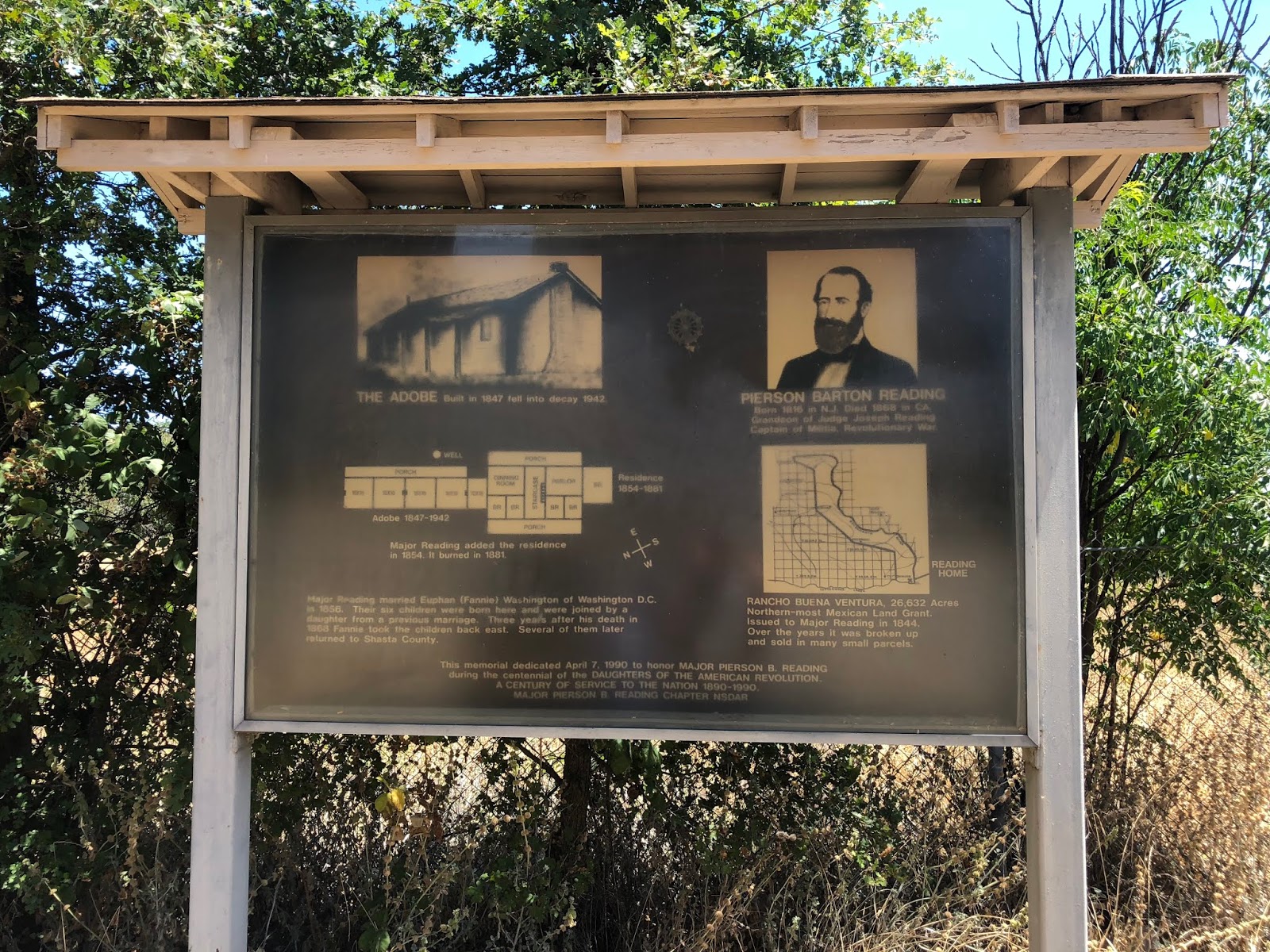
Above: a newer sign with photographs helps record the history of the Reading Adobe on Adobe Lane at Cottonwood. This photograph was taken by Jeremy Tuggle on July 8, 2018.


Above: the location of Reading's Bar. This photograph was taken by Jeremy Tuggle on July 8, 2018.


Above: the entry way into the Reading Family Cemetery where Major Pierson Barton Reading is buried, its located on Adobe Road in Cottonwood. This photograph was taken by Jeremy Tuggle on July 8, 2018.


The Reading Family Cemetery where Major Pierson Barton Reading is buried with members of his family, its located on Adobe Road in Cottonwood. This photograph was taken by Jeremy Tuggle on July 8, 2018.


RESOURCES:


My Playhouse Was A Concord Coach, an anthology of newspaper clippings and documents relating to those who made California history during the years 1822-1888, by Mae Hélène Bacon Boggs. Published by Howell-North Press ©1942

Shasta County, California A History by Rosena Giles, published by Biobooks, ©1949.

Man Of Destiny Pierson Barton Reading Pioneer of Shasta County, California by Helen S. Giffen, edited by Eleanor Lee (Reading) Templeman, published by Shasta Historical Society, © 1985.

The Journal of Pierson Barton Reading Overland to California, 1843, by Madge Richardson Walsh, ©2003 published by the Association for Northern California Historical Research.

RP-004 - Reading, Pierson Barton Pioneer Plaque File on file at Shasta Historical Society.

Mining Corporations – The Shasta Courier newspaper of Shasta, May 16, 1863

Death of Major Reading - The Shasta Courier newspaper of Shasta, May 30, 1868

Died - The Shasta Courier newspaper of Shasta, May 30, 1868

Funeral - The Shasta Courier newspaper of Shasta, June 6, 1868

Pioneer Woman Called Beyond At Washington - The Courier-Free Press newspaper of Redding, May 6, 1918

An E-mail Correspondence - Subject: Jeanette Reading dated August 9, 2018 between David L. Templeman and Jeremy M. Tuggle, filed in the RP-004 Reading, Pierson Barton Pioneer Plaque File on file at Shasta Historical Society.


Tuesday, July 31, 2018

Due To the Carr Fire There Will Be No Blogs This Week Or Next


Spot fires along Copley Mountain from the Carr Fire. Orange flames in dense smoke. This view was taken from the Shasta Dam area. This photograph was taken by Jeremy Tuggle on July 26, 2018.


Due to Shasta County and the Redding area ravaging in flames this week by the Carr Fire, there will be no blogs from me this week or possibly next week. I haven’t been at work since Thursday afternoon, and my family is trying to get our lives back on track. Our house in downtown Redding on Chestnut Street in the historic Breslauer Addition has survived the fire even though we were evacuated twice. A third evacuation for our neighborhood was lifted Sunday morning. 

Up-to-this-date, the Carr Fire has burned over 103, 722 acres. The fire which began by a vehicle malfunction at the Carr Power House has gone on to become the 7th most destructive fire in California State history according to the Record Searchlight and it continues to bring havoc to the North State. Here are some photos and video’s that I took of the Carr Fire...


Spot fires along Copley Mountain from the Carr Fire. Orange flames in dense smoke. This view was taken from the Shasta Dam area. This photograph was taken by Jeremy Tuggle on July 26, 2018.


Spot fires along Copley Mountain from the Carr Fire. Orange flames in dense smoke. This view was taken from the Shasta Dam area. This photograph was taken by Jeremy Tuggle on July 26, 2018.


A view of the Carr Fire from the Shasta Dam area. This photograph was taken by Jeremy Tuggle on July 26, 2018.


A smokey view near the Shasta Dam area with a red sun. This photograph was taken on July 26, 2018 by Jeremy Tuggle.


My house on the left. 1600 block Chestnut Street with the smoke of the Carr Fire in the distance. This photograph was taken by Jeremy Tuggle on July 26, 2018.


1600 block of Chestnut Street looking west with the smoke of the Carr Fire in the distance. This photograph was taken by Jeremy Tuggle.


Looking north up the 1600 block of Chestnut Street in downtown Redding. Smokey, colorful skies. This photograph was taken by Jeremy Tuggle on July 26, 2018.


Looking at a West-North position from the 1600 block of Chestnut Street in downtown Redding. The smoke of the Carr Fire. This photograph was taken by Jeremy Tuggle on July 26, 2018.


1608 Chestnut looking with with the Carr Fire in the distance. Time to evacuate... this photograph was taken by Jeremy Tuggle on July 26, 2018.


A house fire near the corner of Aquamarine and Lake Redding Drive in downtown Redding. I reported it to 911 that night. This photograph was taken by Jeremy Tuggle on July 26, 2018.


Looking at Lake Redding/Harlan Drive area being destroyed by the Carr Fire. This photograph was taken by Jeremy Tuggle on July 26, 2018.


The Carr Fire ravaging the Redding area on Thursday, July 26, 2018. I got rerouted from Eureka Way into this mess on Benton Drive passing through the 11th Street intersection and passing by the historic Diestelhorst Bridge. I was brought out to Sulpher Creek Hill at Miracle Mile and it took a very long time to get through the madness of people evacuating downtown.

Tuesday, July 24, 2018

The Bunker Hill Mine


This map was surveyed on August 12, 1948, as part of the railroad relocation project from Middle Creek to Matheson. The Bunker Hill mine is noted as the George P. Whaley and A.M. Whaley lot.


In 1860, a miner by the name of Samuel Gaston, a resident of Middle Creek, led a party of miners consisting of: James T. Loag, Drury D. Harrill, and Soloman D. Brawstow. The later were all prominent residents of Shasta. However, some accounts refer to them as the Loag party. They started prospecting the channel of Middle Creek and they struck a lucrative vein of decomposed quartz near the mouth of the creek.
   
While they were at their new mining claim, Gaston and his men began the surface work, that day. A couple hours later, another party of miners arrived at the scene. This group was led by Terrance Brennan of Shasta. During my research I haven't found any documents which contains the other names of the Brennan party. The local media often referred to them as Brennan & Company. After their arrival at the mining claim, a heated argument ensued between Brennan & Company and the Gaston party. During this argument Brennan & Company objected to their work because they claimed that they were infringing upon a nearby quartz lode that they owned. They demanded the Gaston party to leave at once and never to return.
   
After Gaston and his men returned to their home’s, Gaston traveled into Shasta where he filed a law suit against Terrance Brennan in the Shasta County District Court, in November of that year. Gaston had reasons to believe that Brennan & Company didn’t own the mining claim. The case was tried before Judge William P. Daingerfield. 
   
Later that month, on November 27, 1860, the Sacramento Daily Union newspaper of Sacramento reported the following account:

"SHOOTING AFFAIR - Terry Brennan and Samuel Gaston who have been engaged in a law suit in reference to a mining claim located near Middle Creek, Shasta county, met on the claim on Monday, morning November 19th, both armed and, after an exchange of some harsh words and threats, resulted in Brennan shooting Gaston in the arm. Brennan gave himself up, says the Northern Argus, but none appearing against he was discharged." (SIC)

Over the years the media outlets in California have twisted the above shooting affray into a bloody battle between Gaston’s party and the Brennan party, at the Bunker Hill mine. The above article was derived from an article that appeared in the Northern Argus, a newspaper from Horsetown. Some accounts are bogus but the above article is the most authentic story of the Bunker Hill mine, due to its gold and lore the mine became famous.

As the trial in the District Court preceded, the disputed mining claim was brought before the miners of the Lower Springs Mining District and the Middle Creek Mining District to determine if Gaston and his men were conducting surface work or quartz lode work on December 5, 1860. They were also hoping to settle the dispute out of court. Apparently, the miners decided that they were conducting surface work and the Gaston party would eventually infringe upon the quartz lode owned by Brennan & Company. There were mining resolutions which were passed that day but they were not in favor of Gaston & Company. Gaston continued the law suit in the District Court. 

The earliest account of this mine being referred to as the Bunker Hill appears in a newspaper article which was printed on Saturday, December 8, 1860 by the Shasta Courier. It’s not clear as to who named this mining claim, but the shooting affray between Brennan and Gaston played an important part of its naming. One of the questions brought before the District Court was in regard to who had completed the most surface work at the mine, and only time would tell.

On Saturday, March 23, 1861, the Northern Argus printed the following column: 

"DISTRICT COURT - The court has been engaged during the greater part of the present week, in trying the case of Gaston against Brennan and others. It terminated on Wednesday last, the jury stood nine for plaintiffs and three for defendants. The case will be tried again during the coming week." (SIC)

During the next week, the jury in the trial voted in favor of the plaintiff on every count. Apparently, it was determined by the District Court that Gaston and his group completed the most surface work at the site. Therefore, they were the rightful owners of this disputed property. Gaston won the lawsuit which allowed him to collect damages from Brennan. 

Then on, Saturday, April 13, 1861, the Gaston party took possession of the Bunker Hill mine and they resumed their mining operations that day. Once again, Brennan & Company started another altercation with them as they rushed into the mining claim and belligerently forced the Gaston party off the property. Brennan & Company threw out all of their equipment and additional belongings they brought with them as well.

Upon their departure from the Bunker Hill mine, Gaston & Company immediately went to get the Sheriff at Shasta, and they returned with Sheriff, John S. Follansbee to Bunker Hill where Gaston and his party had the sheriff arrest the Brennan party for rioting. The Brennan party still claimed ownership of the mine even though the District Court awarded it to Gaston and his group. After the Brennan party were released from jail, Gaston and his men obtained a Writ of Resolution from the District Court of Shasta County. Due to this clause an agreement was reached by both parties who decided not to mine the claim for thirty days until the rightful owner was decided again by the District Court.

It was Judge William P. Daingerfield who officially declared ownership of this mining claim to Samuel Gaston and his party in May of 1861, which ended the Writ of Resolution. Brennan was very disappointed that he lost the potential ownership of the Bunker Hill mine. Lawyers for Brennan’s party motioned for a new trial to be granted but the motion was denied by Judge Daingerfield.

Gaston and his men established the Bunker Hill Company, naming themselves after their mine. Each of them owned shares within the mining company. In April of 1862, the Bunker Hill Company were steadily mining and extracting gold from their placer mine at an lucrative rate of six to ten pounds per day. They employed four men to assist them in their claim. The Shasta Courier, a newspaper from Shasta, reported the following account on Saturday, May 3, 1862:

"BUNKER HILL - On last Thursday, this claim paid ninety-three ounces, and it is improving continually."

Then in, October of 1862, a notice was printed by the Shasta Courier that claimed Brawstow was selling his interest in the Bunker Hill mine. This was a chance for others to buy his shares within this mining company, and the new shareholder profited very well. 

During May of 1863, prospectors Hoy and Kennedy struck a rich vein of ore on land adjoining the Bunker Hill mine. The discovery yielded remarkable results which were heralded by the local media in Shasta. Hoy & Kennedy cleaned up nicely as it was reported that they were making between $900 and $1,700 per day with the employment of three miners extracting the ore near the Bunker Hill mine. The local media opined that this vein was a continuation of the Bunker Hill mine lead.

A ditch was dug from Middle Creek and miners extended it into the Bunker Hill mine to help them convey water into their mining site to assist them in the extraction of gold. If a large abundance of water was available then mining was a regular occurrence on the property. The Bunker Hill Company negotiated a contract with the Spring Creek stamp mill to crush its rock to obtain the ore. It was surface rock that they were crushing. After the deal was made they began delivering large quantities of rock to the nearby stamp mill. 

Two years later, the Bunker Hill Company was still actively perusing their claim. In February of 1865, their miners struck a new vein of gold ore. It was reported by the Shasta Courier newspaper that: "four pans of rock from which, when crushed in a hand mortar yielded twenty-four ounces and eight pennyweights. It still continues to pay nearly the proportion."

Nearly a month later, the Bunker Hill Company continued making progress on their placer mine as they extracted forty ounces in two days by washing pay dirt. The ground contained an abundant of ore in profitable quantity to be extracted by their miners. As the mine kept revealing its secrets they rapidly stayed in production that year. In January of 1866, after a run of a two week period the mine yielded between fifteen and sixteen hundred dollars in gold. The mine continued to produce lucrative ore. There were no adits, shafts or tunnels on the property it was still an active placer mine, not a quartz mine.

Aside from washing pay dirt at the mining site. The miners extracted the ore from a soft slate in a thin strata of decomposed quartz as well. Their miners struck gold in deep pockets of quartz, and located quartz walls with veins of gold on the property. 

In 1872, the construction on the California & Oregon Railroad, a division of the Central Pacific Railroad, finished bringing the railway north to Redding. The construction would not resume north for another ten years. During the interim, in December of 1874, Drury D. Harrill applied to the United States Government for a patent which was granted at a later date for the Bunker Hill mine. After a ten year hiatus, the construction of the railroad resumed north from Redding in 1882.

That year, Chinese immigrants who were employed by the railroad made an amazing discovery of gold pieces valued between $15,000-$20,000 at the Bunker Hill mine, it wasn’t reported by the local media about how or why these gold pieces were left. At that time, the Bunker Hill mine was abandoned. However, this discovery brought a renewed interest to the mine and it was developed again.

In 1896, the Bunker Hill mine was owned by John Varner Scott of Shasta, a Mrs. Carmichael of Oakland, and Mrs. Emily Loag of New York (the widow of James T. Loag.) A man named William Albert Pryor was an overseer of Mrs. Loag’s shares of the mine. Pryor's position granted him access to the mining property and mining rights.

In December of 1900, the Bunker Hill Company employed one man and an armed guard at the mining site to protect their property, because the mine began yielding  $3,000 per day. It’s days of being a lucrative placer mine were ending as the owners wanted to transform the placer mine into a quartz mine with adits, tunnels and shafts. Eventually, additional men were hired by the above company to do that for them.

The first shaft was dug to eight feet below the surface of the earth and a new tunnel was dug in near the hillside to the new shaft. While the miners were digging out and constructing the new tunnel a new vein of gold was discovered by them.

During the year 1915, the mining property included sixty acres of patented land and 460 feet of tunnel. The mine was owned by William A. Pryor, the Shasta druggist, and a man by the surname of Logan. According to G. Chester Brown of the California State Mining Bureau the Bunker Hill mine included a north and south vein which was five feet wide with 200 feet of drifts. Pryor and Logan were working the mine together while they were producing fine specimens of ore.

Eventually, the quartz mine was abandoned again, and during the 1940s, it was relocated again. Miners began redeveloping the mining site and extracting the ore from it. Then the production stopped. The last owner’s of the property was George Whaley and his wife A.M. Whaley of San Francisco, according to a 1948 map of the property which was surveyed for the railroad relocation project from Middle Creek to Matheson.

At the Bunker Hill mine there are remains of an old water well which has been plugged, a rock retaining wall, a plugged shaft and a few fig and grape trees. Along the creek nearest to the mining site there are a few spots indicating that the miners tried probing while miners dug for gold. From historical references it’s learned that drifts and adits were made with underground openings (now plugged). If you go take water with you on a hot day.

The unmarked trailhead to the Bunker Hill mine is located just north of the ribbon bridge that spans the Sacramento River on the Keswick side of the Sacramento River Trail. From this trailhead the trail guides you in about 0.2 miles from the Sacramento River Trail near the mouth of Middle Creek. The trail is a moderate hike into the mine. Another mine called the Compton mine exists north of here at Rock Creek just off the Sacramento River Trail, if you know where to look.


Above: The superintendent of the mine more than likely lived near this plugged water well of the Bunker Hill mine. This photograph was taken by Jeremy Tuggle on June 13, 2015.


Above: One of the plugged shafts of the Bunker Hill mine. This photograph was taken by Jeremy Tuggle on June 13, 2015.


Above: One of the plugged shafts of the Bunker Hill mine. This photograph was taken by Jeremy Tuggle on June 13, 2015.


Above: Miners tried to probe here but without luck they moved on to better diggings. This photograph was taken by Jeremy Tuggle on June 13, 2015.


Above: A Fig tree at the Bunker Hill mine, a rock marking the spot in memory of someone. This photograph was taken by Jeremy Tuggle on June 13, 2015.


Above: Grape trees at the historic site of the Bunker Hill mine. This photograph was taken by Jeremy Tuggle on June 13, 2015.


Above: A rock retaining wall against the trail into the gold mine. This photograph was taken by Jeremy Tuggle on June 13, 2015.


Above: The headstone of the original locator of the Bunker Hill mine, Samuel Gaston (1834-1909). He was interred into the Redding Memorial Park. Gaston was a native of Livingston County, New York. He arrived in Shasta County and settled at Middle Creek in 1852. He was a miner. At a later date, Gaston relocated from Middle Creek to Elko, Nevada where he served as a deputy Sheriff for a number of years. After that, he returned to Shasta County and died in the county hospital. This photograph was taken by Jeremy Tuggle on June 19, 2018.


Resources:

Shooting Affair - The Sacramento Daily Union newspaper, November 27, 1860

Mining In Shasta - The Shasta Courier newspaper, Saturday, April 26, 1862

Bunker Hill - The Shasta Courier newspaper, Saturday, May 3, 1862

A Chance - The Shasta Courier newspaper of Shasta, October 4, 1862

Rich Claim - The Shasta Courier newspaper, Saturday, May 9, 1863

The Mines Played Out - The Shasta Courier newspaper, Saturday, February 11, 1865

Bunker Hill Co. - The Shasta Courier newspaper, Saturday, March 4, 1865

Bunker Hill - The Shasta Courier newspaper, Saturday, April 29, 1865

Bunker Hill - The Shasta Courier newspaper, Saturday, January 6, 1866

Bunker Hill - The Shasta Courier newspaper, Saturday, June 9, 1866

Bunker Hill - The Shasta Courier newspaper, Saturday, June 16, 1866

D.D. Harrill - The Shasta Courier newspaper, Saturday, December 5, 1874

Bunker Hill - The Shasta Courier newspaper, Saturday, October 20, 1877

Bunker Hill - The Shasta Courier newspaper, Saturday, February 29, 1896 

1896 California Voters Registration

A Story of Bunker Hill Mine - Sausalito News, December 15, 1900

Mines and Mineral Resources of Shasta County, Siskiyou County, and Trinity County, by G. Chester Brown, ©1915 published by California State Printing Office. Page 37.

Place Names of Shasta County by Gertrude Steger, published by La Siesta Press, ©1966.

Mindat.org

Mines and Mineral Resources of Shasta County, ©1974, Philip A. Lyden & J.C. O'Brien