Showing posts with label Keswick. Show all posts

Thursday, August 8, 2024

THE IRON MOUNTAIN MINE: A SITE OVERVIEW.


Above: The Iron Mountain Mine; A Site Overview.

In 1865 Charles Camden located the first iron ore body upon Iron Mountain which gave its name to the mountain, a 3,600 ft. high mountain, situated in the West Shasta mining district of Shasta County, California. Over the years the property grew to contain the Brick Flat mine, the Complex mine, the Hornet mine, the Little Nelly mine, the Lost Confidence mine, the Mattie mine, the Minnesota mine, the No. 8 mine, the Old mine, and the Richmond mine. It became a celebrated lucrative producer within this county. Camden then went into partnership with Colonel William Magee, and they eventually brought on James M. Sallee as an owner with them after Sallee located an impressive ore body of silver upon the mountain. The nearby communities of Iron Mountain, Keswick, Matheson, South Park, and Taylor came into fruition due to the mine itself. The first year of production for this mine was in 1879 and the last year of production was in 1963. On September 8, 1983, the Iron Mountain mine became an EPA superfund site and is presently ranked as the third largest polluter in California. In 2010, the Iron Mountain Mine was labeled as a "Toxic Hellhole" by the San Francisco Gate media outlet. For more information, please see the attached YouTube video: "The Iron Mountain Mine; A Site Overview."


Resources: 


A Road to Shasta Would Pay - The Shasta Courier newspaper of Shasta, September 11, 1869

Iron, Mountain - The Shasta Courier newspaper of Shasta, October 21, 1871

Iron Mountain - The Shasta Courier newspaper of Shasta, April 2, 1881

Lost Confidence Mine - The Shasta Courier newspaper of Shasta, May 14, 1881

Iron Mountain - The Shasta Courier newspaper of Shasta, May 21, 1881

Iron Mountain - The Shasta Courier newspaper of Shasta, June 25, 1881

Iron Mountain - The Shasta Courier newspaper of Shasta, September 24, 1881

Rich Mineral Strike - The Record-Union newspaper of Sacramento, August 29, 1881

The Republican Free Press newspaper of Redding, August 8, 1885

Eleven Bars of Bullion - The Republican Free Press newspaper of Redding, September 17, 1887

The Shasta Courier newspaper of Shasta, December 7, 1895

The Shasta Courier newspaper of Shasta, December 14, 1895

The Shasta Courier newspaper of Shasta, January 11, 1896

Will Succeed Hill - The Free Press newspaper of Redding, May 1, 1897

Mines and Miners - The Free Press newspaper of Redding, May 4, 1897

South Park - The Free Press newspaper of Redding, July 22, 1897

Mail Route to Fielding - The Free Press newspaper of Redding, November 19, 1897

Aubury, Lewis E. The copper resources of California: California Mining Bureau Bulletin 23: 65. 1902

William McKendrick - The Free Press newspaper of Redding, December 25, 1903

William McKendrick - The Free Press newspaper of Redding, December 29, 1903

Mines and Mineral Resources of Shasta County, Siskiyou County, and Trinity County, by G. Chester Brown, ©1915 published by California State Printing Office.

Aerial Tramway to Be Built by Copper Company - The Sacramento Daily Union newspaper of Sacramento, April 30, 1921

Shipping 500 Tons of Ore Everyday - The Searchlight newspaper of Redding, January 11, 1922

To Move Keswick P.O. To Matheson - The Searchlight newspaper of Redding, July 7, 1922

Charles F. Reed to be Postmaster - The Searchlight newspaper of Redding, October 20, 1922

Post Office at Keswick to Go - The Searchlight newspaper of Redding, January 14, 1923

25 Prospectors Find Good Leads Around Matheson - The Searchlight newspaper of Redding, January 24, 1923

Iron Mountain Mine No. 8 Is Closed Down - The Courier-Free Press newspaper of Redding, July 18, 1930

Mines and Mineral Resources of Shasta County, California – County Report 6 – by Philip A. Lydon and J.C. O’ Brien ©1974 by California Division of Mines and Geology

(4) Iron Mountain Mine - Jobs and Clean-up from Recovery Act Funds - YouTube

(4) Inside Iron Mountain Mine - YouTube


Wednesday, June 9, 2021

THE CLARA MINE AT KESWICK, CALIFORNIA.

On this episode of Exploring Shasta County History, Jeremy takes you on another exciting mining adventure with his friend, Ralph Bentrim. This former mining property embraces Ralph's property at Keswick. This mining property is a former Au (gold) mine called the Clara which has been developed in parts to allow the Sacramento River Trail to traverse over it. Mining activities has been idled here for many years. The mine is noted as a small producer of gold which was last owned by private parties in 1974. According to county reports it had three parallel veins hosted in granite porphyry, a payshoot of 20 in. wide, 160-feet long, which carried free gold. It also featured a 700-foot adit. Today, the former mining property includes open pits covered in vegetation, a plugged adit and plugged shafts. Check it out, and please subscribe to Exploring Shasta County History, and my YouTube channel.


Above: a plugged shaft of the Clara mine. This photograph was taken by Jeremy Tuggle on May 27, 2021.


THE ADVENTURE: 


Filmed on location May 27, 2021.


RESOURCES:

Mines and Mineral Resources of Shasta County, Siskiyou County, and Trinity County, by G. Chester Brown, ©1915 published by California State Printing Office.

Mines and Mineral Resources of Shasta County, California – County Report 6 – by Philip A. Lydon and J.C. O’ Brien ©1974 by California Division of Mines and Geology

Friday, May 14, 2021

Experiencing the 1896 Old Railroad Grade In Keswick, California.

On this episode of Exploring Shasta County History, Jeremy takes you on an adventure over different parts of the 1896 Old Railroad Grade in Keswick, California. Filmed on location May 12, 2021.


THE ADVENTURE:


Thursday, May 6, 2021

LEGENDARY MINING LORE: GOLD NUGGETS OF HISTORY

Newcomers Frederic Rochon, a native of New York, and his Canadian partners Levi Longfield, and John Hayett, arrived from lower California and settled at Shasta together in the early months of 1870. After their arrival, they immediately located a placer mining claim on Spring Creek. After that, their mining activities took-off with them earning fair wages from this mining claim prior to making the biggest discovery of their lives. Then, on June 25, 1870, this trio discovered the largest gold nugget ever found along the channel of Spring Creek, about where the present-day town of Keswick is today.

They had successfully removed a large boulder in a bar on the channel of the creek, beside a Cottonwood tree which was growing on the bank above them, with their mining tools, when Rochon immediately picked up a lucrative gold nugget with his hand. This gold nugget contained no quartz, nor any other substance, as it was pure gold. Excitement rang out amongst themselves, and they immediately widen their perimeter before leaving the area in hopes of finding more specimens of gold nuggets. 

Then, they departed their mining claim to return home to Shasta where this gold nugget was placed on a scale at a local business. It weighed in as being fifteen pounds and four and a half ounces in gold. It was then valued at $3,200. Up-to-this-date, the main theory was that the mining claims along Spring Creek had been “worked-out", and this find created a brand-new mining boom to Spring Creek but eventually the excitement died out.

This gold nugget gave Rochon fame and fortune with state wide media coverage. Rochon barely credited his partners with any glory nor profit from this discovery. Some media outlets claimed that this was the largest gold nugget ever found in Shasta County history. 

As for Longfield and Hayett they departed the area and never returned. Rochon trusted the gold nugget to be handled by Doctor Benjamin Shurtleff, of Shasta, and his wife, Mrs. Ann (Griffith) Shurtleff who helped Rochon get it properly assayed, documented and photographed. It was their son George Shurtleff who took it to San Francisco with him for exhibition purposes on behalf of the owner and he immediately returned it to Rochon upon his return to Shasta.

There are two stories of how this gold nugget was sold, one version claims that it was sold to Charles McDonald, of Shasta, for $3,600, and the other version claims that it was sold to Santin & Everett, of San Francisco, for $3,200. Rochon eventually moved from Shasta to Round Mountain after selling this gold nugget, and later on, he relocated from Round Mountain to Bells, in Shasta County. Then, in November of 1873, another miner not affiliated with Rochon found a $300 gold nugget near the location of Rochon’s discovery site, and Rochon was in the news again because of this discovery.

Rochon worked in various careers during his lifetime, he was a laborer, a miner, a lumberman, and a carpenter. Rochon died at the Shasta County Hospital in Redding, on November 25, 1907, at the age of ninety-four years old. Years later, in 1921, Rochon's gold nugget was remembered when local residents Joseph Miller and John Stein found a gold nugget weighing nineteen pounds and two ounces along Motion Creek which was valued between $4,500 and $5,200. However, various reports claimed it weighed more than that, which wasn’t the case, immediately it became the largest gold nugget ever found in Shasta County, up-to-that-time. This gold and lore tale are a few of the legendary mining stories of Shasta County.


Above: gold in a scale being weighed, obviously not as large as the gold nuggets mentioned in this article but it gives you a visual of how gold was weighed. Courtesy of Shasta Historical Society.


Resources: 

1870 U.S. Census

A Big Specimen And How It Was Found - The Shasta Courier newspaper of Shasta, July 2, 1870

That Nugget - The Sacramento Daily Union newspaper of Sacramento, July 7, 1870

Shasta County - The Marysville Daily Appeal of Marysville, November 22, 1870

The Shasta Courier newspaper of Shasta, November 29, 1870

The Shasta Courier newspaper of Shasta, November 29, 1873

1876 Great Register of Shasta County

1880 U.S. Census

Largest Nugget Of Gold - The Daily Free Press newspaper of Redding, May 26, 1898

That Spring Creek Nugget - The Daily Free Press newspaper of Redding, May 28, 1898

Redding - The Chico Record newspaper of Chico, August 29, 1906

Fredrich Rochon -The Colusa Daily Sun newspaper of Colusa, November 27, 1907


Gold Nugget Worth About $4,500 Found In Redding Section - The Sacramento Daily Union newspaper of Sacramento, February 15, 1921

$5,200 Gold Nugget From Shasta County Melted At SF Mint - The San Francisco Call newspaper of San Francisco, February 15, 1921


Friday, October 2, 2020

REDISCOVERING THE COMPTON MINE OF THE SHASTA MINING DISTRICT


Above: modern graffiti appears inside the main haulage tunnel of the Compton mine, this photo was taken by Jeremy Tuggle on September 22, 2020.


The Compton mine was a producer of gold which was located in the boundaries of the Shasta mining district about 1 1/2 mile south of the town of Keswick, and south of Keswick Dam on the west side of the Sacramento River, at the mouth of Rock Creek on forty acres of land. In 1915, this mining property was owned and operated by G.F. Bassett, of Redding. Bassett developed the property from a vein of quartz associated in granite-porphyry.

Mining records indicate it contained a small pay-shoot. Bassett brought in two small five-pound stamp mills on the property near the adit of this lode mine which crushed the rock so he could obtain the ore it produced. The stanchions of these stamp mills remain on site along the present-day Sacramento River Trail at that location. 

Active Sacramento River Trail users have seen the trail which leads to the Compton mine many times, but the adit is blocked by a rock in front of it and you can't see the opening until you climb to the top of the trail. It's a very tight squeeze to get into. It contained an adit with a short drift, and two small winzes above the adit which have been plugged. Production notes were not kept for the Compton mine. 


Above: this YouTube video was filmed on location of the Compton mine by Jeremy Tuggle on September 22, 2020.


RESOURCES: 


Mines and Mineral Resources of Shasta County, Siskiyou County, and Trinity County, by G. Chester Brown, ©1915 published by California State Printing Office.

Mines and Mineral Resources of Shasta County, California – County Report 6 – by Philip A. Lydon and J.C. O’ Brien ©1974 by California Division of Mines and Geology


Thursday, March 5, 2020

HAMDEN HOLMES NOBLE AND HIS CONTRIBUTIONS TO SHASTA COUNTY

Hamden Holmes Noble was a son of James W. Noble, a farmer of Somerset County, Maine. Hamden was born in that county at Fairfield on August 16, 1844. This is where he earned his education. Later, he relocated to San Francisco where he first registered to vote in 1866. At that time, Noble was employed as a clerk. He married his wife Grace Chalmers on July 27, 1871, and their wedding was performed by the Reverend L. Walker, in San Francisco. During this union three children were born to them:

1. Grace (Noble) Johnson (1870-1957) married Edwin V.D. Johnson (Edwin V.D. Johnson was the manager/superintendent of the Northern California Power Company, Johnson and his wife Grace lived in Redding from 1903-1910.) 

2. Nora (Noble) Mead (1880-1935) married Ernest E. Mead.

3. Hebe (Noble) Grolle-Crawford (1896-1950) married 1st: Grolle, first name unknown, then she married 2nd: John Crawford. 


Above: Hamden Holmes Noble (1844-1929) poses for a photograph. Courtesy of Shasta Historical Society. 


Later on, Noble became a stockbroker and then he established the Keswick Electric Power Company in 1900 to provide the Iron Mountain Copper Company’s smelter at Keswick with hydro electric power, and later the Balaklala Consolidated Copper Company at Coram. This is when they created Nora Lake near Shingletown which was named after his second daughter, Nora (Noble) Mead (1880-1935). It was a combined fore-bay and storage reservoir for the Volta Powerhouse. This company was renamed as the Northern California Power Company in 1902, and Noble became its president.

Noble would often stay at his daughter’s house in Redding when they made trips to check on their properties in Shasta County. However, Noble felt it was time to build a summer resort for his family to use at Shingletown. In January of 1903, the Northern California Power Company fenced off all the property they owned in Shingletown. Two months later, the Northern California Power Company relocated their office into the north-west room of the Lorenz hotel in Redding.


Above: The headquarters of the Northern California Power Company inside the north-west room of the Lorenz hotel in Redding on Yuba Street. This postcard image was taken between the years: 1904 and 1915. From the collection of Jeremy Tuggle. 

Later that year, a two-story building called Noble’s Bungalow was erected by Hamden H. Noble who utilized the native rocks and stones from the bluff it was built upon, near Shingletown. It had a beautiful view of the Manton Valley below it. It featured a circular design to it and the roof was made of wood. The structure included a square tower and a wide porch supported by stone pillars around the tower. It was a two-story building with the downstairs being one large room which featured a circular fireplace. The upstairs included three wedge shaped bedrooms. 

There was a second building on the property which was used as a kitchen and a servants headquarters. There was also a stable on site as well. Noble installed a pipe in the structure which conveyed fresh water from a nearby spring. The Noble family used this structure as a summer resort when they came north to Shasta County so they didn't have to stay at his daughter's residence in Redding all the time. It was also known as the Castle in the Sky and Noble’s Castle. 


Above: this undated photograph shows Noble's Bungalow which was erected in 1903. It was also known as Castle in the Sky and Noble's Castle. Courtesy of Shasta Historical Society. 

A secondary fore-bay and storage reservoir for the Volta Powerhouse called Grace Lake was created in 1906, approximately one mile north of Nora Lake. It was named after Noble’s eldest daughter, Grace (Noble) Johnson (1870-1957). Two of his three daughters received man made lakes named after them while Hebe didn’t receive one in her honor, at least in Shasta County. 

In 1917, a forest fire gutted the castle. It also destroyed the secondary building and the stable on the property. After the fire, the Noble family returned to the property and they were surprised to see parts of the structure still standing. Later on, his wife Grace died in 1927, and her husband survived her by two years when he died on December 19, 1929 at San Francisco. He was also the founder of the Cypress Lawn Memorial Park in San Mateo County, California where he is buried with his wife. 

The tower and the fireplace remained standing in 1959. It then began a slow deterioration process which made it crumble to the ground. Today, the only remains at the site are a pile of rocks from the castle like structure. A historic plaque was dedicated on July 10, 1988, by the Mt. Lassen Historical Society (now the Shingletown Historical Society), Pacific Gas & Electric Company, and the Trinitarianus Chapter 62 of the E. Clampus Vitus. 


Above: An unidentified boy stands near the center of the circular fire place of Noble's Bungalow. Circa 1955. Courtesy of Shasta Historical Society. 


Above: the remains of Noble's Bungalow. Circa 1955. Courtesy of Shasta Historical Society. 


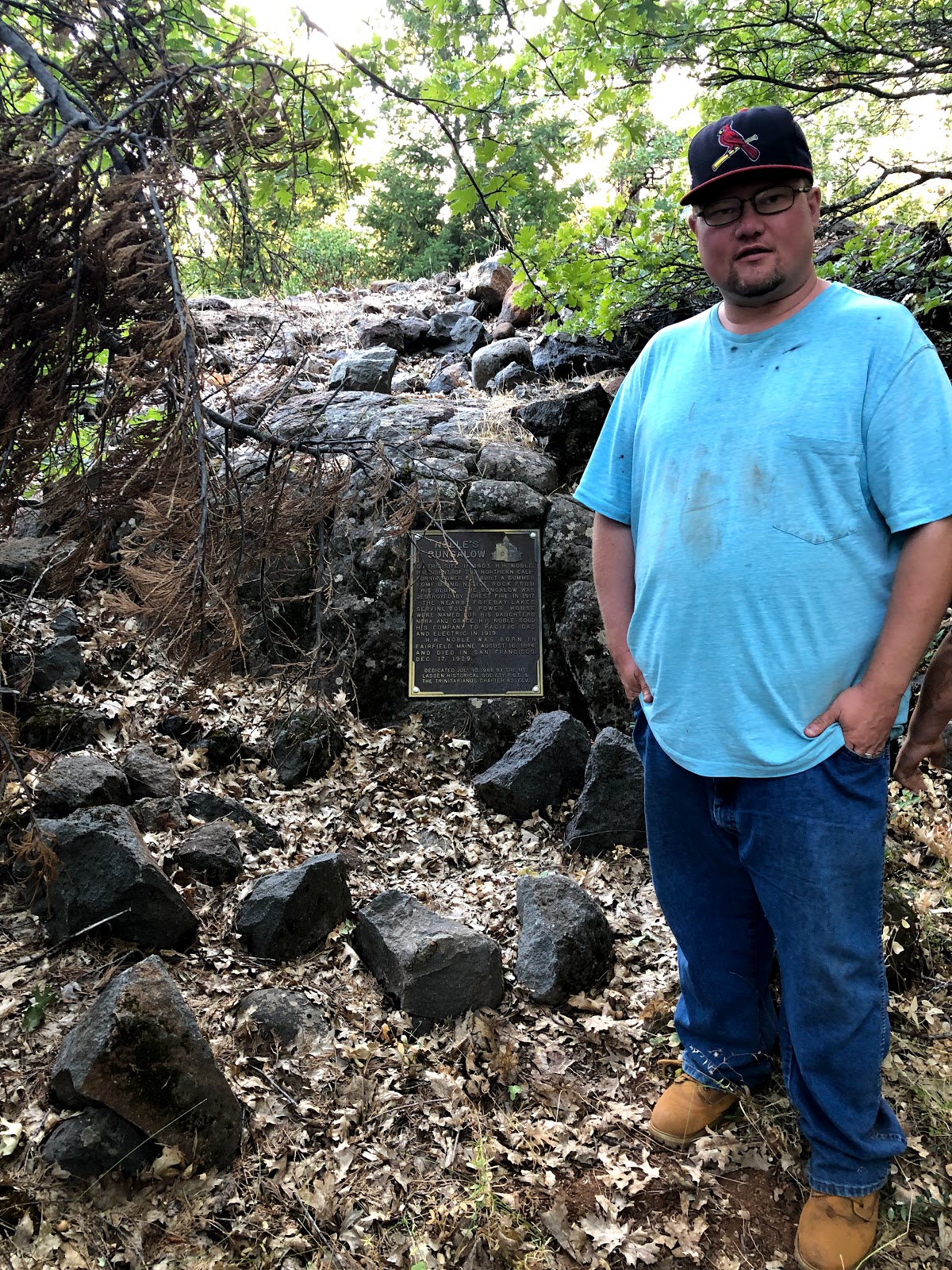
Above: Noble's Bungalow historic plaque dedicated July 10, 1988 by the Mt. Lassen Historical Society, P.G.& E., and the Trinitarianus Chapter #62 of E. Clampus Vitus. Photograph taken by Jeremy Tuggle on August 18, 2019. 


Above: the ruins of Noble's Bungalow. Photograph taken by Jeremy Tuggle on August 18, 2019. 


Above: a different view of the ruins of Noble's Bungalow. Photograph taken by Jeremy Tuggle on August 18, 2019. 


Above: after a long days work, Jeremy Tuggle poses for a photograph next to the historic plaque for Noble's Bungalow. This photograph was taken by Gabriel Leete on August 18, 2019. 


RESOURCES:

1860 U.S. Census

1870 U.S. Census

California Voter Register, 1866

Married - Daily Alta California newspaper of San Francisco, August 1, 1871

1880 U.S. Census

1900 U.S. Census

The Searchlight newspaper of Redding, January 4, 1903.

The Searchlight newspaper of Redding, January 14, 1903

The Searchlight newspaper of Redding, January 18, 1903 

The Searchlight newspaper of Redding, February 28, 1903

The Searchlight newspaper of Redding, March 10, 1903

The Searchlight newspaper of Redding, March 31, 1903

The Searchlight newspaper of Redding, April 3, 1903

The Searchlight newspaper of Redding, April 11, 1903

The Searchlight newspaper of Redding, April 23, 1903

The Searchlight newspaper of Redding, April 30, 1903

The Searchlight newspaper of Redding, May 8, 1903

Getting Ready For A Great Smelter At the Balaklala - The Searchlight newspaper of Redding, May 10, 1903

The Free Press newspaper of Redding, August 14, 1903

1910 U.S. Census

1920 U.S. Census

Hamden H. Holmes in the California Death Index, 1905-1939

Death Ends Long And Useful Life Of H.H. Noble - The Sausalito News newspaper of Sausalito, December 20, 1929

The Covered Wagon 1954, published annually by Shasta Historical Society

Here’s A Castle Ruin Not In Europe by Isabel Bedynek - The Sacramento Bee newspaper of Sacramento, October 18, 1959

VF 729. Noble’s Castle, on file at the Shasta Historical Society

The Covered Wagon 1975, published annually by Shasta Historical Society

Where The ‘ELL Is Shingletown? The Shingletown Story By Marion V. Allen ©1979 Printed by Press Room Inc., Redding, California, Pages 81.

Tuesday, July 23, 2019

ONE YEAR ANNIVERSARY OF THE CARR FIRE; REVISITING THE DEVASTATED AREAS & THE HISTORY OF KESWICK


Above: a welcome to Keswick sign, Keswick was established in 1895. The town sign survived the Carr Fire, located at Market Street and Iron Mountain Road. This photograph was taken by Jeremy Tuggle on August 8, 2018.


The historic and deadly Carr Fire erupted into flames around 1:30 p.m., on July 23, 2018 at the intersection of Highway 299 West and Carr Powerhouse Road, due to vehicle malfunction failure. It ravaged everything in its course of destruction in Shasta County as it entered nearby populated places traveling into Shasta. Spot fires were a regular occurrence. On the afternoon of July 26, 2018, some spectators watched from the vista points near Shasta Dam as the Carr Fire climbed over Copley mountain, but the worst was yet to come.

The fire raged into Lower Springs, Keswick and Redding. Eventually, it made its way into other places in the area. It was scary, unlike anything our county has seen before, we weren't prepared for this monster, but our fire fighters and first respondents battled the blaze. Everyone was on high alert, and some evacuations were almost last minute. Pure fear and pandemonium spread over Keswick and Redding when the famous fire whirlwind ravaged them, that night.

The fire kept getting hotter and had its own weather pattern. Then it jumped the Sacramento river, and also made its way south-east to Harlan Drive and the Lake Redding Drive area. Many people were evacuated from their home's including downtown Redding at Chestnut Street. All the hotels and motels were completely booked for many miles by evacuees. Emergency shelters were set up at various places in the county. Traffic in and out of Redding was a nightmare in its own. The Carr Fire grew to become the 6th most destructive fire in California state history and it became the most destructive fire in the history of Shasta County. One hundred percent containment was held on the fire at 229, 651 burned acres on August 30, 2018. Eight lives perished during the deadly fire, a tally of 1,079 homes were destroyed, while another tally of 79 homes were damaged which included the Shasta County Fire Station No. 53 at Keswick, which was a volunteer fire company.

The Carr Fire destroyed the town of Keswick leaving only two residences standing next to each other on separate lots on Weiland Street. However, one of Keswick’s unknown secrets were revealed. The strange metal dome shape structures seen on the property of Alan Crabtree were seen for the first time. They were usually blocked from the view of the public by his buildings on the property and they attracted much attention on Facebook and many people called into the Shasta Historical Society wondering what they were. We didn't know much about them, and yet we could only speculate. Through a mutual friend I was placed in contact with Crabtree and he believes that they were “covers for artillery and people sold surplus from them, years ago.” However, it’s not known exactly what they were originally used for. According to Crabtree the inside of the covers had iron in them.


Above: only two houses survived the Carr Fire which are located on Weiland Street near Bush Street at Keswick. Both houses are shown here in this photograph above. This photograph was taken by Jeremy Tuggle on August 8, 2018.


Above: the residence at 11541 Weiland Street survived the Carr Fire. This photograph was taken by Jeremy Tuggle on August 8, 2018.

Above: the residence at 11557 Weiland Street survived the Carr Fire. This photograph was taken by Jeremy Tuggle on August 8, 2018.


Above: one of the strange metal dome shape structures, possibly used as a cover for artillery, from which people sold surplus from them, years ago. This photograph was taken by Jeremy Tuggle on August 8, 2018.

You could say that history has repeated due to the Carr Fire as it’s not the first time the town of Keswick has been destroyed by fire. The phrase “We will rebuild” which was coined by local residents after the Carr Fire comes to mind, because in past history, it did rebuild after the destruction of those major fires. Today (July 23, 2019), marks the one-year anniversary since the hellish Carr Fire erupted into flames.

THE ESTABLISHMENT OF KESWICK:


Long before the town site of Keswick was established the present town site was bustling in action with horse racing, cock fighting, gymnastic exercises, and additional entertainment purposes for our local residents to enjoy. A horse racing arena called the Oakland Horse Racing Track was established there in 1852 by pioneer T.J. Stump. Stump owned the track until 1856, it was also home to a suburb of Shasta called Hogtown which never took-off and eventually disappeared. Hogtown was located near the Stump Ranch that Stump owned and lived upon.

Stump sold out to Frank Thompson and later owners made extensive changes to the property. The smelter town of Keswick was established in 1895, due to the nearby production of the Iron Mountain mine, which was owned and operated by the Mountain Copper Company LTD., who had purchased the mining property from Charles Camden, Colonel William Magee and James M. Sallee, that year. The mine was located in 1865 by Camden and Magee, and it quickly became known for its mass copper production. The mining property was part of the Shasta County copper belt. Sallee became a partner in 1884, after discovering a lucrative vein of silver in their mine.


Above: the Keswick smelter was the the first copper smelter in Shasta County. It was built between 1895 to March 1896, when one of the first furnaces of the smelter began its operation. It was formerly located on Spring Creek on the site where the Spring Creek Powerhouse is today on Iron Mountain Road. Note: the denuded hill sides from the deadly chemicals of the smelter fumes. Date: unknown. Courtesy of Shasta Historical Society.

While the smelter was being erected upon Spring Creek the first order of business by the Mountain Copper Company LTD., was to erect living quarters for their personnel, and this included the superintendent residences. The living quarters consisted of a one two-story building comprised of sixteen rooms with furnishings which included baths and toilets. This made their staff feel comfortable at home. The company also built a mess hall and a entertainment hall. Construction then followed on two company office buildings.

On October 18, 1895, the Shasta Courier newspaper reported the following:

“Keswick and the camps are booming, locomotives tooting up and down the new track. It’s a regular hive of industry.”

The owner and president of the Mountain Copper Company LTD., was Lord William Keswick of London, England, who the town of Keswick was named for. The Mountain Copper Company, LTD., holdings on Iron Mountain included the following mines on the adjacent properties: the Complex, the Hornet, the Lost Confidence, the Mattie, the No. 8, the Old Mine, and the Richmond.

As the new settlement of Keswick boomed it flourished, even though it was a rough-and-rugged up-and-coming-place to live. The town was primarily established due to the nearby copper smelter which was designed to process the ore from the Iron Mountain mine. Then on, November 23, 1895 the local media offered the following glimpse of the area:

“While the Iron Mountain improvements result in considerable benefit to the country in various respects, the inflow of tough characters, which always follows on the heels of any great enterprise, is bound to cause considerable and public exbense” (SIC)

The settlement also contained thirty-five saloons, a railroad station, stores, boarding houses, hotels and a school. In December of that year, due to the high number of saloons in Keswick the Mountain Copper Company LTD., banned all employees who “patronized the saloons” there. It appeared that they wanted a sober crew of employees who took the job seriously. With that many saloons in operation, one can see that this company had their job cut out for them. 

“W.S. Harvey-Wray of Keswick, was a visitor here, Sunday. He is to be assistant editor of Mountain Mine monthly paper, or magazine, to be issued by parties employed with the company. The residing surgeon and physician, Dr. Kenneth Millican, A.B., M.R.C.S., will be chief editor. George A. Poor, the veteran book and job printer of Redding, has the contract to print the periodical, which will be sixteen pages, two columns to a page.” (SIC) The above magazine only operated for a period of six months at Keswsick when it was discontinued by the owners.

A second post office called Taylor was established in the smelter town on May 18, 1897, by the United States Postal Service who appointed John K.O. Hair as the first postmaster. Keswick now had two post offices serving their community. Taylor was the post office and Keswick was the town site. This post office served Keswick until August 15, 1922 when it was discontinued and the mail from the Taylor post office was rerouted to the Keswick post office.

During July of 1897, the third branch store of the McCormick-Saeltzer Company was established in the growing smelter town at the new suburb of Keswick, called South Park. Keswick was attracting attention in the local media, and the firm was offered a room inside the brand-new Keswick hotel or Hotel Keswick at that location by its owner, John N. Stephenson. This store was owned by James McCormick, Rudolph M.F. Saeltzer and Williamson L. Smith who were all local businessmen.


Above: this undated photograph shows the Keswick hotel or Hotel Keswick building which was designed by architects W.J. Bennett and his partner Gove. The hotel was erected by carpenters McCarthy & Gillespie at South Park in Keswick. The Keswick branch of the McCormick-Saeltzer Company's sign is visible on the left side of the building. Courtesy of the Shasta Historical Society and the Siskiyou County Museum. 

South Park was booming as new structures were rapidly built by local carpenters. Keswick has had its share of fires but nothing like the Carr Fire. On May 12, 1898, the first fire in the history of Keswick ignited causing $40,000 in damages. It was opined that this fire ignited in the saloon of McCandless & Patterson, however, another account revealed that it started in a boarding house called Our House, due to careless lodger who left a candle burning inside his room. It destroyed nearly half of the business portion of Keswick. The Keswick hotel survived but it suffered a minimal damage of $500. A water brigade battled this fire. Keswick lacked a fire department at that time.

Later reports favored the boarding house fire theory. Keswick also lacked fireproof brick buildings, as the town was entirely made of wood by local carpenters and it still became the target of future fires. In just two years, Keswick contained a thriving population of 1,200 people according to media reports of the era.

The United States Postal Service headquarters in Washington D.C., established a post office called Keswick at that location on January 9, 1896 with Louis Schwichman (sometimes spelled as Schwickman) as postmaster of this new post office. It stayed in business until 1923 when it was discontinued. Then on, February 29, 1896 the Shasta Courier newspaper heralded the following column:

The town had a Methodist Church which was used for their place of worship. Weekly membership meetings were held at the church. In February of 1901, Keswick raised money for improvements to be made on their church building. The expense incurred was $150. It was the Reverend Fay Donaldson who often preached inside this church. The church walls were papered through-out the building, and new baseboards were added, the interior was remodeled at that price during that month.


Above this circa 1900s photograph of Keswick was taken by the Eastman View Company of Kennett. Courtesy of Shasta Historical Society.

In addition to that month, there were many residents who were even talking about the possibility of an electric road to be built between Redding and Keswick, one article mentioned the following excerpt:

"As quickly as the weather will allow the engineer corps will start a line north from Redding to Reid's Ferry where it will cross the river and follow up the stream to the new Keswick bridge. There it will re-cross the river and proceed up the south side of Spring Creek to Keswick. Mr. Johns believes Keswick can be reached by the route in about six miles. The heaviest expense would be the buidling of a bridge at the ferry. At Keswick station the line could cross on an extension built onto the county bridge."

Then on April 20, 1901, fire struck the town of Keswick a second time when flames broke out in the Mascot Saloon, conducted by Cecil & Bray. The origin of this fire was not reported. Once again, the town’s residents kept no fire insurance, even though it had been available to them. The loss was smaller than the 1898 fire, and only did $30,000 in damage, a tally of 20 buildings were destroyed.

Another new feature to Keswick in 1901 was electricity. The Keswick Electric Power Company began generating electricity for the smelter at Spring Creek, and eventually the town of Keswick. The electricity was sent from the Volta Powerhouse on Battle Creek and channeled it towards Keswick,

After those business was re-established by July of 1902 business was booming at Keswick as an influx of shoppers used their stores to purchase goods of all kinds. Later on, another disastrous fire claimed the entire business district of Keswick on November 14, 1907. The fire was started by a “fire bug” according to local media accounts. The entire loss was $60,000, and as usual not one person in town kept fire insurance.

Minimal damage was done to the post office, a butcher shop and a bakery as well. Keswick was still without a fire department and once again the community relied on their own efforts to make containment on the fire. As Keswick emerged out of the smoke, the town laid in ashes. A new post office was re-established as the Keswick post office in 1960. With all these fires occurring in the smelter town, Keswick has shown us over the years that we can rebuild. Additional fires would strike the town site in its future.

Our staff at Shasta Historical Society compiled an inventory of burned up or damaged sites due to the Carr Fire. Our inventory contains twenty-four entries and this listing is available to the public upon request. Most of the historic sites on the list do not include those inside the boundaries of the Whiskeytown National Recreation Area or Shasta State Historic Park however, there are some entries that made the listing.


Above: the Shasta County Fire Station Number 53 sign at Keswick in front of their building was badly burned by the Carr Fire. This photograph was taken by Jeremy Tuggle on August 8, 2018.


Above: the Carr Fire burned the Shasta County Fire Station Number 53 building at Keswick, and property. This photograph was taken by Jeremy Tuggle on August 8, 2018.


Above: an interior view looking in from a window of the building. The Shasta County Fire Station Number 53 at Keswick. This photograph was taken by Jeremy Tuggle on August 8, 2018.


Above: looking inside from a window of the building. The Shasta County Fire Station Number 53 at Keswick. This photograph was taken by Jeremy Tuggle on August 8, 2018.


Above: near the intersection of North Street and Market Street at Keswick. Destruction of the Carr Fire. This photograph was taken by Jeremy Tuggle on August 8, 2018.


Above: a speed limit sign in the town of Keswick burned by the Carr Fire as well as the property around it. This photograph was taken by Jeremy Tuggle on August 8, 2018.


Above: at the intersection of Bush Street and Center Street at Keswick. Destruction of the Carr Fire. This photograph was taken by Jeremy Tuggle on August 8, 2018.


Above: the intersection of School Street and Bush Street at Keswick. Destruction of the Carr Fire. This photograph was taken by Jeremy Tuggle on August 8, 2018.


Above: a house in Keswick totally destroyed by the Carr Fire. This photograph was taken by Jeremy Tuggle on August 8, 2018.


Above: another house and property destroyed by the Carr Fire in Keswick. This photograph was taken by Jeremy Tuggle on August 8, 2018.


Above: devastation from the Carr Fire in Keswick. This photograph was taken by Jeremy Tuggle on August 8, 2018.


Above: a sign at Keswick: "WARNING: ASH & DEBRIS MAY BE HOT AND CONTAIN HAZARDOUS MATERIALS."  This photograph was taken by Jeremy Tuggle on August 8, 2018.


Above: fire fighters on duty at Keswick. This photograph was taken by Jeremy Tuggle on August 8, 2018. 


Above: a private residence destroyed by the Carr Fire at Keswick. This photograph was taken by Jeremy Tuggle on August 8, 2018.


Above: near the intersection of School Street and North Street at Keswick. Devastated area. This photograph was taken by Jeremy Tuggle on August 8, 2018.


Above: the U.S. Mail boxes along Main Street at Keswick badly burned. This photograph was taken by Jeremy Tuggle on August 8, 2018.


Above: at Keswick, burnt vehicles, power lines in the distance. This photograph was taken by Jeremy Tuggle on August 8, 2018.


RESOURCES:

W.S. Harvey-Wray – The Shasta Courier newspaper of Shasta, February 29, 1896.

The Smelter Magazine – The Shasta Courier newspaper of Shasta, September 12, 1896

Fire At Keswick – The Sacramento Daily newspaper of Sacramento, May 13, 1898

Keswick Partially Destroyed By Fire – The San Francisco Call newspaper of San Francisco, May 13, 1898

RISING FROM THE RUINS – The Daily Free Press newspaper of Redding, June 14, 1898.

Flames Sweep Smelter Town – The San Francisco Call newspaper of San Francisco, April 21, 1901

New Route For Electric Line - The Free Press newspaper of Redding, February 5, 1901

Keswick Improves Its Worship Place - The Free Press newspaper of Redding, February 8, 1901

Changes At Keswick - The Free Press newspaper of Redding, June 23, 1902

New Keswick Belfry - The Free Press newspaper of Redding, July 12, 1902

Town Burned – The Red Bluff News newspaper of Red Bluff, November 15, 1907

Ffity Years of Operation by The Mountain Copper Company, LTD., in Shasta County California by William F. Kett ©1947, 162 pages. Published by California Division of Mines

Shasta County, California A History by Rosena Giles, published by Biobooks, ©1949.

The Covered Wagon 1949, publishes by Shasta Historical Society.

The Covered Wagon 1954, publishes by Shasta Historical Society.

Place Names of Shasta County by Gertrude Steger, published by La Siesta Press, ©1966.

Mines and Mineral Resources of Shasta County, ©1974, Philip A. Lyden & J.C. O'Brien

The Covered Wagon 1996, published by Shasta Historical Society.

U.S., Appointments of U.S. Postmasters, 1832-1971

UPDATE: Carr Fire now most destructive in Shasta County history, by Mike Chapman, The Redding Record Searchlight newspaper of Redding, August 3, 2018