On September 9th, tragedy struck the residence of
Arkansas Jones when his wife Helenor M. Jones was murdered by Indians during a raid. Their home was located four miles from Copper City, on the Copper City road. The Jones' were personal friends of the David Graves family who lived in Copper City, and their eight year old daughter was visiting them that day.
Around 10:00 a.m., Helenor began complaining of a head ache and she went to lie down on her bed, leaving the girl alone. All of a sudden, six or eight hostile Indians broke into their house. The Indians found her inside her
home lying down in bed, and with no remorse, they shot three or four arrows
which punctured into her body and left deep wounds. The hostile Indians then shot her with a
pistol, and she was also beaten with a club. All of this transpired while
her husband was out hunting at the time of her murder. The Graves daughter escaped the property and found a hide out. She survived the attack.
Another tragedy occurred
on September 10th, on Cow Creek eight miles from Millville at the ranch of
William L. Allen. His wife Catherine Allen and two of their young
children were brutally murdered by Indians. Catherine sustained injuries from a
bullet which was discharged from a rifle which caused her death, and after she died her
throat had been slashed with a knife. Two of their
children were brutally clubbed to death, and a third child sustained the same
type of beating. However, the third child survived the cruel attack.
While the
atrocities garnered media attention, local residents lived in fear of
the Indians, and they eventually requested military assistance from Fort
Reading. The commanding officers of the military fort denied them military
assistance because they were not given military orders to assist the settlers at
that time. After that, Shasta County residents established volunteer
groups to exterminate the Indians. These groups were organized in Millville and
Copper City. These volunteer groups killed countless Indians who were not
involved in the two massacres, and the death toll of the Native Americans
climbed.
Two years later
on Wednesday, August 22, 1866, the local Indians continued their hostile
attack’s against the Dersch family when another raid was made by them that day
at the Dersch homestead. This time the entire family was home with the
exception of George Dersch, who was at Klotz Mill in Shingletown getting a load
of lumber to bring home. The following information is gleaned from the Shasta
Courier newspaper on Saturday, August 25, 1866:
“INDIAN RAID – Mr.
Dodge, of Shingletown, informs us on Wednesday a party of Indians visited the
place of Mr. George Dersch, on Bear Creek, in this county, and proceeded to
plunder the house. Mr. Dersch was absent at the time; but Mrs. Dersch and
children were in the garden. Hearing a noise, and suspecting the cause, Mrs.
Dersch hurried towards the house, and was met by one of the savages and shot,
the ball entering her right side. The red devils then robbed the house of
everything it contained of value, and escaped to the hills. We have not learned
weather Mrs. Dersch’s wound is dangerous or not.
P.S. – Since the
above was put in type we learn that Mrs. Dersch was first shot in the right
side, the ball going clear through. She then started to run away, when she was
shot in the back, the ball coming out in front. – It is supposed the wounds
will prove fatal.” (SIC)
It was Ezekial
T. Thatcher, a family friend and neighbor, who stopped by for a visit just
after the horrible tragedy took place. Thatcher was told that George Dersch
went to the Klotz Mill in Shingletown and he immediately jumped on his horse
and galloped off to notify him. On his way out he notified a doctor named William
N. Guptill, a Millville resident, who was the nearest physician to them. Doctor
Guptill hi-tailed it out to the Dersch homestead to treat Anna’s injuries that
day, but the worst was expected to come.
It was Doctor
Guptill who wrote the following correspondence to the Red Bluff Independent which
was originally dated August 24, 1866, but it wasn’t printed in their newspaper
until August 29, 1866:
Millville – August
24, 1866
Editor Independent – Mrs. George Dersch
residing at the crossing of Bear Creek, about four miles above Parkville, in
this county, was shot by Indians on the 22d inst., about 2 o’ clock in the
afternoon. I was called to attend her, and found her in an arbor in the
orchard, about two hundred yards below the house. On examination, I found two
gunshot wounds in the abdomen; one entering about two inches above the
umbilicus, passing out at the right side, while the other entered on a line
with the first, more to the left, passing out on the left of the spine. The
intestines protruded, she died about 8 o’ clock.
Upon questioning her I elicited as follows:
she was making soap at the leach at the rear of the house, when she saw two
Indians with their guns resting on the fence and pointing at her; they fired
immediately, and you know the rest. She says the Indians were both well dressed
in checkered shirts and hats. They plundered the house of everything they could
find, including $60 in coin, and two fine rifles.
Yours respectfully,
Wm. N. Guptill,
M.D.” (SIC)
Above: Doctor William Neil Guptill, M.D., was a native of Maine born about 1814, died unknown. He was also a Justice of the Peace who held an inquisition upon the body of Catherine Allen and he was the one who treated Mrs. Anna Marie (Kemmelmier) Dersch. Courtesy of Shasta Historical Society.
The Shasta
Courier followed up with an article on Saturday, September 1, 1866 stating the
following account:
“INDIANS OVERTAKEN
AND KILLED – On the anoucement of the murder of Mrs. Dersch, on Bear Creek,
last week, Mr. Klotz, of Klotz mill, raised a party of eight men and started in
pursuit of the Indian murderers. Getting on the track, Klotz trailed the
savages over the hills and ravines, until last Wednesday evening at which time
he over-took them on Antelope Creek, about two miles above the Antelope mills,
in Tehama County. On coming in sight of the red skins Klotz and his men fired a
volley, which killed four of them, and wounded three more, who unfortunately
escaped into the thick underbrush. A feather bed-tick, blankets and articles of
wearing apparel found in their camp have been identified as belonging to the
Dersch family, and proves conclusively that they were the murderers of Mrs.
Dersch. It is to be regretted that any of the red devils escaped.” (SIC)
The man
identified as Mr. Klotz in the above newspaper article is Rudolph Klotz who
owned and operated the Klotz Mill, a water-powered saw mill on Millseat Creek at
Shingletown. The above article failed to report the events leading up
to the murder of Anna Maria (Kemmelmier) Dersch, and those facts are presented
below:
A few months
prior to the murder of Anna Maria (Kemmelmier) Dersch, her husband George
Dersch hired three tenants on the Dersch homestead as farm hands to assist with
the employment of several Indians who appeared to be friendly towards the
Dersch family, even though other Indians had raided their house and property in
1863. Then one day, three Indians were punished by a severe whipping from the
Dersch tenants for stealing potatoes during a potato harvest on the property.
Automatically, the Indians were banished from their Bear Creek
property. Due to the above events the Indians retaliated against the Dersch
family on August 22, 1866. Anna Maria (Kemmelmier) Dersch was buried in the
Parkville Pioneer Cemetery at the age of thirty-five years old.
The 1870 U.S.
Census records George Dersch at age thirty-nine, his occupation is a farmer
with a value of real estate of $2,000 and a value of personal estate at $2,000.
George’s eldest child Frederick Dersch was listed at age fourteen, his
occupation was driving team, and his daughter Anna was listed at age ten.
George’s brother Frederick Dersch was listed at age thirty-seven, his
occupation is a farm laborer. A tenant by the name of Lebon Aubushon was living
with them as well at the age of thirty-three; his value of personal estate was
listed at $100. Its possible Lebon was one of the tenants who whipped the
Native Americans the day of the potato harvest.
On February 6,
1877, George Dersch remarried to Bridgett Moylan in Redding and George brought
her to his Bear Creek property where the family remained living until George F. Dersch died on October 1, 1900. He is buried in the Parkville Pioneer Cemetery,
next to his beloved first wife, Anna Maria (Kemmelmier) Dersh. His second wife
out-lived George another four years. She moved to Sacramento where she died
April 6, 1904. Her body was returned to Shasta County where she was interred in
the Shasta Catholic Cemetery.
The Dersch
Homestead became California Historical Landmark Number 120 when it was
designated on March 31, 1933. The Dersch house was destroyed by fire in 1934
and it was rebuilt that same year. The only remaining structure on the Dersch
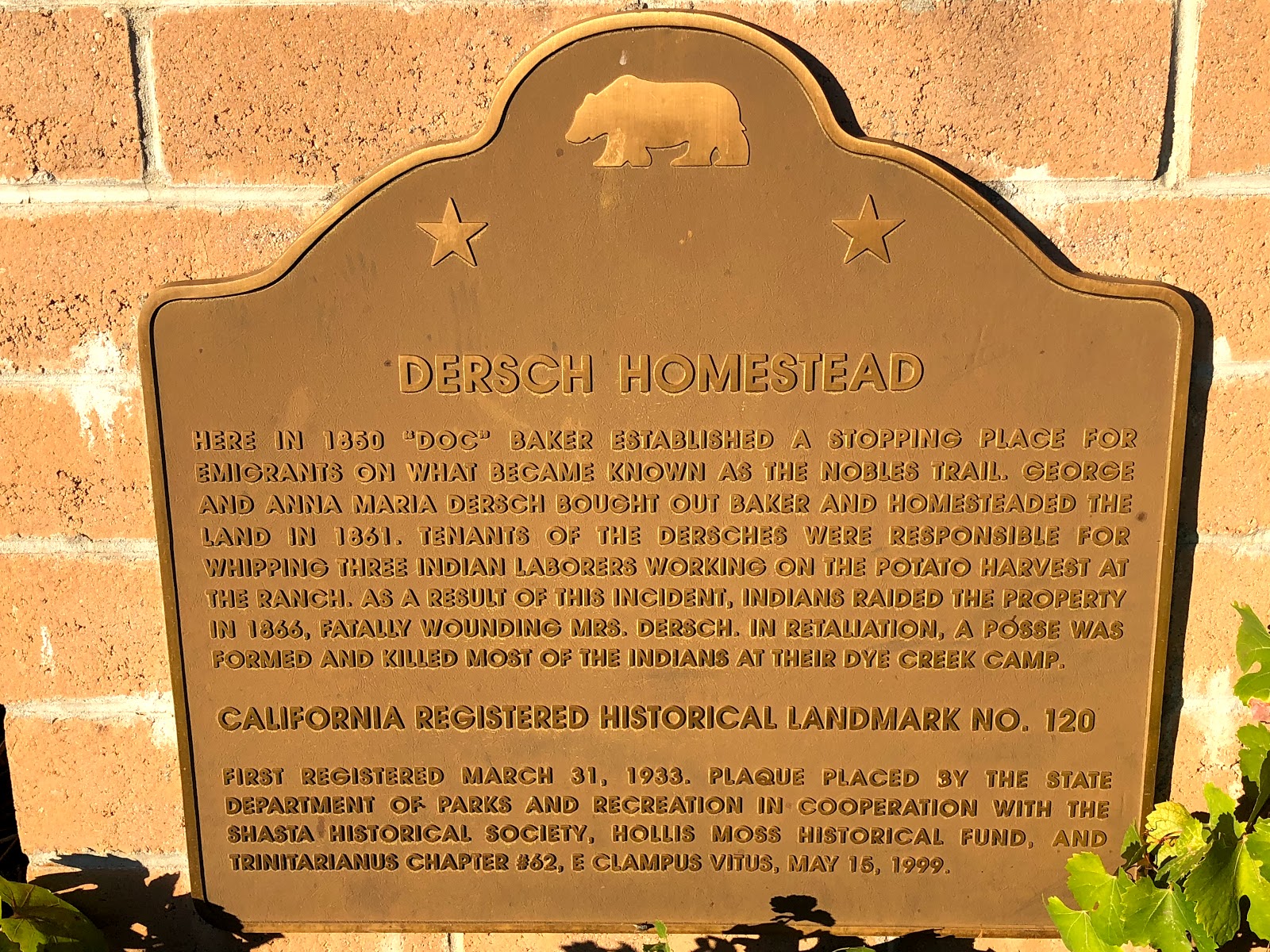
Homestead is the barn. A historic plaque was placed at the Dersch Homestead by
the State Department of Parks and Recreation, Shasta Historical Society, Hollis
Moss Fund, and the Trinitarianus Chapter #62, E Clampus Vitus on May 15, 1999.
Above: this house was built in 1934 after the original Dersch home was destroyed by fire. This photograph was taken by Jeremy Tuggle on October 10, 2018
Above: this plaque was placed at the Dersch Homestead by the State Department of Parks and Recreation, Shasta Historical Society, Hollis Moss Fund, and the Trinitarianus Chapter #62, E Clampus Vitus on May 15, 1999. This photograph was taken by Jeremy Tuggle on October 10, 2018
.
Above: a portion of the historic Dersch homestead. A barn in the background. This photograph was taken by Jeremy Tuggle on October 10, 2018
Above: Bear Creek runs near the property, an older bridge which is out of service appears over the creek. This photograph was taken by Jeremy Tuggle on October 10, 2018.
Above, L-R: the headstones of George F. Dersch and his wife Anna Maria (Kemmelmier) Dersch. They are interred into the historic Parkville Pioneer Cemetery, located on Parkville Road. Note: there are two headstones for Anna. One of them spells her given name as "Annie". The writing etched into her headstone's give her name, death date, and the following sentence, "Wife of George Dersch, was killed by Indians on Bear Creek." She was also a native of Bavaria. This photograph was taken by Jeremy Tuggle on October 10, 2018.
Above: the headstone of George F. Dersch, husband of Anna Maria (Kemmelmier) Dersch. He was born on March 28, 1832. He was interred into the Parkville Pioneer Cemetery. This photograph was taken by Jeremy Tuggle on October 10, 2018.
Above: "Anna Maria (Kemmelmier) Dersch" headstone number one. The is the closest headstone to the grave of George F. Dersch. She was interred into the Parkville Pioneer Cemetery. This photograph was taken by Jeremy Tuggle on October 10, 2018.
Above: "Annie Maria (Kemmelmier) Dersch" headstone number two. This is the farthest lot from the headstone of George F. Dersch. She was interred at the Parkville Pioneer Cemetery. It's not known why there are two headstone's in her memory. This photograph was taken by Jeremy Tuggle on October 10, 2018.
Above: the road to the left is Dersch Road which takes travelers past the historic Dersch homestead. It is named in honor for the Dersch family. This is the stopping point for Parkville Road at Dersch Road. This photograph was taken by Jeremy Tuggle on October 10, 2018.
RESOURCES:
1850 U.S. Census
1852 California State Census
1860 U.S. Census
Solomon D. Baker, Declaration of Homestead dated March
27, 1862
Coroner’s Inquest Report – Mrs. William Allen dated
September 10, 1864
Coroner’s Inquest Report - Helenor M. Jones dated September
21, 1864
Horrible Massacre By Indians - The Shasta Courier
newspaper of Shasta, September 10, 1864
Another Indian Murder - The Shasta Courier newspaper of
Shasta, September 17, 1864
Our Indian Difficulties - The Shasta Courier newspaper of Shasta, September 17, 1864
Volunteers - The Shasta Courier newspaper of Shasta, September 24, 1864
More Indians Killed - The Shasta Courier newspaper of Shasta, October 8, 1864
Indian Raid - The Shasta Courier newspaper of Shasta,
August 25, 1866
Correspondence - The Red Bluff Independent newspaper of
Red Bluff, August 29, 1866
Indians Overtaken and Killed - The Shasta Courier
newspaper of Shasta, September 1, 1866
Death of Mrs. Dersch - The Shasta Courier newspaper of Shasta, September 1, 1866
The Settler’s Vengeance - The Red Bluff Independent
newspaper of Red Bluff, September 5, 1866
1867 California Voters Registration
1870 U.S. Census
1880 U.S. Census
BP-005.1 Baker, Solomon Dodge Pioneer Plaque File on file
at Shasta Historical Society
The Good Old Times In McClean County, Illinois written by
Dr. E. Duis. Published by Bloomington. ©1874 pages 206-207.
DP-009 Dersch, George Pioneer Plaque File on file at
Shasta Historical Society.
Our Storied Landmarks – Shasta County, California,
written by May H. Southern, published by Balakshin Printing Company, ©1942.
Shasta Historical Society Pioneer Record - George Dersch,
dated: March 23, 1943
Shasta County, California A History by Rosena Giles,
published by Biobooks, ©1949.
Our Pioneers - The Dersches by Beverly Steele, Ridge Rider
News newspaper of Shingletown, January 4, 1993
Our Pioneers - The Dersches Part II by Beverly Steele,
Ridge Rider News newspaper of Shingletown, January 11, 1993
Our Pioneers - The Dersches Part III by Beverly Steele, Ridge Rider News newspaper of
Shingletown (no date)
Wintu Trails by Helen Steadman Hogue. Published by Shasta Historical Society ©1977. Printed by Redding Printing Company Inc.,


 Posts
Posts