Showing posts with label hotels. Show all posts

Saturday, December 12, 2020

SIMEON FISHER SOUTHERN AND THE HAZEL CREEK AREA

Simeon Fisher Southern, a native of Stephensburg, Kentucky, was born to Stephen Fisher Southern and Rebecca (Duncan) Southern, on September 6, 1822. As a boy, Simeon grew up on his father's farm as a farmhand assisting his father when he wasn't attending school. Southern was often referred to by the nickname of "Sims". He became well-educated during his adolescents. He became a well-respected man during his lifetime.  Later in life, he departed Kentucky, leaving his family behind, and traveled America living in the following states: Arizona, Louisiana, New Mexico, and Utah before venturing west to California where he settled at Shasta about 1854. 

Then in, 1855, Southern partnered with Charles F. Louis, another resident of Shasta, to own and operate the Eagle hotel which became the newest hostelry in the Queen City of the North, Shasta. His business ethics made his hostelry flourish with success against the more upscale hotels along Main Street during this era. It wasn't long before he found time to court an elegant woman named Sarah Emma Lafferty, also a Kentucky native, and the daughter of Thomas Lafferty and Elizabeth (Smith) Lafferty. By January of 1856, Simeon appears to have been operating the Eagle hotel by himself without the assistance of Charles F. Louis. 


Above: an advertisement for the Eagle hotel at Shasta proprietors: S.F. Southern and C.F. Louis. From the Shasta Courier newspaper edition of September 22, 1855.


Simeon and Sarah's romance continued to blossom, and they were married on February 26, 1856 at Shasta by E.K. Shed, Esq., a close personal friend and business partner of Simeon Southern. Earlier that year, Southern and Shed purchased the St. Charles hotel on Main Street at Shasta. This was Southern's second hostelry that he owned, a third hostelry was leased by him which was called the Empire hotel. It was located on Main Street at French Gulch and he operated this hotel with S.F. Black until 1858 when Simeon and Sarah decided to relocate from Shasta to Dog Creek in the Sacramento River Canyon. 

After settling at Dog Creek, Southern went into partnership with J.S. Cameron in operating the Dog Creek House, a little inn which proved successful due to the travelers of the Sacramento River Road, heading north and south bound through the canyon. Southern was elected as Justice of the Peace of the Sugar Loaf Township, which included Dog Creek and Hazel Creek. Simeon and Sarah later moved north to Hazel Creek where Southern erected a log cabin style building combined with a trading post on a plateau overlooking Hazel Creek which he owned and operated.

Sarah assisted her husband in the hotel as well. Simeon Southern eventually enlarged his building into a two-story wooden structure with luxurious and comfortable rooms for his guests. He also kept livestock at Sweetbrier in 1860, which he ended up owing $5.91 in delinquent taxes that year. He also built a mule corral on the hotel property at Hazel Creek.

Hazel Creek received its name from the many Hazelnut bushes which grew along the channel of the creek. Southern was not the first resident of Hazel Creek there were other people before him. In 1855, Hazel Creek was the site of lucrative gold strikes. Now Southern was enhancing the area. There were still mining claims nearby which were extensively mined when the Southern's moved there in 1859.


Above: people on the upper balcony and on the lower balcony and ground floor pose for a photograph at Southern's Hotel and Stage Station on H:azel Creek, date unknown. Courtesy of Shasta Historical Society.


In 1867, the miners at Hazel Creek were finding very course pieces of gold sometimes mixed with quartz and weighing from an ounce to fifty dollars in value while ground sluicing the area. One of the advantages these miners had compared to other mining localities was the amount of free water from Hazel Creek which made the extraction process easier. The area was considered as very deep diggings in a rocky area which made it harder to mine the ore. Most of the miners spent their findings at Southern's trading post usually on new mining equipment and supplies they needed.

Two years later in July of 1869, an excerpt of an article from the Shasta Courier newspaper reported the following account regarding Hazel Creek: "Hazel Creek which empties into the Sacramento on the east side just opposite of Southern's Store, is paying better this season then it has for a number of years. McKenzie & Garret, Johnson & Co., Keaton brothers, and a number of others are making from $3 to $5 per day, to the hand. The gravel and dirt on this creek is of a burnt reddish hue and contains any amount of porous quartz, some of which is very rich in free gold."

In 1871, Southern's hotel became a prominent stage stop along the Sacramento River Road for the Greathouse Company of Shasta. This company was owned by George L. Greathouse, a brother-in-law of Sarah (Lafferty) Southern. Sometimes it was referred to as Southern's Station. About this time, it was reported that the Hazel Creek mines in the area were playing out and miners were getting unfavorable results. Southern, who had some mining claims of his own in the area proved the local media wrong about Hazel Creek, and it was then, that the Shasta Courier newspaper wrote the following column in October of that year:

"FROM HAZEL CREEK - S.F. Southern came in town Wednesday from Hazel Creek bringing undoubted evidence that the mines of that section are "giving out", in the shape of some well-filled purses of gold dust and a number of nice specimens." (SIC)

Another interesting column about Simeon Southern appeared in the Shasta Courier newspaper edition of October 18, 1873, which reports the following: "S. Southern, of Southern's station, came down this week to do a little trading with our wholesale merchants. Times have been hard in Sim's locality lately, and he could only bring down about ten pounds of gold dust this trip." 

During their union together Simeon Fisher Southern and Sarah Emma (Lafferty) Southern had the following children born to them: 

1. Ada Southern (1858-?)
2. William F. Southern (1859-1935) 
3. Ida Mae Southern (1864-1928))
4. Mae Hazel Southern (1867-1943) [Note: She became the first President of the Shasta Historical Society in Redding.]
5. Sarah A. Southern (1868-?)
6. Elzey Thomas Southern (1870-1932)
7. Fannie Emma Southern (1872-1948)
8. Nellie Belle Southern (1875-1908)
9. Jeanette Isabel "Belle" Southern (1877-1908)
10 . Simeon Fisher Southern Jr. (1879-1893)

During the latter part of September, in 1880, the 19th President of the United States Of America, Rutherford B. Hayes and his party consisting of First Lady, Lucy Ware (Webb) Hayes, General W.T. Sherman, and General Phillip Sheridan registered to stay at Southern's hotel after visiting Redding from Chico which won Simeon Southern's hostelry some praise in national media coverage due to the president's campaign tour in California.

The presidential party were on their way north from Redding to Yreka but they decided to make a stop overnight at Southern's hotel. The whole family met the entire presidential party that day. Simeon "Sims" Fisher Southern died on December 6, 1892 at Hazel Creek. 

In 1902, Southern's hotel and Stage Station were sold to timbering interests by Sarah (Lafferty) Southern, who controlled her husband's estate at the time. She sold out to Knight & Shelbey who erected the first sawmill in the Hazel Creek area. The area became known as Sims after Sarah's husband and Hazel Creek retained its name. Sarah (Lafferty) Southern then relocated south to Redding, when she survived her husband by twenty-seven years before she died. 


Above: this is the Sims Schoolhouse at Sims with its students and teacher posing for a photograph. Courtesy of Shasta Historical Society.

At Sims, Knight & Shelbey had a small logging operation on location. They were transporting logs by horses and steam donkeys to their water-powered sawmill. Water was taken from Hazel Creek to operate it. A year later, in 1903, a new company came to fruition called Sims Lumber Company which had purchased the sawmill property and logging interests from Knight & Shelbey. 

During the decade of the 1910's Sim's became a campground for the California Highway Commission who was overseeing a series of surveys in the area for the north valley highway systems. It brought renewed activity to the area. In 1911, Southern's hotel and Stage Station became a tourist attraction due to its lucrative and vast mining history in the area. The demise of this hotel was not recorded, its unknown how long it stood. Sims Lumbering Company continued logging operations at Sims until 1913 when they sold out to George Ralph & Sons. 


Above: built out of box cars and situated along the railroad tracks was the Southern Pacific Railroad Depot at Sims. Circa 1910. Courtesy of Shasta Historical Society.


Above: Sims became the campground for the employees of the California Highway Commission during their survey's of north valley highway systems in 1913. The California Highway Commission was established in 1895 as the main state highway bureaucracy in California. It was the predecessor of the California Transportation Commission which organized and replaced it in 1978. Courtesy of Shasta Historical Society. 

The Ralph's enhanced the area with a new logging railroad to their sawmill  They also erected a water tank for their small steam locomotive which needed to fill its engine with water to transport the logs to and from the sawmill. In 1919, the Shasta Mill & Lumber Company purchased this sawmill and continued production in the area.

Between 1933 and 1939, Sims was called Camp Sims by the Civilian Conservation Corps which utilized the area as a camp ground for their crews. A plaque was placed at Sims which state the following: "With its wooded valley and beautiful river setting, Sims, was a haven to the boys from Company 978 who came from the busy cities of San Francisco, Oakland and other Bay Area communities. Camp Sims, like other CCC camps was administered and built by the U..S. Army. But it was the Forest Service who was in charge of actual work projects. Besides fire fighting, the boys from Camp Sims gained a real reputation for building three fire lookouts-Sims, Bradley, and Sugar Loaf, constructing part of Everett Memorial Highway, and building Panther Meadows [on the upper slopes of Mt. Shasta.]"

In 1933, a bridge was built to provide fire protection on the east side of the Sacramento River at Sims.  Today, Sims is designated as a historic site in Shasta County which features an easy walking trail and fishing access. Sims Road off Interstate 5 in the Sacramento River Canyon also retains its name in honor of Simeon Fisher Southern. 


Above: this plaque states the following: "This tablet marks the location of the famous Southern Hotel and Stage Station the original building was a log cabin built in 1859. During a half century many noted people who made early California history were entertained here in this hotel. Dedicated to the memory of Simeon Fisher Southern and his wife Sarah Lafferty Southern pioneers of the gold trail 1849-1855. Erected by their daughters May H. and Fannie E. Southern, May 30, 1931. This photograph was taken by Jeremy Tuggle on October 17, 2020.


RESOURCES:


Married - The Shasta Courier newspaper of Shasta, March 1, 1856

Births - The Shasta Courier newspaper of Shasta, April 9, 1859

1860 U.S. Census

Delinquent Taxes - The Shasta Courier newspaper of Shasta, December 8, 1860

California Voters Register, 1866

Hazel Creek - The Shasta Courier newspaper of Shasta, August 31, 1867

Soda And Hazel Creeks - The Shasta Courier newspaper of Shasta, October 19, 1867

Upper Sacramento Items - The Shasta Courier newspaper of Shasta, March 20, 1869

Upper Sacramento Items - The Shasta Courier newspaper of Shasta, July 10, 1869

1870 U.S. Census

Items - The Shasta Courier newspaper of Shasta, February 18, 1871

From Hazel Creek - The Shasta Courier newspaper of Shasta, October 14, 1871

Brief Mentions - The Shasta Courier newspaper of Shasta, October 18, 1873

1880 U.S. Census

The Presidential Party Among the Hydraulic Mines - The Sacramento Daily Union newspaper of Sacramento, September 25, 1880

President Hayes At Yreka - The Humboldt Times newspaper of Eureka, September 28, 1880

Sawmill Is To Be Erected At Sims - The Courier-Free Press newspaper of Redding, February 13, 1913  

California, Pioneer and Immigrant Files, 1790-1950, for Simeon Fisher Southern.

May H. Southern’s scrapbook’s. Nine binders. Unpublished personal and researched material compiled by Southern. Available at Shasta Historical Society. 

Our Storied Landmarks – Shasta County, California, written by May H. Southern, published by Balakshin Printing Company, ©1942.

My Playhouse Was A Concord Coach, an anthology of newspaper clippings and documents relating to those who made California history during the years 1822-1888, by Mae Hélène Bacon Boggs. Published by Howell-North Press ©1942

Shasta Historical Society Pioneer Record: Simeon Fisher Southern, dated May 8, 1943.

SP-035, SOUTHERN, Simeon F., Pioneer Plaque Program File, available at the Shasta Historical Society.

Shasta Historical Society - Genealogical Records 7-59: Southern, Simeon Fisher.

Shasta County, California A History by Rosena Giles, published by Biobooks, ©1949

Place Names of Shasta County by Gertrude Steiger, published by La Siesta Press, ©1966

U.S., Appointments of U.S. Postmasters, 1832-1971

Thursday, September 13, 2018

Redding's first class hostelry: the Golden Eagle hotel


This is the earliest known sketch of the Golden Eagle hotel in Redding. There is a sign promoting Dooley's Restaurant and the hotel bar. Taken from a late 1880s Birds Eye View Map of Redding. Proprietors: Spellman & Kern. From the collection of Jeremy Tuggle.


The beginning of the Golden Eagle hotel in Redding was reported in this column from the Republican Free Press newspaper on April 9, 1887:

“Barney Conroy is figuring on a two-story brick building on the corner of Yuba and California Streets, and it is rumored that he and Mr. Wiseman, his son-in-law, will go into business.” (SIC)

Bernard “Barney” Conroy was an Irish immigrant and a pioneer settler of Shasta County, who arrived in 1856 from New York with his wife Mary (Flannigan) Conroy and their daughter Ellen. Another child named Stephen was added to the household that year when they settled at Horsetown where Conroy previously owned and operated a saloon. Barney and Mary had six more children between the years 1858 and 1872, respectively.
  
Conroy had experience as a hotel proprietor since he formerly owned the Redding Hotel in 1881. While plans were underway to erect this new two-story building, the local media often referred to it as Conroy’s building, its official name wasn’t released until a later date. It was the Holt & Gregg Company of Anderson who received the contract from Conroy to do the brick work of his building. Apparently, he did not go into business with Wiseman but allowed him to rent one of his own business offices in the hotel for his son-in-law’s company. John T. Wiseman was a native of Texas who married Conroy’s daughter Catherine and they lived in Redding. In May, the construction began as the Holt & Gregg Company had an overflow of bricks in their brickyard ready to start the construction of the first-story. Eventually, they had to produce additional bricks at their brickyard by burning a new kiln on the property specifically for this project.
  
During July, a laborer working on the Conroy building fell off a scaffold with a loaded wheelbarrow of bricks. His body hit the hoist and he fell to the ground as the bricks fell on top of him which critically injured him. The wheelbarrow landed near him. The unidentified man was rushed to a local hospital where his injuries were treated. It was the only injury during the course of the hotel’s construction.
  
One of the first companies to move inside the Conroy building was the John T. Wiseman & Company. The following article was heralded in the Republican Free Press newspaper on July 16, 1887:

“J.T. Wiseman & Co.

This is the name of the firm which will occupy the first two rooms of Barney Conroy’s new brick building on the corner of Yuba and California Streets. The first room, 25x90, will be filled with groceries, hardware and goods of that character, and the second store 22x50 feet will be the dry goods and fancy goods department. These rooms will be finished right away, and the firm expects to be ready for business near the first of August. J.T. Wiseman is a son-in-law of Barney Conroy and for a long time was identified with Sisson & Crocker at the railroad front, and at present owns an interest in a store at Deming, N.M. The company will be W.E. Chesley, wholesale dealers in wines, liquors and groceries, and who is well known to every business man in the upper country. This firm has plenty of capital and will doubtless, with our other large stores, make Redding a center for a large trade. We like to see business men come among us, for business men attract business the world over.” (SIC)

The Holt & Gregg Company completed the brick work on July 30, 1887, which gave the hotel an imposing site. The new hotel would soon be opened to the public on the first day of August. From the start the hotel lacked a few things including some of its furniture, its bar and its restaurant. A month later, a Canadian immigrant by the name of Thomas Dooley, a resident of Chico established his new restaurant in Redding inside Barney Conroy’s hotel. Dooley had twenty years as an experience restaurant owner and he was quite impressed with Redding’s growth and prosperity, which is why he selected the city to be his new place of business. He already had restaurants in operation in Willows and Chico. These restaurants were well favored by the public.
  
Thomas Dooley offered the following foods on his menu: “the choicest cuts of meat, the different variety of game, changes of vegetables daily, and receive directly from Morgan & Co’s large oyster beds (selects),  the choicest and largest eastern oysters, also crabs and shrimp weekly. Fresh and salt water fish.”  Dooley hired only the best cooks at his establishment.

That year, the Conroy building was well underway of becoming a first class establishment as it was preparing its self to compete in business against the following hotels and boarding houses: the New City hotel, proprietor Henry Clineschmidt, it was located on Market Street near Tehama Street. A two-story lodging house owned by A.S. Castle on California Street between Butte and Tehama Streets. It was eventually leased to S. Clein. The Major hotel which was located opposite of the Castle lodging house and post office, proprietors Kunene & Blohm. The Paragon hotel was located opposite of the Redding Depot, proprietor George Groves, and later the Del Monte hotel which was under construction. The Del Monte hotel’s construction was almost completed by October 8, 1887.

The original two-story structure of the Golden Eagle hotel included forty-two rooms on the second floor and the first floor included a meeting parlor (banquet room), Dooley’s Restaurant and a bar. Additional business offices were built into the building also on the first floor; some were described in an earlier paragraph. Both floors of this building were connected by a staircase. This hotel was based on what is called the “European plan” where the owners only charged their customers the rent of the room and not for meals. There were additional charges for the meals.

The imposing brick work of the Golden Eagle hotel gave the local media the following to boast about on October 1, 1887:

“There will be a solid block of brick from the corner of California and Yuba Streets to the corner of Placer and Market Streets. Two and a half blocks.” (SIC)

That month, Barney Conroy finally received his new furniture that he had ordered for his business. Some of the furniture included the tables and chairs for his banquet room. He also received a liquor license which was granted to him by the Shasta County Tax Collector so he could begin operating his new bar. Then on, November 12, 1887, the local media announced the following...

“Barney Conroy has christened his hotel the “Golden Eagle”.  It took several of them to build it.”

In November, a jeweler by the name of B.H. Bacon a former resident of San Louise Obispo relocated to Redding in 1887, and opened a jewelry and confectionary store inside the Golden Eagle hotel. Bacon was also a chocolatier that made fresh homemade chocolates and candies. He also packaged them and sold them inside his store. Bacon also sold American watches manufactured by Seth Thomas and other brands from different clock manufacturers.

Another new addition that month to the Golden Eagle hotel was the law office of William D. Biegle, a native of New York, and a former miner. Biegle originally mined for gold at Whiskeytown. Whiskeytown is where he lived and he commuted to work in Redding each day.  Fraternal societies began using the hotel’s parlor room (banquet room) for many luncheons and other events as well. Conroy enjoyed having a successful business. During December of 1887, the first doctor to run a practice inside the hotel opened an office inside room number eleven. His name was Doctor J.A. Dawson. Dawson was a former resident of Oakland, and he relocated to Redding that month. Eventually, he found a more suitable office space in Redding and moved out of the hotel.

During May of the following year, the Bennett-Mackey Cable Company moved into the Golden Eagle hotel after a business office became available to rent from Conroy, when a former tenant had moved out. Local and national newspapers were being sold by a man with the surname of Woodward. Woodward operated Woodwards Newspaper Stand which was also located inside the Golden Eagle hotel.

Then in, November of 1888, John T. Wiseman purchased stock within the McCormick-Saeltzer Company of Redding, and he saw a need to relocate his store from his father-in-law’s hotel into the building of the McCormick-Saeltzer Company which was then located on the west side of Market Street. It was general merchants Abram & Karsky of Weaverville who occupied the store space that formerly belonged to the John T. Wiseman Company inside Conroy’s Golden Eagle hotel. Then in, December of that year, a second doctor by the name of Benjamin E. Stevenson, M.D., a physician and surgeon opened his doctor’s office inside the hotel. It was a regular business office and not a regular hotel room like the previous doctor had.

Conroy sold his hostelry to John Spellman and his partner E. Kern in 1889, and they became the new proprietors of the Golden Eagle hotel. Under their ownership, the Golden Eagle hotel included: Dooley’s Restaurant, the Golden Eagle Barber Shop, and a bar. By that time, Dooley’s Restaurant had changed hands and it was now owned by J.H. Duffield who offered the same menu that Thomas Dooley did.

Under the new ownership, a surprising suicide took place in the Golden Eagle hotel on March 21, 1889, when the body of C.E. Crookshanks was discovered in room number 35. It had been determined that poisoning from morphia sulphate was the cause of his death. He was found by both Spellman and Kern. Crookshanks was a native of Oregon who registered at the hotel on the 18th of that month. The sheriff and the coroner were both notified of the death, and a Coroner's Inquest was held upon the body.

It’s possible that it was Spellman & Kern who sold this establishment to James M. Bryan and his brother Thomas D. Bryan. During the 1890s new businesses were brought into the Golden Eagle hotel building which included: a bar, and a billiards room. There was also the Golden Eagle Barber Shop whose proprietor was E. Kern, the Golden Eagle Jewelry Store whose proprietor was Adolph Dobrowsky. The Redding Cigar Factory, and the Golden Eagle Cigar Store whose proprietor was John W. Potts.


The Daily Free Press newspaper of Redding published this advertisement on August 27, 1897, by the Bryan Brothers for their Golden Eagle hotel, offering a first class service in Redding and free bus to and from all trains.


Then on, May 1, 1899, the Bryan brothers leased the hotel to J.H. Leveck who ended up buying the hotel from the Bryan brothers, and Leveck became the new proprietor. It was J.H. Leveck, who turned a room of this hotel into his residence. Room rates at the Golden Eagle hotel cost travelers $1.00  a day and upwards, and the meals were twenty-five cents a plate. The Golden Eagle hotel flourished with success and Leveck saw a need to improve the building.

In September, Leveck negotiated a contract with the Holt & Gregg Company to add a third-story to this building. In addition there would be fifty-eight new rooms, which gave the hotel a total of 100 rooms. As construction began the hotel kept busy with new daily arrivals checking in.

During 1904, Leveck sold out to the Hurst siblings, George & Ferdinand, who purchased the hotel and operated this hostelry for a short time. They kept the same rates Leveck offered. That year, it was W.H. Nutting who was the proprietor of the Golden Eagle Barber Shop, a clean cut would have cost you fifteen cents. Two years later, the Hurst brothers eventually sold the establishment to the Gronwoldt siblings. It was George Gronwoldt and Augustas H. Gronwoldt who took possession of the hotel on March 15, 1906, and they began operating it. 

The next week on March 24, 1906, the pioneer Bernard "Barney" Conroy died in San Francisco at the home of his son-in-law, John T. Wiseman. He died after a brief illness. Conroy was the original founder of the Golden Eagle hotel. The news of his death was heralded all over the state by the media and many people mourned his death.

The Gronwoldt’s had a hotel monopoly in Redding and at one time owned the Alta House and the Redding Hotel as well as other establishments. They had a knack for the hotel business and they promoted the name of the Golden Eagle as much as possible by slapping the name on china, silverware, hand towels, ivory soap bars with special wrapping, match boxes, and other novelty items. It was Augustas H. Gronwoldt who became a four-time Mayor of Redding.


Above: the Golden Eagle Cigar Store on July 4, 1907. L-R: are the new owners, John Bartosh and George Bartosh who purchased this store from John W. Potts at the beginning of the month. Courtesy of Chet Sunde.


The Gronwoldts eventually sold some shares of the hotel to James Hoyle, and it was Hoyle who sold his interest in the hotel to Henry Wagner of Sacramento in June of 1909. Wagner was previously employed as a railroad man and he became a new partner with the Gronwoldts. 

During May of 1914, the Gronwoldt’s planned additional improvements to the hotel by including the installment of a heating and air conditioning system at a cost of $3,500. The improvements on the agenda included a new kitchen, and a new dining room, and a remodel of the entire first floor.  The media speculated that the upgrades would take all summer to complete.

Another addition to the building was a wireless telegraph tower for a new telegraph station at Redding and the spot chosen for the tower was the roof top of the Golden Eagle hotel. The man in charge of installing the new tower in August of 1914 was the jeweler, Adolph Dobrowsky, who was also the watch inspector of the Southern Pacific for the Shasta County division. Dobrowsky would receive telegraph reports from Mount Hamilton through radio transmission. 

In 1917, my great-great paternal uncle Otto M. Tuggle was employed by the Gronwoldt siblings as a bell hop at this hotel. He worked for them during a three year span. Years, later Tuggle wrote down some of his fond memories of working at the Golden Eagle hotel in Redding which are kept in the archives of the Shasta Historical Society.

The restaurant inside the hotel during the 1920s was called the Golden Eagle Grill. During my research the earliest address that I have found for the Golden Eagle hotel is from 1926 when it was located at 425 Yuba Street. That year, the first floor of the hostelry included the following: the Golden Eagle Drug Company, the Golden Eagle Jewelry Store, and the Golden Eagle Cigar Store. Two years later, the first floor stayed the same with the exception of the Golden Eagle Drug Company which appears to have been a short lived business venture.

In the decade of the 1930s the hotel’s address changed from 425 Yuba Street to 1449 Yuba Street, and it now included the Golden Eagle Coffee Shop. The coffee shop replaced the former Golden Eagle Grill, and it advertised as serving the best meals at moderate prices. The first floor also included the following: the Golden Eagle Liquor Store and the Golden Eagle Tavern. In 1938, the Grownoldt brothers still had ownership of this hotel, it appears that the third parties ownership dissolved long before this year commenced.

Two years later, the Gronwoldt's still kept a first class hostelry. Dobrowsky still owned the Golden Eagle Jewelry Store, and James Bartosh kept a variety of cigars in stock at the Golden Eagle Cigar Store. The Golden Eagle Tavern served mixed drinks and cocktails, while the Golden Eagle Liquor Store provided locals with all sorts of packaged liquors and wines. A number of small robberies occurred during the years too, which gained the Gronwoldt's and other various businesses inside the hotel unwanted media press.

After the death of Augustas H. Gronwoldt Sr., in Redding on June 15, 1945, his son Augustas H. Gronwoldt Jr., and his widow Sophronia (Brown) Gronwoldt became the new proprietors of the hotel. They operated it until they were bought out by Clark R. Nye and David W. Hinds in 1958. Then on, September 22, 1962, a ravaging fire destroyed the historic Golden Eagle hotel. The following people were the three individuals whose life’s perished in the fire: Charles Brack of Idaho Falls, Idaho, Edward De Bob of Eureka, California, and a local Redding area rancher named Herb Johnson.

During the excitement of the blaze people were departing the burning building any way they could which included jumping from the third-story and landing in the street. This caused critical injuries to their bodies and quite a number of people ended up injured and in the local hospital. To this day, it’s a well-remembered establishment by many local residents.


THE HOLLYWOOD CONNECTION:

In 1961, the parents of nationally renowned Hollywood actor Tom Hanks (born in 1956) were employed at the Golden Eagle hotel. Hanks’ mother Janet (Frager) Hanks was the hotel manager at that time and his father Amos M. Hanks was a cook at the Golden Eagle Coffee Shop. Tom Hanks and three of his older siblings would often visit their parents while they worked there. They lived in a house at 2132 West Street in Redding; the former Hanks home is still standing today at that location. At a later date, Hanks’ parents divorced and it was Janet (Frager) Hanks who relocated to Red Bluff.


Above: the Golden Eagle hotel with early day automobiles parked in front of the hostelry. Circa, 1920s. Courtesy of Steve Brui.


Above: an interior view of the Golden Eagle hotel banquet room, circa 1920s to 1930s. Courtesy of Steve Brui.


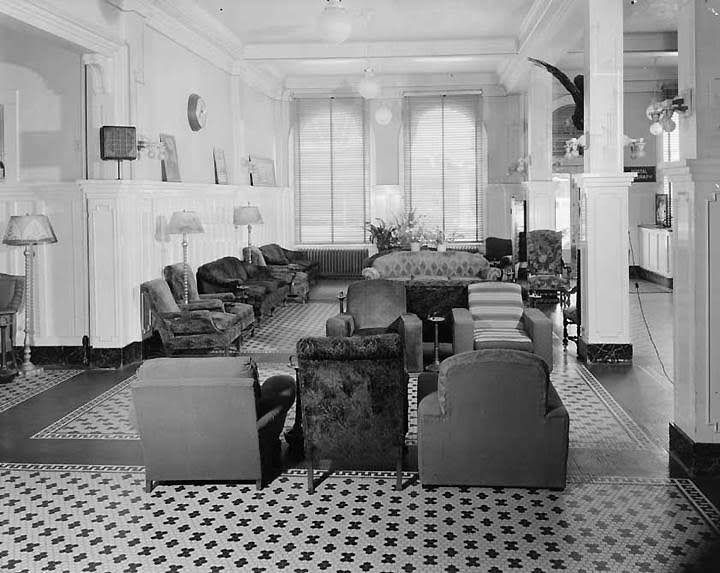
Above: the interior view of the Golden Eagle hotel lobby, 1941. (Public Domain.)


Above: the interior view of the Golden Eagle Coffee Shop, 1941. (Public Domain.)


Above: an interior lodging room of the Golden Eagle hotel, 1941. (Public Domain.)


Above: the Golden Eagle hotel at Redding, California, postcard by J.H. Eastman in 1945. Courtesy of Steve Brui.


Fire gutted the historic Golden Eagle hotel building on September 22, 1962. The building was in such bad shape it couldn't be remodeled, and it was soon demolished. (Public Domain.)


Above: this marker dedicates some of the early history of the Golden Eagle hotel which operated on this lot from 1887- 1962. It was dedicated as a historic site on September 22, 2017 by the Grindstone Club in cooperation with the City of Redding. The site is located where the double parking structure is on Yuba and California Streets. This photograph was taken by Jeremy Tuggle on October 3, 2017.


GOLDEN EAGLE HOTEL NOVELTY ITEMS:


Above: this plate is from the Golden Eagle Grill restaurant. Its manufactured by Warwick. Warwick's iconic decal on the back of the plate dates back to the 1920s. From the Gronwoldt period. From the collection of Jeremy Tuggle.


Above: an opened Golden Eagle hotel reverse strike match box, complete with matches. From the Gronwoldt period. Manufactured by the Diamond Match Box Company of Chico, California in the 1920s. From the collection of Jeremy Tuggle.


Above: a hand towel from the Golden Eagle hotel. White with blue pin stripe and white lettering which states, "Golden Eagle Hotel - Redding". From the Gronwoldt period. Manufacturer: unknown, manufactured in the 1920s. From the collection of Jeremy Tuggle. 


Above: an opened Golden Eagle hotel reverse strike match box, complete with matches (same as below). Advertising the Coffee Shop and Tavern. From the Gronwoldt period. Manufactured by the Ohio Match Company of San Francisco, California in the 1930s. From the collection of Jeremy Tuggle.


Above: a closed Golden Eagle hotel reverse strike match box, complete with matches (same as above). Photo of the hotel on the front cover. From the Gronwoldt period. Manufactured by the Ohio Match Company of San Francisco, California in the 1930s. From the collection of Jeremy Tuggle.


RESOURCES:


1880 U.S. Census

Barney Conroy’s brick - The Republican Free Press newspaper of Redding, May 21, 1887

Holt & Gregg - The Republican Free Press newspaper of Redding, May 21, 1887

A laborer fell - The Republican Free Press newspaper of Redding, July 16, 1887

Furious Flames - The Republican Free Press newspaper of Redding, July 30, 1887

Dooley - The Republican Free Press newspaper of Redding, September 24, 1887

The Del Monte Hotel - The Republican Free Press newspaper of Redding, September 24, 1887

Dr. J.A. Dawson – The Republican Free Press newspaper of Redding, December 17, 1887

The Republican Free Press newspaper of Redding, October 1, 1887

Attention - The Republican Free Press newspaper of Redding, January 7, 1888

Howell & Wood - The Republican Free Press newspaper of Redding, March 3, 1888

The Bennett- Mackey Cable Company - The Republican Free Press newspaper of Redding May 26, 1888

Our County Dads - The Republican Free Press newspaper of Redding, October 8, 1888

Suicide - The Republican Free Press newspaper of Redding, March 23, 1889

John W. Potts - The Daily Free Press newspaper of Redding, August 10, 1897

John W. Potts - The Daily Free Press newspaper of Redding, August 8, 1899

1899 City of Redding Directory

Golden Eagle Hotel advertisement - The Republican Free Press newspaper of Redding, September 2, 1899

Local Happenings - Red Bluff Daily News newspaper of Red Bluff, September 20, 1899

1900 U.S. Census

Barney Conroy Is Dead - The Sacramento Union newspaper of Sacramento, March 27, 1906

Buys Golden Eagle Interest - The Sacramento Union newspaper of Sacramento, June 26, 1909

To Improve Redding Hotel - The Sacramento Union newspaper of Sacramento, May 28, 1914

Redding To Have Wireless - The Sacramento newspaper of Sacramento, August 11, 1914

World War 1 Draft Registration Card for Otto Tuggle, June 5, 1917.

Old Timer Passes In San Francisco - The Courier-Free Press newspaper of Redding, August 22, 1923

No Arrests Yet In Hotel Safe Money Mystery - The Searchlight newspaper of Redding, February 12, 1929

1938 City of Redding Directory

1940 City of Redding Directory

1951 City of Redding Direcotry

1960 City of Redding Directory

1961 City of Redding Directory

The Record Searchlight newspaper of Redding, September 23, 1962

6 Dead Or Missing As Fire Destroys Hotel At Redding, The San Bernardino Sun newspaper, September 23, 1962

Two Killed In Redding Hotel Fire - The Santa Cruz Sentinel newspaper of Santa Cruz, September 23, 1962

Searchers Have Found A Third Body - The La Habra Star newspaper of La Habra, September 24, 1962