
 Posts


Before the gallows
In the years following the Gold Rush, Shasta County was a rough and rapidly changing corner of California. Established on February 18, 1850, the county quickly attracted miners, merchants, adventurers, and drifters seeking their fortunes in the northern Sacramento Valley and the rugged mountains beyond. Mining camps sprang up almost overnight wherever gold could be found, but where gold was discovered, trouble was never far behind.
The growing population created an immediate need for courts, sheriffs, jails, and laws. These institutions developed slowly, however, and justice sometimes depended on a combination of newly established courts, local officials, and citizens willing to take matters into their own hands. Some accused men appeared before formal courts, while others faced hastily organized citizens’ juries. The line between lawful justice and vigilantism could be difficult to distinguish.
Shasta County’s first elected sheriff was Michael Oppenheimer, but there was no proper county jail in those earliest days. According to the historical record of the Shasta County Sheriff’s Office, prisoners could be confined in a special cell at Shasta beneath the Trinity House, a hotel, saloon, and gambling establishment built by David Corsaut, who later served as sheriff.
Citizens sometimes devised their own punishments. At Horsetown, one accused thief was tied up and dunked into the cold waters of Clear Creek before being released with a warning never to return. When more serious crimes occurred, citizens sometimes organized courts, selected judges and juries, heard testimony, and rendered verdicts. And when the verdict was death, there was always the rope.
A deadly clash of cards – Easterbrook and Price
One of the earliest cases occurred on March 14, 1851, at Oak Bottom, about 10 miles from Shasta. Josiah Price and his mining partner, Easterbrook, had been drinking and playing cards with others inside a canvas tent when an argument developed. Price eventually left the tent, and Easterbrook followed.
Witness Isaac Roop testified that Easterbrook shouted, “God damn you, I intend to meet you!” Price replied, “I intend to meet you,” and a shot followed. Price called for water after being wounded, while Easterbrook fled and was captured about sixty yards away. He reportedly told his captors, “It was an accident, and I was drunk.” Roop subsequently found a recently discharged pistol.
Citizens quickly organized an ad hoc court. Jesse Dutton served as chairman and Robert W. Crenshaw as secretary. Twelve men were selected as jurors, attorneys volunteered for the defense and prosecution, witnesses testified, and Easterbrook was allowed to speak on his own behalf. He reportedly mentioned his wife and young daughter while insisting that he had not intended to kill Price.
The jury unanimously found Easterbrook guilty of first-degree murder and sentenced him to death. On March 15, approximately 24 hours after the killing, Easterbrook was hanged at Reading Springs.
Later historical records also associate a man named Pearson with Price’s killing and list both Easterbrook and Pearson as having been executed. The detailed contemporary account, however, focuses on Easterbrook and does not establish Pearson’s role. Until additional primary evidence is found that discrepancy remains unresolved. The case illustrates how quickly frontier justice could move. The killing, capture, trial, conviction, and execution unfolded in roughly a single day.

Kit Shannon, Bates, and Tatman
Another deadly confrontation occurred in July 1852. Richard Touzalin, whose surname is also recorded as Trusdale, was passing through Shasta when he became involved in a confrontation with Kit Shannon, a native of Texas. After an initial fistfight at the California Exchange, the men encountered each other again, and Shannon attacked Touzalin with a bowie knife. Touzalin died from his wounds.
Citizens arrested Shannon and organized their own proceedings. A judge and jury were selected, Shannon was convicted, and on July 6—only two days after the confrontation—he was hanged under the authority of Sheriff David Corsaut. The case again demonstrated the uncertain boundary between citizens’ justice and the developing county government.
Later that year, Ira Tatman and Tom Bates were convicted in District Court in connection with the killing of Francis Mitchell and hanged on November 30, 1852. A later newspaper recollection, however, remembered Tatman and Bates as having killed a miner and stolen his mule and other belongings, and placed their hanging in 1851. The writer also recalled that their handcuffs had to be cut from their hands by his father, a local blacksmith who operated a shop with George McComber.
Whether the writer misremembered the year or details from separate events became intertwined remains uncertain. The discrepancy illustrates the difficulties historians face when later recollections conflict with other surviving records.
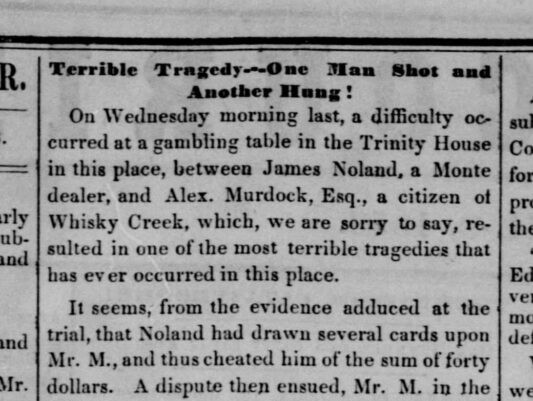
“You have a pistol, defend yourself!” – Noland and Murdock
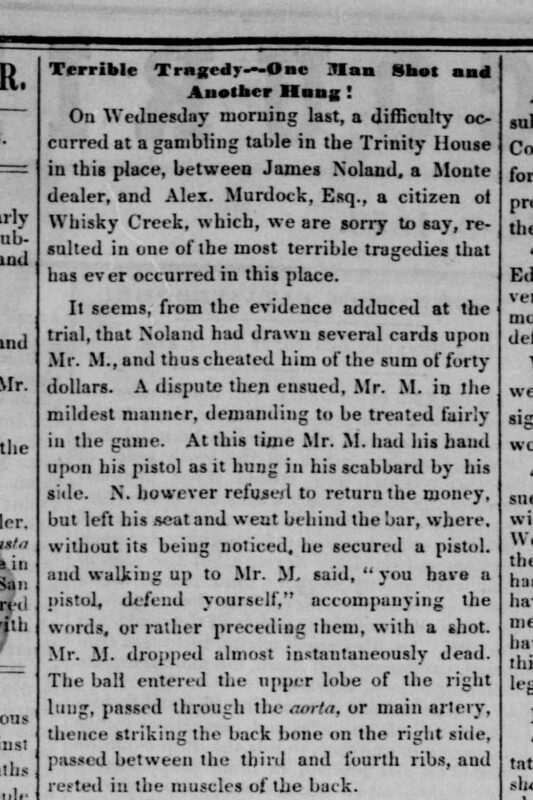
On April 5, 1853, a quarrel inside Shasta’s Trinity House ended with a gunshot, a citizens’ trial, and one of the most dramatic executions of the town’s early history. According to the Shasta Courier, James Noland, a monte dealer, and Alex Murdock of Whiskey Creek were gambling when an argument erupted over $40. Murdock accused Noland of dealing unfairly. Although Murdock carried a pistol in his waistband, witnesses testified that he made no attempt to draw it.
Noland walked behind the bar, obtained a pistol, and returned. According to the Courier, he confronted Murdock with the words, “You have a pistol, defend yourself!” and fired. The bullet struck Murdock in the upper right portion of his body, passing through a major artery and reaching his backbone. He died almost immediately.
The newspaper reported that Noland afterward was “dancing jumping and laughing around his victim with the greatest glee” and boasting about the killing as one of his “jobs.” Noland claimed self-defense, but witnesses said Murdock had made no attempt to use his weapon. He reportedly admitted before his execution that he had not feared Murdock would shoot him.
Sheriff David Corsaut arrested Noland, but citizens organized a public meeting at the Shasta Hotel the following day. Twelve men were selected as a jury, and after hearing the testimony, they found Noland guilty and ordered him hanged at six o’clock that evening.
The execution itself went badly. According to the Courier, the rope struck against Noland’s chin rather than properly catching around his neck, and he struggled before dying. Within roughly twenty-four hours, a gambling dispute had become a killing, arrest, trial, conviction, and execution—another stark example of the speed of frontier justice.
Violence against Native people
The story of Shasta County’s early justice cannot be told only through the men who appeared before courts or citizens’ juries. Newspapers also recorded instances in which Native people were killed outside the developing legal system.
In March 1853, the Shasta Courier reported that a Native man accused of taking a bag of hard bread from a wagon at Cottonwood was pursued for about a mile and a half, fired upon several times, captured, and killed the following morning by a group of white men. The next day, another Native man accused of taking beef was reportedly taken to Major Pierson B. Reading’s ranch and hanged. The newspaper stated that the hanging occurred with Reading’s permission and the approval of a Cow Creek chief. Neither man was named, and the report gives no indication that either received a formal trial.
In February 1854, the Courier reported another series of killings. White men from Johnson’s Ranch reportedly captured and hanged two Native people, another was shot the following day, and two more were hanged near Woodman’s Ranch on Cow Creek. Two of those killed were identified as Pit River Indians who had reportedly been found among the Cow Creek Indians after Numtaramin, identified as a Cow Creek chief, informed settlers of their presence.
Another report from September 1855 described the hanging of an unnamed Native man in the Dog Creek area after settlers accused him of theft. Again, no formal trial was described.
These reports preserve the perspectives and accusations of settlers and newspaper editors, not those of the Native people who were killed. Their names, testimony, and accounts were generally not recorded, and the accusations against them therefore should not be treated as established facts. These incidents were not conventional judicial executions, but acts of extrajudicial violence during a period when the developing legal system did not extend equally to everyone.
Jeptha R. Marsh and a changing legal system
Not every man sentenced to die reached the gallows. Jeptha R. March was convicted of murdering Hamilton Timmons near the mouth of Middle Creek on the Sacramento River after a dispute reportedly involving liquor. Although the men appeared to reconcile, March later entered the cabin where Timmons was eating with his partners and shot him through the heart.
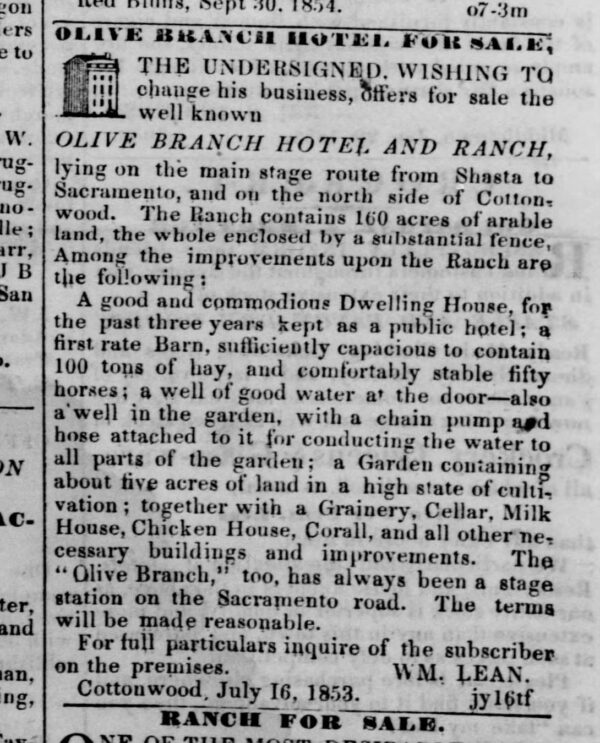
Sheriff William A. Nunnally captured March at the Olive Branch House on Cottonwood Creek, and March was returned to Shasta, convicted of first-degree murder, and sentenced to hang. His attorneys appealed, arguing that one of the jurors had lived in Shasta County for only two or three weeks despite a thirty-day residency requirement. The California Supreme Court overturned the conviction and ordered a new trial.
March was later tried again in Colusa County, convicted, and once more sentenced to death. His execution was repeatedly postponed through gubernatorial intervention. On January 11, 1858, March escaped from the Colusa jail. Remarkably, an order from newly inaugurated Governor John B. Weller arrived that same evening commuting his death sentence to life imprisonment. March had escaped only hours before learning that his life had been spared.
His case stood in sharp contrast to the rapid citizens’ trials of only a few years earlier. Appeals, judicial review, stays of execution, and gubernatorial intervention had become part of the process. A death sentence was no longer necessarily the final word.
Alexander Higgins and the first legal hanging
According to the county’s historical record, Alexander Higgins became the subject of Shasta County’s first legal hanging after killing his traveling partner, David C. “Levi” Goodwin, with an axe at Horsetown on June 13, 1855. The killing followed an argument involving shared gold, money, and travel plans.
Higgins’ first trial encountered difficulty when a juror was found legally unqualified to serve. A second jury convicted him and sentenced him to death. Sheriff John A. Dreibelbis, who had captured Higgins, oversaw his public execution at Shasta on November 9, 1855.
Before his death, Higgins wrote a lengthy letter published in the Shasta Courier. He described his life from his birth in Longford, Ireland, through his service in the U.S. Army’s 4th Artillery during the Mexican-American War and his eventual journey to California. Much of his final statement warned against alcohol, which he described as a “soul-destroying and crime-engendering habit.”
Higgins was reportedly escorted by approximately seventy-five men to the gallows. Unlike the citizens’ executions of earlier years, his case proceeded through the formal courts, marking another stage in Shasta County’s transition toward government-administered criminal justice.
The Portuguese Flat murder – Charles Blair
On October 4, 1856, six Chinese miners living near Portuguese Flat, later known as Pollard Flat, in the Sacramento River Canyon near Slate Creek, were attacked by white men. One miner was mortally wounded with knives and died the following day. The Shasta Republican reported that the other miners resisted their attackers and drove them away, leaving behind a pistol and hat. The newspaper also reported that the miners had been robbed of $89.
Charles Blair, also identified in later records as Frances Blair, was arrested. Later accounts connected Jesse Stanley with the attack. Stanley reportedly fled toward the Pit River country and was eventually arrested, although little information survives concerning his ultimate fate. Blair was convicted of first-degree murder on December 2, 1856, and sentenced to hang at Shasta on January 16, 1857. But Blair never reached the gallows.
While confined in the Shasta County Jail, he attempted to escape and was recaptured. His attorneys petitioned Governor J. Neely Johnson for clemency, and his execution was postponed. On May 1, 1857, Johnson reduced Blair’s sentence to life imprisonment. Sheriff John A. Dreibelbis transported him to San Quentin, where he was received on May 9.
Blair’s story took another turn on May 16, 1859, when Governor John B. Weller pardoned him on the condition that he leave California and not return. A man once sentenced to die on the Shasta gallows had instead received a reduced sentence and ultimately a gubernatorial pardon.
The name of the Chinese miner who was killed has not been found in the surviving records examined so far. Although his name has been lost, his death remains an important part of the history of Portuguese Flat and Shasta County. Chinese miners played an important role in California’s Gold Rush economy while facing discrimination, unequal treatment, and violence.
A county taking shape
By the end of the 1850s, Shasta County had changed considerably from the mining frontier of the decade’s beginning. Citizens’ courts and immediate executions increasingly gave way to formal trials, judges, juries, appeals, stays of execution, gubernatorial intervention, and pardons.
The transformation was neither simple nor complete. Native people were subjected to extrajudicial violence outside the developing court system, while the murder of an unnamed Chinese miner revealed another side of the insecurity and violence of Gold Rush California. Their experiences cannot be separated from the larger history of the county.
The cases preserved from these years show a county struggling to determine what justice should mean. Some accused men faced citizens’ juries assembled almost overnight. Others stood before established courts and appealed their convictions. Some reached the gallows; others escaped it through an increasingly formal legal process.
Gold had brought thousands of people into the region. Violence tested the communities they created, and the law developed alongside them. For a brief and turbulent period, the gallows became one of the starkest symbols of authority on the northern California frontier. And beneath the gallows, Shasta County’s early history unfolded—a story of violence, justice, and a frontier slowly learning to live by the law.
